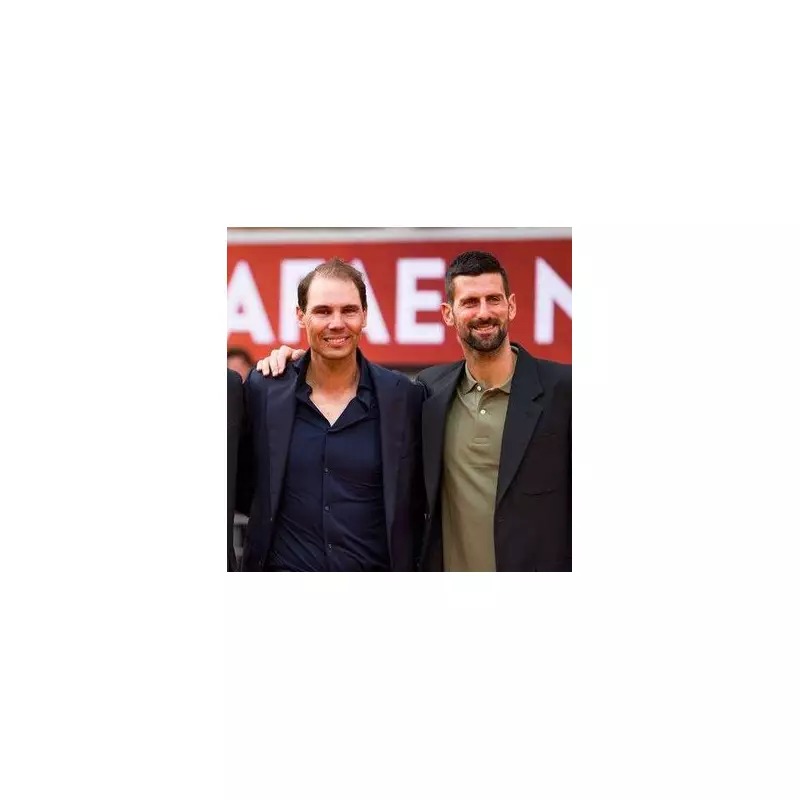
For a rare group of professional tennis players, the ultimate test came in facing the sport's legendary 'Big Three' at the peak of their powers. Former Belgian pro Steve Darcis belongs to that exclusive club, having competed against Roger Federer, Rafael Nadal, and Novak Djokovic when each was at the summit of the game.
The Unforgettable Feeling of Facing Federer
While the eternal debate over the Greatest of All Time (GOAT) rages on among fans and pundits, Darcis offers a unique perspective from across the net. For him, one experience was uniquely demoralising. "The best for me by far is Roger. He killed me," the 41-year-old confessed. He contrasted the feeling of playing Federer with matches against Nadal and Djokovic.
"I played Rafa... he will usually beat you, but even if you lose 6-2, 6-2, there are lots of rallies," Darcis explained. "You have the feeling that you probably cannot win, but that you are not so far." He found a similar dynamic with Djokovic, recalling he once served for a set and had chances, leaving him with the sense he had at least competed.

Facing Federer was a different story entirely. "But with Roger, if he is on a good day, you have the feeling that you cannot play tennis," Darcis stated. "After 30 minutes it's already 6-1, 3-0. It's very tough." This sensation of utter powerlessness, despite his own elite skill, cemented Federer as the most formidable opponent in a single match.
Conceding the GOAT Debate to Djokovic
Despite Federer's on-court dominance over him, Darcis is a realist when it comes to the broader historical argument. He acknowledges that the cold, hard statistics point overwhelmingly in one direction. "If you have to pick someone [as the greatest of all time], you have to read the statistics. And there is only one guy who is winning all the statistics. This is Djokovic," he conceded.
This clear-eyed assessment separates the feeling of facing a player from the objective measurement of career achievement. For Darcis, Djokovic's unparalleled record in Grand Slams and other major metrics makes his case for the GOAT title indisputable from a historical standpoint.
The Wimbledon High That Led to a Year-Low
Steve Darcis carved his own name into tennis history on a sunny day at the All England Club in 2013. Ranked 135th in the world, he stepped onto Court One to face the mighty Rafael Nadal, a reigning French Open champion and tournament favourite. In one of Wimbledon's greatest shocks, Darcis triumphed in straight sets, 7-6, 7-6, 6-4.
This victory marked Nadal's first-ever exit in the first round of a Grand Slam. "I thought to myself, I'm playing good, let's try and let's play my game, not his," Darcis recalled of his aggressive tactics. "I wanted to risk a little bit more, to go for it." The strategy worked to perfection, delivering the biggest win of his career.
However, the fairy tale had a cruel twist. During the match, Darcis suffered a severe shoulder injury. "I had really bad shoulder pain during the match... like 10 minutes after the match I couldn't lift my shoulder," he said. The diagnosis was a torn ligament requiring surgery.
The consequence was devastating. Instead of capitalising on his newfound fame, Darcis was forced to withdraw from Wimbledon and spent the next year in rehabilitation. "It was one of the best wins of my life, but it started one of the worst years," he reflected, describing the profound mental and physical toll it took.
Darcis's career, which included two ATP titles and leading Belgium to two Davis Cup finals, is now viewed through the dual lens of that spectacular victory and the painful sacrifice it demanded. His unique experience against the 'Big Three' provides a poignant footnote to the GOAT debate, highlighting the difference between statistical greatness and the unforgettable, humbling sensation of facing a genius in full flow.