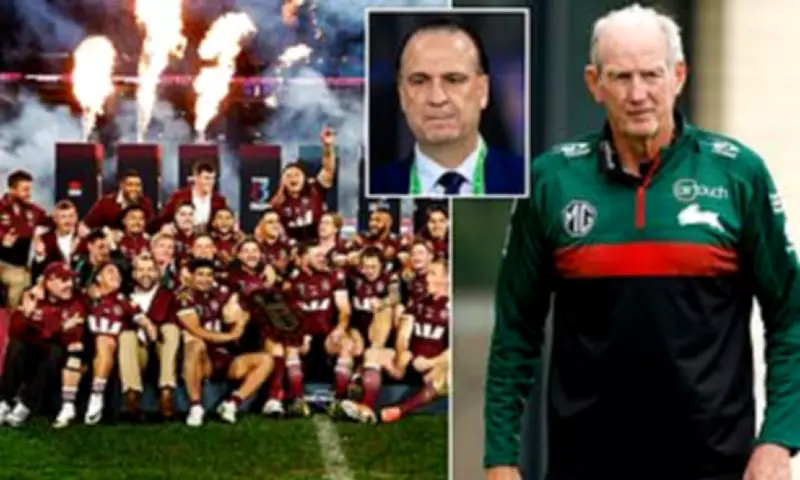
Wayne Bennett Supports State of Origin Selection Reforms While Issuing Core Rules Warning
Renowned rugby league coach Wayne Bennett has publicly endorsed the landmark modifications to State of Origin's selection criteria while simultaneously issuing a stern warning to Australian rugby league authorities. Bennett emphasized that core eligibility rules determining how players qualify to represent New South Wales or Queensland must remain untouched to safeguard the competition's integrity.
Historic Changes to Selection Framework
Previously, State of Origin coaches were restricted to selecting players who met fundamental eligibility requirements and had committed to representing either Australia or a tier two nation internationally. These foundational rules mandated that players must have been born in their respective state, resided there before turning thirteen years old, or had a parent who participated in State of Origin football.
This framework effectively excluded players born in New South Wales or Queensland who had chosen to represent England or New Zealand at the international level from participating in the annual three-match series. Under the newly implemented guidance, players can now represent NSW or Queensland irrespective of their national team allegiance, provided they still satisfy the core qualifying criteria.

Bennett's Cautious Endorsement
The South Sydney Rabbitohs coach expressed support for these changes but urged lawmakers to exercise extreme caution to avoid diminishing State of Origin's authenticity. 'They've got to preserve the Origin, they've got to preserve what state versus state means,' Bennett stated in an interview with The Courier Mail. 'Fans need to know it's a genuine rivalry between two states. You can't come here at 20 years of age and play Origin. That will destroy it. They can't touch that rule. It doesn't become authentic.'
Bennett's comments highlight a delicate balance between modernization and tradition within the sport's most celebrated domestic competition.
Immediate Impact on Prominent Players
The rule adjustments represent an exciting development for rugby league, removing significant obstacles for multiple players previously ineligible for the three-match series or contemplating defection to play international football for a tier one nation.
Notable beneficiaries include:
- Addin Fonua-Blake: Born in Sydney but having elected to represent both Tonga and New Zealand internationally, the forward can now qualify for New South Wales selection.
- Kalyn Ponga: The Newcastle star, who has previously expressed desire to play for New Zealand, can now represent the Kiwis without sacrificing his Queensland jersey, being Mount Isa-born.
- Victor Radley: The Roosters player was previously ineligible for New South Wales due to his commitment to England, his father's homeland, ahead of the 2022 Rugby League World Cup.
Regarding Radley's situation, Bennett commented: 'I've always felt for Victor Radley – he's a wonderful player and he's been here all his life. Why can't he play for New South Wales? That only enhances the game if you can get the best players playing. And then if he wants to go and play for England as he does, well that's great, I'm happy for him.'
Broader International Game Implications
Bennett also praised the potential positive effects on international rugby league. 'Moving from that point to the internationals. I'm a fan of what they're doing with that stuff because they're only going to make the international games stronger,' the former Queensland coach added. 'We've seen what's happened in the last five years with regards to Tonga and Samoa and PNG. I'm amazed at times that people want to make a fuss over nothing.'
He explained the previous disparity: 'They've had the tier two players that can have the option if they don't play for Australia, they can go back and play for Tonga and Samoa. If you're a New Zealander or an Englishman, you can't do that.'

Concerns from Other Legends
Not all rugby league luminaries share Bennett's measured optimism. Former Australia coach Mal Meninga expressed reservations about the rule modifications. 'I worry about the future of Origin. I worry about Origin in terms of where the Queensland kids and Indigenous kids go. Are they going to get beaten up by the Islanders? That's my only issue with it,' Meninga told the outlet.
Having played 32 matches for the Maroons between 1979 and 1994, and later coaching the side in 30 matches from 2006 to 2015, Meninga added: 'I hope this doesn't stand in the way of guys of genuine Queensland heritage playing State of Origin.'
The contrasting perspectives from Bennett and Meninga underscore the complex debate surrounding evolution versus preservation in one of sport's most fiercely contested rivalries, as administrators navigate between expanding talent pools and maintaining traditional state identities.