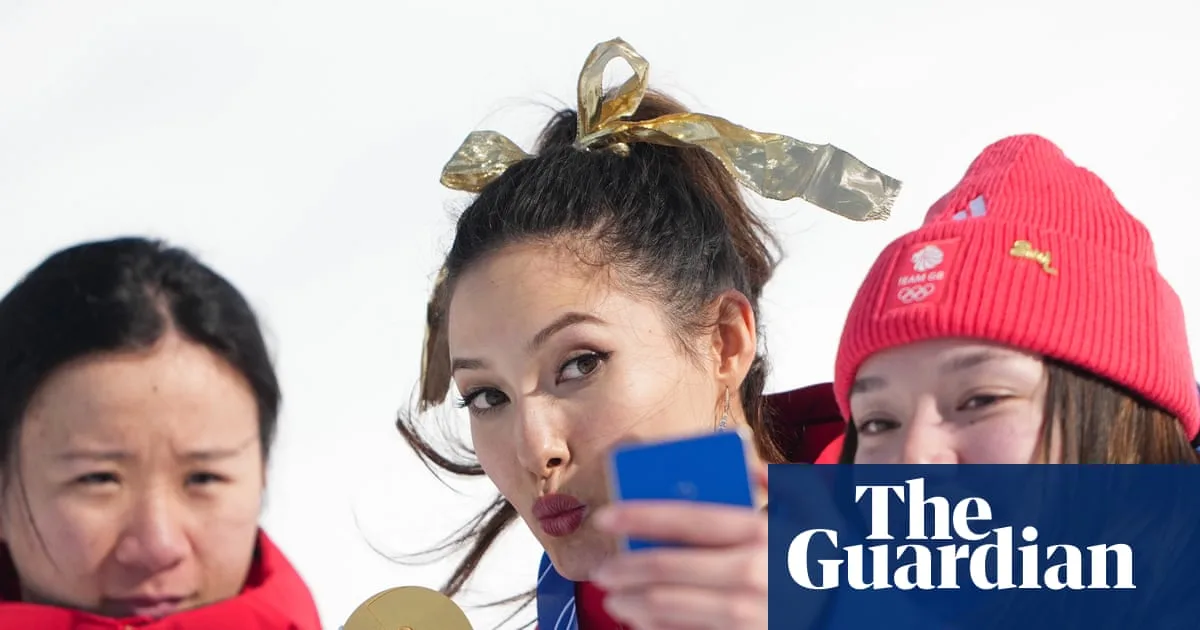
Eileen Gu Claims Silver at Winter Olympics Amid Controversy and Scheduling Dispute
Eileen Gu Wins Silver at Winter Olympics Amid Controversy

Eileen Gu Secures Silver Medal at Winter Olympics in Big Air Freestyle Event

Skiing sensation Eileen Gu, who has generated significant controversy for opting to represent China instead of the United States, had to accept a silver medal at the Winter Olympics in Milan-Cortina once again. Gu, originally born in San Francisco but competing for her mother's homeland of China, aimed for her second medal of the 2026 Games as she attempted to defend her big air ski freestyle championship on Monday.

The 22-year-old athlete did manage to secure a medal, marking the second achievement in her three-medal campaign in Italy, but it was not the gold she had hoped for. China's prominent sporting figure failed to retain her gold medal from the Beijing Games, instead earning silver as Canada's Megan Oldham claimed victory with an outstanding performance.

Return to Competition and Scheduling Challenges

Monday's final represented the first occasion that Gu has participated in the big air discipline since she won gold four years ago, which contributed to her three-medal collection at the 2022 Games. Despite the time gap, there are sufficient similarities between big air and slopestyle, both featuring comparable jumps, allowing Gu to find her rhythm swiftly. She placed second in the qualifying round two nights prior, trailing behind Oldham, who had previously won bronze in the slopestyle event.

Heavy snowfall in Livigno caused weather delays, leaving athletes in a state of anxious anticipation. The big air event presented Gu's second opportunity for a medal at these Games, following her silver medal in the slopestyle last week, where Mathilde Gremaud took gold. Gu remains the sole female freeskier registered for all three disciplines: slopestyle, halfpipe, and big air. Notably, Monday's final coincided with the initial three-hour halfpipe training session, creating a logistical challenge.

Organizational Criticism and Training Dispute

Gu expressed frustration with organizers over the weekend after they declined to grant her equal practice time for her third and final event, the halfpipe. She revealed that she contacted officials at the International Ski and Snowboard Federation (FIS), responsible for setting the schedule, seeking assistance but received no support.

On Instagram, Gu wrote, 'The Olympics is the stage upon which miracles materialize and the impossible ceases to be so right before our very eyes. It inspires both athletes and sports lovers to dream big and break limits.' She continued, 'This decision is disappointing to me because it seems to contradict the spirit of the games. Daring to be the only woman to compete in three events should not be penalized - making finals in one event should not disadvantage me in another.'

Gu emphasized, 'What kind of message does this send to future athletes who love skiing for its essence and want to compete in every event? This was a totally avoidable issue and I am saddened by the hardline stance FIS has chosen to take.' Speaking to reporters on Saturday after qualifying for the big air final, Gu insisted she was not requesting special treatment but merely desired the same practice opportunities as her competitors.

She added, 'Halfpipe is an entirely different event. It's like sprinting and a marathon. They're both running but they're completely different sports.'

Financial Success and Representation Controversy

Gu has accumulated an astonishing $23 million over the past year, yet a closer examination of her finances reveals a puzzling detail that has intrigued the sports community. Of that substantial fortune, only approximately $20,000 is estimated to have originated from her skiing endeavors, where she chooses to represent China rather than the United States.

The two-time Olympic gold medalist earns a relatively modest sum from the sport that propelled her to global fame. However, as her wealth increases, so does the criticism from her birthplace, where detractors and former athletes have openly labeled the San Francisco-born skier a 'traitor'.

This situation stems from a high-stakes decision that saw the California-born prodigy reject Team USA to represent a nation located 6,000 miles away. By exchanging her American allegiance for a Chinese bib, Gu has capitalized on a billion-dollar market while being denounced as a defector by the country that nurtured her.

Motivations and Citizenship Questions

Gu strongly refuted claims that financial incentives, such as representing Chinese companies, influenced her decision. She stated, 'I'm glad that there's enough money in the sport now for people to think that's a consideration,' in an interview with TIME Magazine last month.

Born in the United States, Gu switched to represent her mother's homeland, China, at the age of 15. She explained that her motivation was to inspire more young people, particularly girls, to engage in freestyle skiing, a sport that was not widely popular in China. Gu told Time Magazine, 'The US already has the representation. I like building my own pond.'

Prior to the previous Olympics, Gu estimated that at least a quarter of her life had been spent in the Far East. This did not shield her from scrutiny. Following her victory in Beijing, she faced questions about her citizenship status, as China prohibits dual citizenship, and state media reported that she renounced her US citizenship upon becoming a Chinese national at age 15.

Gu avoided addressing whether she had relinquished her US citizenship four years ago, telling TIME, 'I don't really see how that's relevant.'