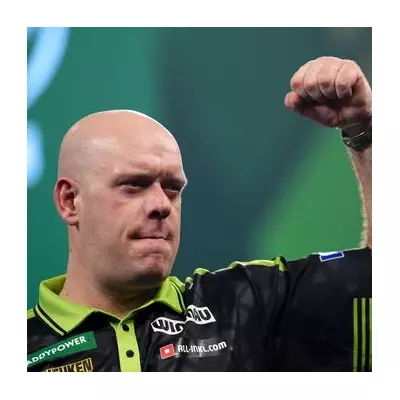

Luke Littler stands on the brink of darting history as he prepares to defend his PDC World Darts Championship crown against the formidable Gian van Veen this Saturday. The teenage sensation, known as 'The Nuke', aims to become the first player since Gary Anderson in 2016 to win back-to-back titles at Alexandra Palace.
The Final Showdown: Littler's Bid for Back-to-Back Glory
Since his astonishing run to the final two years ago, Luke Littler's ascent has been meteoric. At just 18 years old, he has transformed from a little-known prodigy into one of the sport's most electrifying talents. His opponent, 23-year-old Gian van Veen, is a darting whizz-kid in his own right, promising a thrilling clash of generational talent.
Littler is acutely aware of the legacy at stake. "I've joined another list of short names," he said, referencing his place among the elite. "Now obviously the only goal is to join a list of people going back-to-back world champions. It's very special to just keep adding to these lists." He added, with characteristic humility, "I've got every right to think I can [do it], but I never, ever say I'm going to win it."
The 501 Question: A Mathematical Necessity
Amidst the anticipation for the final, a perennial question surfaces among fans: why do players start each leg on 501 points, rather than a round 500? The answer is rooted in mathematics and is designed to increase the game's difficulty and strategic depth.
The core rule is that a player must finish by hitting a double—landing a dart in the outer ring of the board. As every double score is an even number, a player must have an even total remaining to check out. If the game started on 500, an even number, a player could theoretically aim exclusively at the 20 segment for the entire leg without ever needing to adjust their strategy.
By starting on 501, an odd number, players are forced to hit an odd score at some point during the leg. This compels them to demonstrate greater accuracy and a wider tactical range, targeting segments like the 19, 17, or bullseye to manoeuvre themselves into a favourable finishing position.
From Pub Pastime to TV Spectacle: The Evolution of 301 to 501
The standard starting number has not always been 501. Historically, the game was played from 301. This figure originated from the use of cribbage boards for scoring in early 20th-century pubs. A standard cribbage board has 60 holes, and five laps around it total 300 points. The final single point represented the 'game hole' or home, a traditional requirement to complete a match.
As darts evolved into a professional sport tailored for television, 301 was deemed too short for broadcast. The distance was extended to 501 to allow for more dramatic, high-scoring legs, while cleverly preserving the essential tradition of beginning on an odd number. This change ensured the 'double-out' rule remained a consistent and challenging test of skill.
So, when Luke Littler and Gian van Veen step up to the oche on Saturday night, every dart they throw will be part of a game finely tuned by history and mathematics. The odd starting number of 501 is a small but crucial pillar supporting the sport's demanding and thrilling nature.