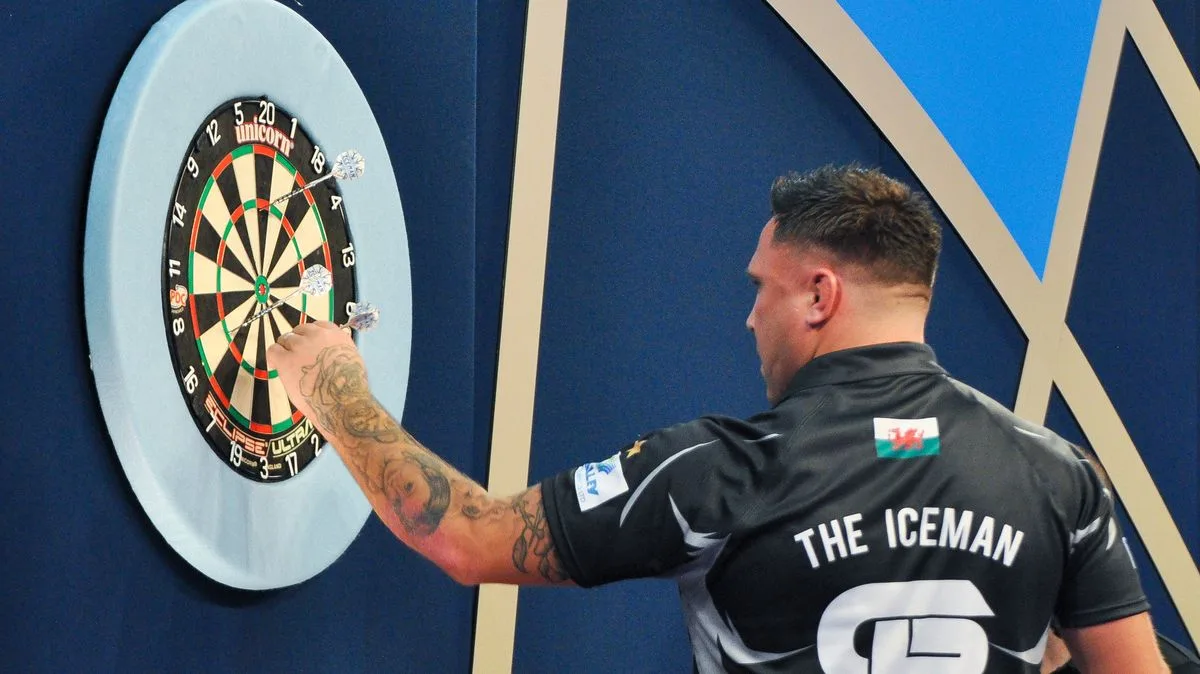
Luke Littler stands on the brink of darting history as he prepares to defend his PDC World Darts Championship crown against Dutch rival Gian van Veen this Saturday. The teenage sensation, known as 'The Nuke', aims to become the first player since Gary Anderson in 2016 to win back-to-back titles at Alexandra Palace.
The Mathematical Genius Behind 501
While fans eagerly anticipate the final, a perennial question resurfaces: why does a leg of darts begin on 501, and not a round 500? The answer lies in a clever piece of game design that elevates the skill required. The core principle is the 'double out' rule, where a player must finish the game by hitting a double—the thin outer ring of the board.
Since every double on the board is an even number, a player must have an even score remaining to check out. If the game started on 500, an even number, a player could theoretically aim for the 20 segment for their entire visit without ever needing to adjust. Starting on 501, an odd number, forces a strategic shift.
This simple extra point compels players to hit an odd number at some stage, demanding greater accuracy and tactical range. It pushes competitors to master segments like the 19, 17, or bullseye, preventing a monotonous focus on the treble 20 and increasing the overall challenge.
From Pub Pastime to TV Spectacle
The sport's scoring has evolved from its humble origins. Historically, the standard game was 301. This number is believed to have originated from the use of cribbage boards for scoring in early 20th-century pubs. A standard cribbage board has 60 holes, and five laps around equals 300 points, with the final single point representing the 'game hole' to finish.
As darts transformed into a professional television spectacle, 301 was deemed too short for broadcast, allowing matches to end before building sufficient drama. The distance was extended to 501, providing more scope for high-scoring visits and dramatic comebacks while preserving the crucial tradition of beginning on an odd number.
Littler's Quest for Back-to-Back Glory
All this theory will be put into practice on the Ally Pally stage this weekend. Littler, still only 18, faces a formidable opponent in 23-year-old Gian van Veen, a prodigious talent in his own right. When asked about the possibility of consecutive world titles, Littler was cautiously confident.
"I've joined another list of short names, now obviously the only goal is to join a list of people going back-to-back world champions," Littler said. He added, "It's very special to just keep adding to these lists... but now the main goal is to go back-to-back. Obviously I've got every right to think I can [do it], but I never, ever say I'm going to win it."
Whether it's the mathematical nuance of 501 or the pressure of a world final, this Saturday's showdown promises to be a masterclass in the skill, strategy, and nerve that define professional darts.