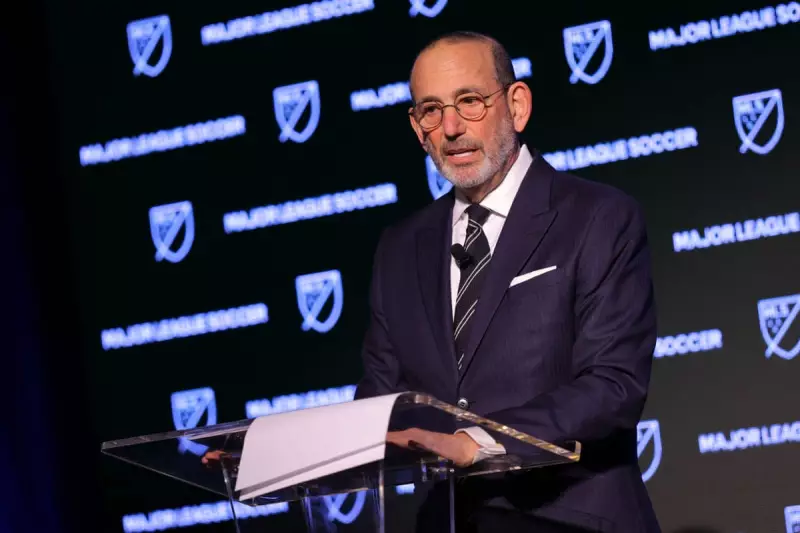
Major League Soccer Commissioner Don Garber has declared that the league's fortunes are no longer intrinsically linked to the success of the United States Men's National Team (USMNT) on the global stage. He delivered this significant assessment during his annual state of the league address in Washington DC.
MLS Evolves Beyond National Team Dependency
Speaking at Audi Field, the home of DC United, Garber reflected on how the league's strategy has shifted over two decades. He explicitly stated he does not believe there is the same dependency today as there was years ago on the US team performing well at the FIFA World Cup to drive MLS growth.
"I can remember in 2002... we had this thought that we pivoted on the success of our national team in order to succeed," Garber recalled. The context for his remarks was notable, coming just before the draw for the 2026 World Cup, which the US will co-host.
Garber argued that the league's current diverse, international roster provides its own momentum. He highlighted that MLS now features players from 80 different countries, with 37 called up for recent national team duty. The presence of global icons like Lionel Messi playing for Inter Miami was cited as a key factor in the league's elevated profile, reducing the imperative to rely solely on American stars.
Vancouver's Stadium Stalemate Reaches Critical Juncture
While discussing the league's overall health, Garber turned his attention to a pressing issue on the West Coast: the future home of the Vancouver Whitecaps. The club, which is enjoying its best-ever season and has reached the MLS Cup final, faces an uncertain stadium situation.
The Whitecaps are tenants at BC Place, a centrally located stadium with a lease the ownership finds unfavourable. This has led the club's owners to explore a potential sale, having enlisted investment bank Goldman Sachs to broker a deal over a year ago, though no concrete buyers have yet emerged.
Garber praised Vancouver as "one of the better soccer cities in North America" and commended the team's performance. However, he issued a stark warning regarding the infrastructure. "What we have there has to change," he asserted, noting that despite over a year of negotiations with city and provincial authorities, there has been no progress on plans for a new, soccer-specific stadium.
"The MLS team, its owners, its fans, its players have done everything to earn the support that they’re not getting today from the city and the province," Garber said pointedly.
Implications and Tough Decisions Ahead
Garber's comments frame a clear ultimatum for local authorities. While he acknowledged that BC Place will host matches during the 2026 World Cup, he emphasised that the current arrangement is insufficient for the Whitecaps' long-term ambitions. The league's preference is for clubs to own their venues, and MLS is soon to have 30 dedicated soccer stadiums across its franchises.
"We need to wait and see if the city and province want to do that," Garber stated. "If they don’t, we’ll have to make some tough decisions." This leaves the future of the club in Vancouver contingent on a resolution to the protracted stadium issue.
Garber's dual message underscores a league at a crossroads: confident in its own independent commercial and sporting appeal on the world stage, yet still grappling with foundational infrastructure challenges in key markets as it continues its expansion.