US Lawmakers Divided as Iran War Talks Collapse, Sparking Partisan Fury
The failure of negotiations to end the US war with Iran has triggered a starkly partisan political storm in Washington DC. Leading Republicans are making hawkish calls for former President Donald Trump to "finish the job," while top Democrats warn that resuming hostilities would be disastrous for the nation.
Republican Hawks Push for Escalation
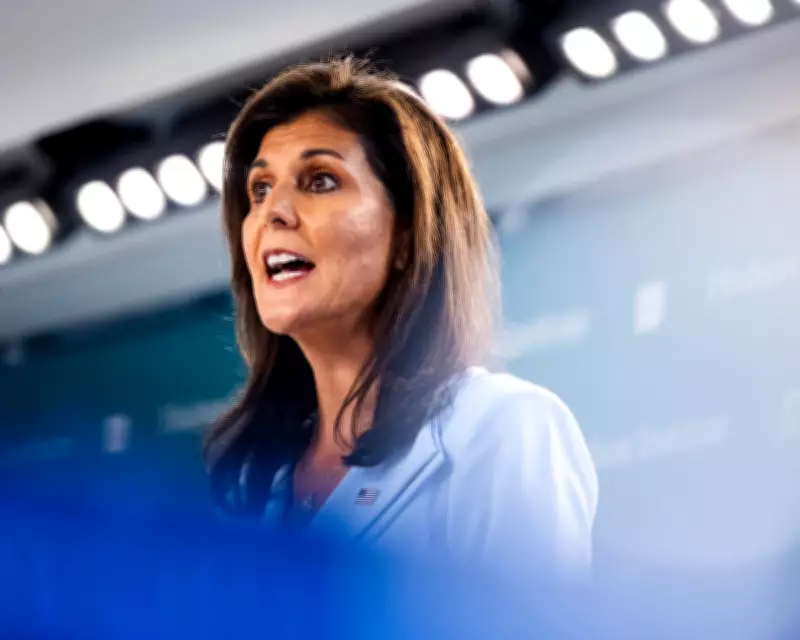
Nikki Haley, who served as Trump's UN ambassador during his first term, spearheaded the Republican charge. In an interview on CNN's State of the Union on Sunday, she described the current two-week ceasefire as a tense standoff. "This is like a game of chicken," Haley said. "It's who caves first. The Iranian regime is hoping that Trump will cave. Today, he showed he's not." She was referring to Trump's threat, issued hours after marathon peace talks in Pakistan ended without result, that the US military would blockade the Strait of Hormuz to cripple Iran's control over the vital shipping passage.
Haley urged Trump to "go after Iran where it hurts," emphasizing that economic pressure could "really bring Iran to its knees." She also outlined a bold military strategy, suggesting a small, quick special forces operation to seize Iran's enriched uranium supplies. "This is a special forces mission," she told CNN. "It would take about a week to 10 days to get done. They know how to do it."

US Senator Ron Johnson, a Wisconsin Republican, echoed this hardline stance on ABC's This Week. He advocated for the total removal of the Iranian regime, acknowledging it "could be longer term." "We have to finish the job," Johnson insisted. "We will not have won until we have completely defanged the Iranian regime."
Democratic Warnings Against Renewed Conflict
In sharp contrast, top Democrats fiercely rebutted these bellicose remarks. US Senator Mark Warner of Virginia, the leading Democrat on the Senate's intelligence committee, warned that attempting to seize Iran's enriched uranium would be "very, very dangerous." Speaking on State of the Union, he argued, "It would take 10,000 troops on the ground guarding a perimeter. We'd have to send special operators in, and the Iranians could then bomb their own facility, potentially trapping our troops."
His fellow Democratic senator from Virginia, Tim Kaine, told This Week that he plans to reintroduce a war motion in the Senate to try to halt Trump's potential return to full-scale hostilities. Kaine, who serves on both the Senate armed services and foreign relations committees, stressed that even an imperfect ceasefire is preferable to resuming war. "Returning to full war will just compound the suffering of American troops and the American citizenry who are suffering under a devastated economy because of what Donald Trump has done," he said. Kaine added, "We shouldn't be in this war to begin with. Donald Trump launched this war without the support of allies, the American public, or Congress."
Broader Opposition Beyond Capitol Hill
Beyond the halls of Congress, Zohran Mamdani, the Democratic mayor of New York City, reiterated his passionate opposition to the US-Israel war with Iran. In an interview with Al Jazeera, he laid out a moral case against the conflict, noting its deep unpopularity among Americans. Mamdani criticized the allocation of "tens of billions of dollars to kill people, money that could otherwise be used to make life easier for people." He quoted the late rapper Tupac Shakur from his 1993 song, Keep Ya Head Up: "They got money for wars, but can't feed the poor."
The collapse of negotiations has thus exposed deep fissures in US political leadership, with Republicans championing aggressive military and economic measures against Iran, while Democrats caution against the perils of renewed conflict and advocate for diplomatic solutions.