Trump's Marathon State of the Union Address Sets New Record
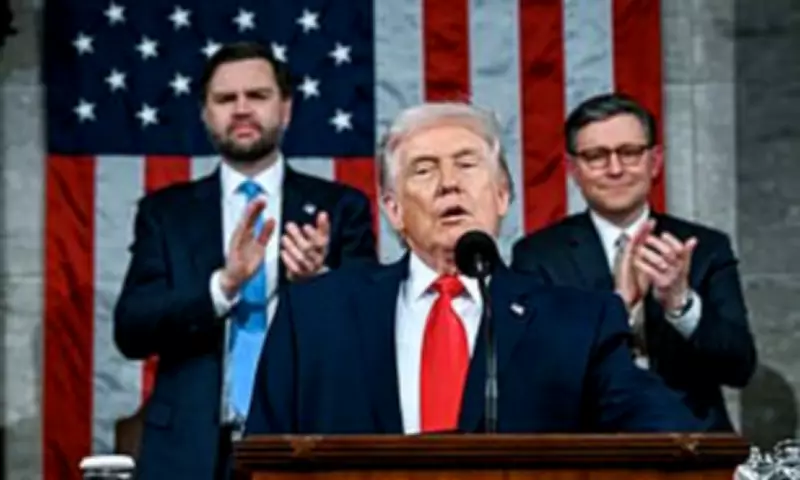
President Donald Trump addressed a joint session of Congress on Tuesday night, delivering the first State of the Union of his second term at the US Capitol. The speech, lasting approximately one hour and forty-seven minutes, set a new record for the longest such address, surpassing his own previous mark from last year. This historic event occurred just days after the Supreme Court struck down his signature global tariffs, as he contemplates potential military strikes on Iran and navigates some of the weakest political standing of either presidency.
Economic Turnaround and Policy Victories
In his lengthy oration, Trump asserted that the nation has achieved a dramatic transformation under his leadership. He claimed that inflation is plummeting, incomes are rising rapidly, and the economy is roaring like never before. The President highlighted that mortgage rates have reached their lowest point in four years, with the annual cost of a typical new mortgage decreasing by nearly $5,000 since he took office. Additionally, he noted that the stock market has set fifty-three all-time record highs since the election, boosting pensions and retirement accounts for millions of Americans.
Trump emphasised that American oil production has increased by more than 600,000 barrels per day, with natural gas production at an all-time high. He also announced that more Americans are working today than at any time in the country's history, with all jobs created under his administration being in the private sector. The President credited tariffs for contributing to the economic turnaround, despite a recent Supreme Court ruling against them, stating that alternative legal statutes would keep similar measures in place.

Border Security and Immigration Policies
The address placed significant focus on immigration and border security. Trump declared that the United States now has the strongest and most secure border in American history, with zero illegal aliens admitted in the past nine months. He reported a fifty-six percent reduction in the flow of deadly fentanyl across the border within one year. The President also highlighted a substantial decline in the murder rate, which he described as the single largest drop in recorded history.
Trump called on Congress to pass the Delilah Law, which would bar states from granting commercial driver's licenses to illegal aliens. He shared emotional stories of victims affected by illegal immigration, including Delilah Coleman, a five-year-old injured by an illegal alien driver, and Lizbeth Medina, a teenager murdered by a previously arrested illegal alien. The President demanded the full restoration of funding for border security and homeland security, criticising Democrats for cutting off Department of Homeland Security funding.
Health Care, Energy, and Domestic Initiatives
Trump outlined several domestic policy initiatives, including health care reforms. He introduced the Most Favored Nation program, which he claimed would lower prescription drug prices from the highest in the world to the lowest. The President shared the story of Catherine Rayner, who obtained a fertility drug for under $500 instead of $4,000 through the program. He also addressed energy concerns, announcing the Ratepayer Protection Pledge to ensure that AI data centres provide their own power needs without raising utility bills for Americans.
Regarding homeownership, Trump signed an executive order banning large Wall Street investment firms from buying single-family homes and asked Congress to make the ban permanent. He announced plans to give workers without employer retirement plans access to federal-style retirement accounts with matching contributions up to $1,000 annually. The President also called for the passage of the Stop Insider Trading Act to prevent members of Congress from profiting from insider information.

Foreign Policy and Military Achievements
In foreign affairs, Trump highlighted the obliteration of Iran's nuclear weapons program through Operation Midnight Hammer and warned against future attempts by Iran to rebuild such capabilities. He noted that NATO countries have agreed to pay five percent of GDP for military defence at his request, compared to the previous two percent. The President celebrated the end of eight wars during his first ten months, including conflicts in Gaza, Cambodia, and between Pakistan and India, while expressing efforts to end the war between Russia and Ukraine.
Trump honoured military personnel, including Specialist Sarah Beckstrom, who was killed by a terrorist in Washington DC, and Staff Sergeant Andrew Wolfe, who survived a similar attack. He presented Chief Warrant Officer Eric Slover with the Congressional Medal of Honor for his actions during a raid in Venezuela that captured dictator Nicolas Maduro. The President also recognised Navy Captain Royce Williams, a 100-year-old veteran, with the same honour for his heroism during the Korean War.
Cultural and Social Issues
The address touched on cultural matters, with Trump advocating for a ban on states transitioning children to a new gender against parental will. He shared the story of Sage Blair, who was placed in an all-boys state home after school officials attempted to socially transition her without parental knowledge. The President also praised First Lady Melania Trump for her work on AI legislation and foster care initiatives, noting her bipartisan support.
Trump concluded by reflecting on America's 250th anniversary, emphasising the nation's legacy of freedom and innovation. He declared that the golden age of America is upon us, with a future that will be bigger, better, and more glorious than ever before. The speech reinforced his message of national renewal and unwavering commitment to putting America first in all policy matters.