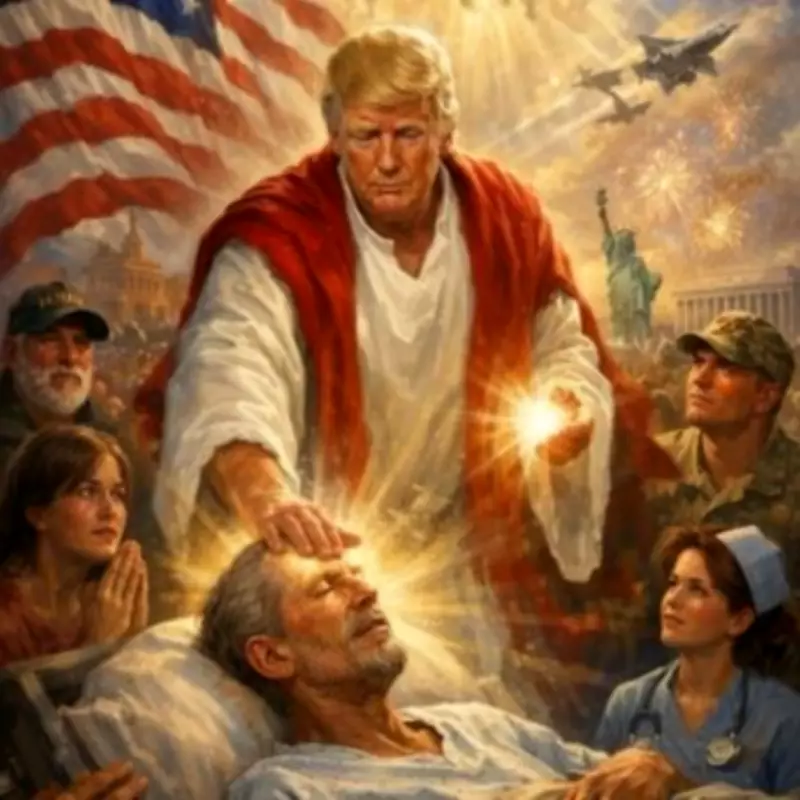
President Donald Trump has ignited a firestorm of criticism from within his own political base following a controversial social media post where he appeared to compare himself to Jesus Christ. The incident, which occurred on TruthSocial, represents what many analysts believe could be a decisive moment in the erosion of Trump's support among conservative voters who once championed his Make America Great Again agenda.
Blasphemy Accusations Rock Trump's Base
The post, which depicted Trump in a manner reminiscent of religious iconography, prompted immediate condemnation from religious conservatives who previously viewed the former president as their political savior. Within moments of the post appearing online, prominent conservative voices branded Trump a "blasphemer," marking a significant departure from the unwavering support he enjoyed during his initial presidential campaign and first term in office.
Growing Disillusionment Among MAGA Loyalists
This incident represents merely the latest in a series of controversies that have gradually chipped away at Trump's standing with his core supporters. His second term has been characterized by what many describe as chaotic governance and a series of policy reversals that have alienated segments of his base. The comparison to Jesus Christ appears to have struck a particularly sensitive nerve among evangelical Christians and religious conservatives who form a substantial portion of Trump's political coalition.

Conservative activist Riley Gaines articulated the sentiment of many disillusioned supporters when she stated: "Seriously, I can't understand why he'd post this. Is he looking for a response? Does he actually think this? Either way, two things are true. A little humility would serve him well, and God shall not be mocked."
Erosion of Support From Former Allies
Trump's response to criticism from within his own movement has further exacerbated the situation. Rather than demonstrating contrition or understanding, the president lashed out at former supporters, dismissing them as "nut jobs" and "troublemakers." This reaction has alienated influential voices within conservative media who once served as his most vocal cheerleaders.
The growing distance between Trump and prominent conservative figures represents a significant shift in the political landscape. Figures like Alex Jones, Tucker Carlson, and Candace Owens, who previously provided unwavering support, have become increasingly critical of the president's actions and rhetoric. Jones, a prominent conspiracy theorist, had previously expressed hope that Trump could be freed from what he described as "demonic forces," indicating the depth of concern among some former allies.
Multiple Controversies Weigh on Trump's Standing
The Jesus comparison controversy follows several other incidents that have damaged Trump's credibility with his base. These include his dismissal of the Epstein Files as a Democratic hoax, his reversal on promises to avoid military engagements in the Middle East, and now what many perceive as mockery of their religious faith. Together, these incidents have created what political analysts describe as a "three strikes" scenario that may prove insurmountable for Trump's political future.
Corruption Allegations Compound Political Troubles
Compounding Trump's political difficulties are serious allegations of corruption that have emerged during his second term. Democrats have accused the president of "exploiting the Presidency to enrich himself" through cryptocurrency schemes allegedly involving foreign governments. Specific claims include allegations that a member of the United Arab Emirates' royal family invested $500 million in the Trump family's cryptocurrency company just before Trump's inauguration.
These allegations stand in stark contrast to Trump's campaign promises to "drain the swamp" of Washington corruption. For voters who supported Trump specifically to combat political corruption, the emerging allegations represent a profound betrayal of trust that further undermines his political standing.

Midterm Elections Loom as Critical Test
With midterm elections approaching, the political consequences of Trump's declining support are becoming increasingly apparent. Early indicators suggest that disillusioned MAGA voters may choose to stay home rather than support Republican candidates, potentially handing significant victories to Democratic opponents. This trend has already manifested in special elections where lower Republican turnout has contributed to Democratic wins.
The question facing political analysts is no longer whether Democrats will perform well in the upcoming elections, but rather how substantial their victories might be. Trump's comparison to Jesus Christ may represent the final element in a perfect storm of political missteps that could permanently damage his influence within the Republican Party and conservative movement.
No Political Resurrection in Sight
For a politician whose career has been marked by remarkable comebacks and unexpected political resilience, the current situation appears particularly dire. The combination of religious offense, policy reversals, corruption allegations, and alienation of former allies creates a political environment in which recovery seems increasingly unlikely.
As one political observer noted, Trump's political career may face a fate similar to that which he described for his opponents: buried in a tomb with no possibility of resurrection. The man who once commanded unwavering loyalty from millions of Americans now faces the prospect of becoming politically irrelevant, with his most loyal supporters questioning whether their faith in him was ever justified.
The ultimate irony may be that Trump, who frequently positioned himself as a political savior, has through his own actions potentially sealed his political fate. The comparison to Jesus Christ, intended perhaps as a display of strength or defiance, may instead serve as the final demonstration of a political hubris that ultimately alienated the very people who once constituted his most reliable base of support.