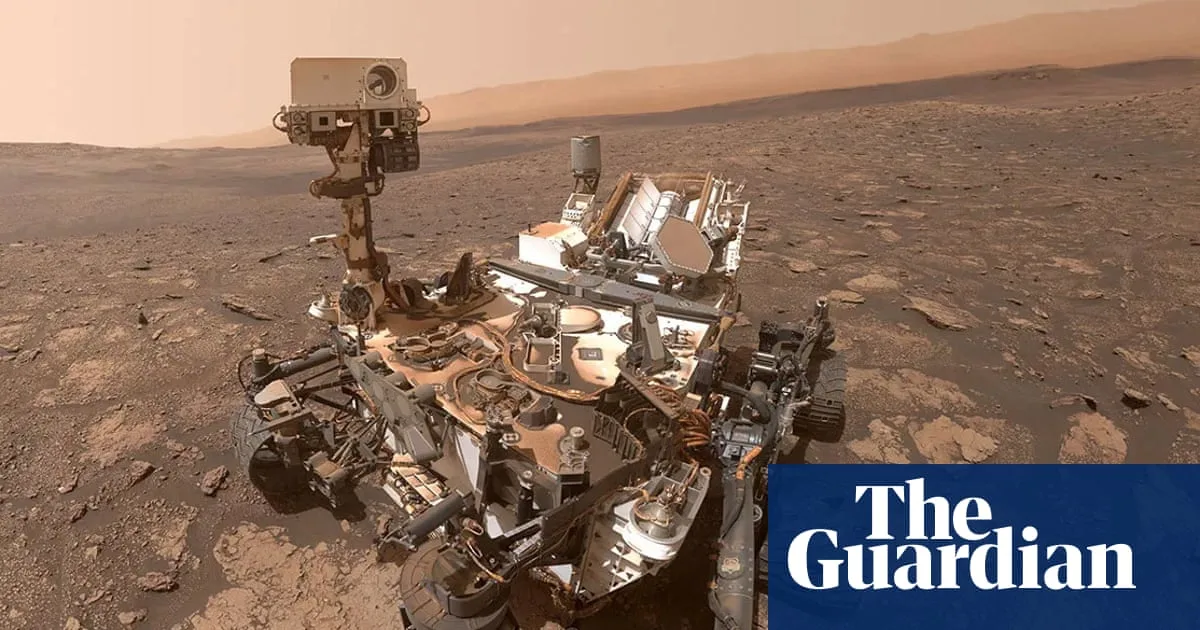
Nasa's Curiosity rover has detected organic molecules on Mars, including five previously unseen compounds, in a dried lakebed near the planet's equator. The discovery, published in Nature Communications, adds to evidence that chemical building blocks for life may have been preserved for billions of years.
Among the seven molecules identified were benzothiophene, a sulphurous chemical often delivered by meteorites, and a nitrogen-bearing compound with a structure similar to precursors of DNA. However, the rover's instruments cannot determine whether these compounds originated from ancient life, meteorites, or geological processes.
“We think we’re looking at organic matter that’s been preserved on Mars for 3.5bn years,” said Prof Amy Williams, an astrogeologist at the University of Florida and a Curiosity mission scientist. “Is it life? We can’t tell, based on this information.”
The findings are significant because Mars once had conditions suitable for life, with liquid water and a protective atmosphere. Prof Andrew Coates of University College London noted, “It had all the conditions for life to start there when life was starting on Earth.” However, scientists had doubted whether organic traces from that era, 3.7bn to 4.1bn years ago, could survive the planet's harsh radiation and extreme temperatures.
The discovery bolsters hopes for the European Space Agency's Rosalind Franklin mission, scheduled for 2028, which will drill two metres deep to search for organic compounds and assess their origins.