Trump Points Finger at Hegseth for Iran War Concept During Tense Conference Address
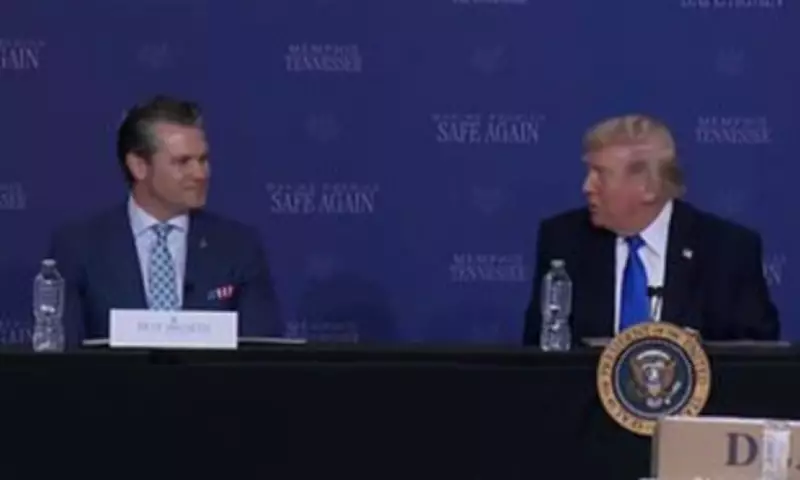
In a revealing moment at a Tennessee conference on Monday, former President Donald Trump appeared to deflect responsibility for the Iran conflict onto Defense Secretary Pete Hegseth, suggesting the military action was his subordinate's brainchild. Addressing the audience, Trump recounted: 'I called a lot of our great people... and I said, "Let's talk. We got a problem in the Middle East. We have a country known as Iran that, for 47 years, has been just a purveyor of terror, and they're close to a nuclear weapon."'
Turning directly to Hegseth, who was seated to his right, Trump added: 'And Pete, I think you were the first one to speak up. And you said, “Let’s do it, because you can’t let them have a nuclear weapon."' Observers noted Hegseth forcing an awkward smile as Trump continued discussing what he described as ongoing negotiations with Iran that had 'started last night.'
Global Economic Fallout from Strait of Hormuz Closure Intensifies
The political drama unfolds against a backdrop of severe economic disruption, now entering its fourth week. The closure of the Strait of Hormuz by Iran has created what International Energy Agency chief Fatih Birol calls a 'major, major threat' to the global economy. Through this narrow waterway passes approximately 20% of the world's oil supply, and Iran has restricted access exclusively to allied nations.

Birol, speaking at Australia's National Press Club, warned: 'No country will be immune to the effects of this crisis if it continues to go in this direction.' He compared the current energy situation to 'two oil crises and one gas crash put all together,' referencing the 1970s energy shocks and consequences of Russia's 2022 Ukraine invasion.
According to Austrian researchers, extended closure could affect up to $1.2 trillion in exports. While brief disruptions under two weeks might have limited impact, blockages exceeding four weeks could trigger cascading global supply chain issues. The United Kingdom faces particular vulnerability, importing $12 billion annually through the strait, including $5.9 billion in Qatari liquefied natural gas and propane alone.
Diplomatic Maneuvering and Military Escalation Continue
Trump's diplomatic claims contrast sharply with Iranian statements. While Trump announced on his Truth Social platform that 'very good and productive' conversations had occurred about a 'complete and total resolution of hostilities,' Iranian officials have categorically denied any negotiations took place.
Iranian Parliament Speaker Mohammad Bagher Qalibaf stated on X: 'No negotiations have been held with the US,' adding that 'fake news is used to manipulate the financial and oil markets.' An unnamed Iranian foreign policy analyst told Fars News Agency that 'no sane official in Iran would indulge in such foolishness' regarding talks with the United States.
Military actions have escalated despite diplomatic claims. Iran launched missile strikes on Tel Aviv on Tuesday, just one day after Trump described peace talks as constructive. The attacks triggered air raid sirens across Israel, with six injuries reported in northern Israel from falling debris. Israeli Prime Minister Benjamin Netanyahu has vowed to continue strikes in 'both Lebanon and Iran,' while claiming progress in 'smashing the missile programme and the nuclear programme.'
Political Repercussions and Public Opinion Shifts
The conflict has taken a toll on the Trump administration's public standing. According to a Daily Mail/JL Partners poll, Defense Secretary Pete Hegseth has become the joint most unpopular Cabinet secretary with a net approval rating of minus 10, representing a 10-point drop since February 28 when initial strikes against Iran commenced.
Hegseth himself recently criticized media and allies for what he termed 'Trump Derangement Syndrome,' accusing the press of wanting 'President Trump to fail' while lashing out at 'ungrateful allies in Europe.' He asserted that the world 'should be saying one thing to President Trump: Thank You.'

International leaders have called for immediate de-escalation. EU chief Ursula von der Leyen emphasized in Canberra: 'It is of utmost importance that we come to a solution that is negotiated, and this puts an end to the hostilities that we see in the Middle East.' She noted that 'we all feel the knock on effects on gas and oil prices on our businesses and our societies.'
Trump has suggested unconventional solutions, including potentially jointly managing the Strait of Hormuz with Iran's next ayatollah when it reopens. When asked about control of the vital waterway in any peace deal, Trump responded: 'maybe me, me and... whoever the next ayatollah (is).' He has given conflicting timelines for conflict resolution, stating the war could end within a week if talks progress well, but adding ominously: 'Otherwise, we'll just keep bombing our little hearts out.'