Trump Family's Secret $500 Million Cryptocurrency Agreement With UAE Royal Revealed
In a development that has sent shockwaves through political and financial circles, the Trump family discreetly finalised a monumental $500 million cryptocurrency agreement with a powerful Abu Dhabi royal figure merely days before Donald Trump's return to the White House in January 2025. This previously undisclosed arrangement, which directed nearly $200 million to entities linked to the Trump family, was followed months later by the United States granting the same foreign nation extensive access to sensitive artificial intelligence technology.
The January 2025 Agreement and Its Key Players
The substantial deal, involving the Trump-backed cryptocurrency firm World Liberty Financial, was formally signed on January 16, 2025. Signatories included Eric Trump alongside executives connected to Sheikh Tahnoon bin Zayed Al Nahyan, who serves as the United Arab Emirates' national security adviser and is the brother of the nation's president. This transaction effectively made a foreign government official the largest shareholder in a company with direct ties to the sitting US president, an occurrence described as unprecedented in modern American political history.
According to documentation examined by the Wall Street Journal, which first confirmed the arrangement alongside company records and informed sources, the purchasing entity was Aryam Investment 1. This company is controlled by Sheikh Tahnoon, widely regarded as one of the Middle East's most influential figures. The agreement granted Aryam a 49 percent ownership stake in World Liberty Financial for the $500 million sum, with $250 million paid immediately. From this initial installment, a staggering $187 million was directed to Trump family entities.

National Security Concerns and Subsequent AI Technology Access
Sheikh Tahnoon, who oversees a vast business empire valued at over $1.3 trillion, has long been viewed with apprehension within Washington's intelligence and national security communities. He controls G42, a prominent artificial intelligence and surveillance firm that faced scrutiny during the Biden administration due to its historical connections with China's Huawei and other Chinese technology companies. US officials had previously blocked or restricted Emirati access to advanced American AI chips, citing fears that sensitive technology could be diverted to Beijing.
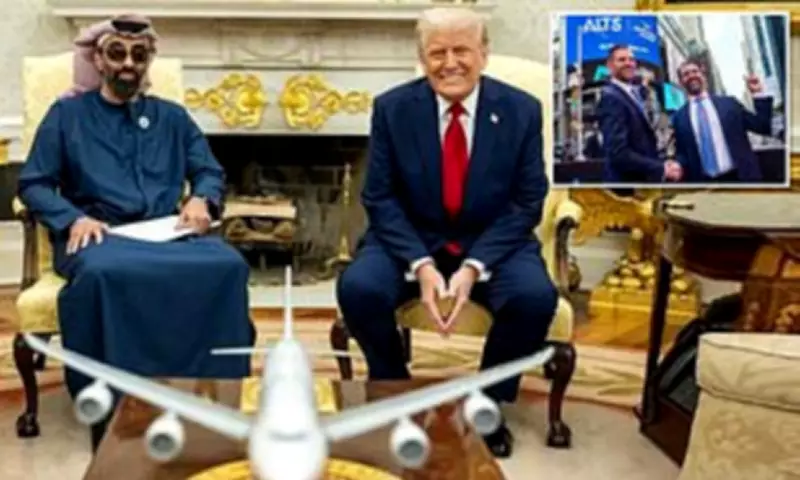
This landscape shifted dramatically under the Trump administration. In March 2025, Tahnoon met with Donald Trump in the Oval Office, accompanied by senior administration officials, where he reportedly expressed strong interest in expanding cooperation on artificial intelligence and technology. Merely two months later, the Trump administration approved a framework permitting the UAE to receive approximately 500,000 advanced AI chips annually—a volume sufficient to construct one of the world's largest data centre clusters.
Financial Mechanics and Corporate Structure Changes
At the time of the January agreement, World Liberty Financial possessed no operational products, with its sole revenue derived from selling a token called WLFI, which had raised approximately $82 million. The Aryam investment fundamentally transformed the company's prospects. The deal triggered immediate multi-million-dollar payouts to Trump-linked entities, as well as to companies affiliated with the family of Steve Witkoff, Trump's longstanding friend and newly appointed Middle East envoy.
Following the transaction, the Trump family's ownership stake in World Liberty Financial diminished significantly. Disclosures later indicated their ownership dropped from 75 percent to roughly 38 percent, confirming that the foreign-backed entity had become the largest shareholder. The company's five-person board saw the addition of two senior executives from G42—Martin Edelman and Peng Xiao—alongside Eric Trump and Zach Witkoff, Steve Witkoff's son who served as World Liberty's CEO. Notably, World Liberty did not publicly disclose these new board members or the identity of its largest investor.

Strategic Moves and Further Connections
Weeks before the US–UAE chip agreement was announced, Zach Witkoff appeared on stage in Dubai to reveal that MGX, another Tahnoon-controlled fund, would utilise World Liberty's new stablecoin, USD1, to complete a $2 billion investment into the cryptocurrency exchange Binance. This manoeuvre instantly propelled USD1 into the upper echelons of global stablecoins and provided World Liberty with a $2 billion cash reserve, which the company now invests in US Treasury bonds, generating tens of millions in interest.
Neither company disclosed that MGX and World Liberty shared leadership or that both were controlled by executives tied to Sheikh Tahnoon. This revelation adds to an existing pattern of business relationships, as Tahnoon's companies had previously invested $1.5 billion into a firm operated by Trump's son-in-law, Jared Kushner. Furthermore, shortly after Trump's inauguration, Tahnoon's MGX was announced as an investor in a $500 billion AI data centre project involving OpenAI and SoftBank—a venture Trump personally promoted from the White House.
Political Reactions and Ethical Scrutiny
The disclosure of these interconnected events has provoked fierce criticism from political opponents and ethics experts. Democrat Connecticut Senator Chris Murphy expressed his condemnation on social media, describing the situation as 'mind blowing corruption'. He highlighted that Trump reversed decades of national security objections to selling advanced AI chips to the UAE, with national security experts expressing alarm, while secret payments were made to the Trumps beforehand.
Legal specialists and former government ethics officials have characterised the sequence as explosive. Kathleen Clark, a former ethics lawyer for Washington, D.C., stated to the Wall Street Journal, 'This sure looks like a violation of the foreign emoluments clause, and more to the point, it looks like a bribe.' Ty Cobb, who served as a top White House lawyer during Trump's first term, was unequivocal: 'My advice as an ethics lawyer would have been clear: You don't do business deals with the families of the leaders of foreign countries. It taints American foreign policy.'
Official Responses and Ongoing Developments
The White House has firmly denied any conflict of interest. Spokeswoman Anna Kelly asserted, 'President Trump only acts in the best interests of the American public. There are no conflicts of interest.' White House counsel David Warrington added, 'The President has no involvement in business deals that would implicate his constitutional responsibilities.'
A spokesperson for World Liberty Financial maintained that the deal did not grant any government access or influence, stating, 'We made the deal in question because we strongly believe that it was what was best for our company. We operate by the same rules and regulations as any other company in our space.' An individual familiar with Tahnoon's investment emphasised that the sheikh reviewed World Liberty's plans for months and that 'at no time during that due diligence or thereafter was the investment discussed with President Trump.'
This complex web of financial transactions and policy decisions continues to raise profound questions about the intersection of private business interests, foreign relations, and presidential ethics in contemporary American politics.