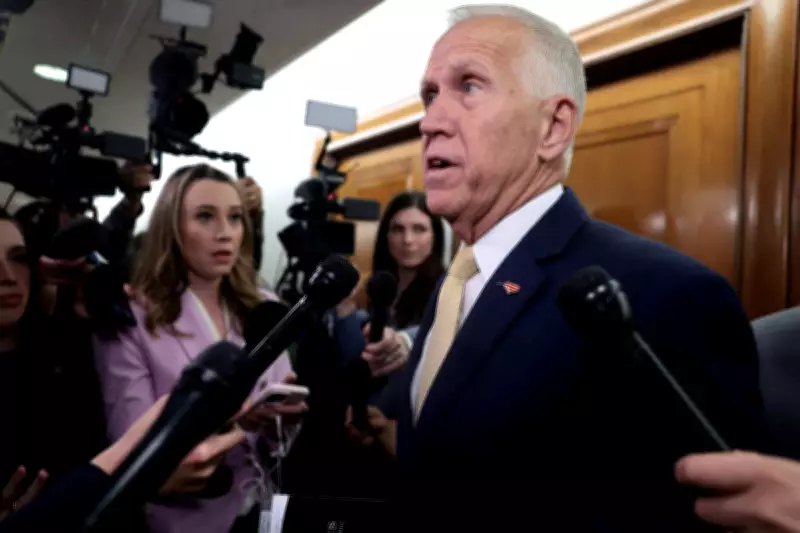
A Republican senator who has been one of Donald Trump’s biggest obstacles through twin GOP congressional majorities has announced that he is ending his opposition to the nomination of Kevin Warsh to be the next chair of the Federal Reserve.
Tillis Announces End to Opposition
Thom Tillis of North Carolina made the announcement Sunday on NBC’s Meet the Press, handing the administration a much-needed win at a moment where the president’s Cabinet appears to be in flux and under scrutiny for bad behavior.
Tillis told NBC’s Kristen Welker that his opposition was no longer necessary after he received assurances from the Department of Justice around its now-halted efforts to go after the current Fed chair, Jerome Powell, with a criminal investigation surrounding renovations to the agency’s headquarters. That probe was viewed by many of the White House’s critics, Tillis included, as an attempt to put political pressure on Powell to resign or otherwise bend to Trump’s will.

“We worked a lot over the weekend to make sure that we were very clear that we have assurances from the DOJ that I needed to feel like they were not using the DOJ as a weapon to threaten the independence of the Fed. So this will allow Mr. Warsh to move on with his confirmation on time,” Tillis told NBC News.
DOJ Investigation and Its Implications
The Department of Justice is not bound to its decision to drop the case against Powell and could theoretically resume it in the future. But the agency hasn’t indicated any plans or interest in doing so just yet, and the motivation to burn Powell would lessen, but not disappear, if a new Fed chair were to be appointed.
During Warsh’s confirmation hearing, Tillis told the president’s nominee that his qualifications were outstanding, and that his opposition hinged solely on the administration’s conduct. As chair of the committee, he had the power to keep Warsh’s nomination on hold indefinitely.
“You have extraordinary credentials. They’re impeccable,” said Tillis. “Problem I have is where we are right now.”
He told journalists after the hearing: “Let's get Chair Powell comfortable with actually exiting at some point, not to 2028, and do that by eliminating a bogus investigation that started this whole drama.”
Tillis’s Unique Position in the Republican Party
Tillis is unique within the Republican conference, a moderate Republican with a voting record that is ultimately more aligned with the president than Sens. Lisa Murkowski or Susan Collins, two senators with longer histories of siding with Democrats on some issues, yet one who went through a public break-up with Trump in 2025 and has never mended fences.
His dispute with Trump stems from his opposition to the GOP reconciliation package last year. Named the “big, beautiful bill,” the legislation extended the 2017 GOP tax cuts signed under Trump’s first term while also expanding funding for ICE. It also cut Medicaid by introducing new eligibility and reimbursement requirements, which Tillis opposed due to the projected effects those cuts will have particularly on rural hospitals.
Since then he has been one of the few Republicans in the Senate willing to offer open criticism of the administration, including over issues like ICE’s enforcement surge in Minneapolis which ended after the deaths of two Americans.
Political Consequences and the Fed Chair Controversy
His decision to not run for re-election also put Republicans in a bind in North Carolina, where a race to succeed him is being led by a Democrat in most polling. The Republican senator would almost certainly have been forced to face a Trump-backed Republican primary challenge if he’d remained in the race. One other incumbent GOP senator, Louisiana’s Bill Cassidy, is fighting off a Trump-backed challenger in his state as he reckons with Trump’s simmering anger over Cassidy’s 2021 impeachment vote.
Tillis voted against impeaching the president after the January 6 attack on Congress in 2021, but found that Trump’s ire was inescapable after the reconciliation vote.

Powell, meanwhile, became a target of the president over his repeated refusal to cut interest rates, which the president has repeatedly said is hindering U.S. economic growth. The Fed chair has also blamed the president’s tariff strategy for raising inflation and consumer prices, further annoying Trump.
The president has repeatedly suggested that he would fire Powell, causing tremors in the markets and concerns about the central bank’s independence and political sovereignty going forward. Like the probe, he’s also been largely forced to back off those threats by Republicans in Congress. Warsh, in Trump’s view, is more open to lowering rates despite the risks of further inflationary pressures.