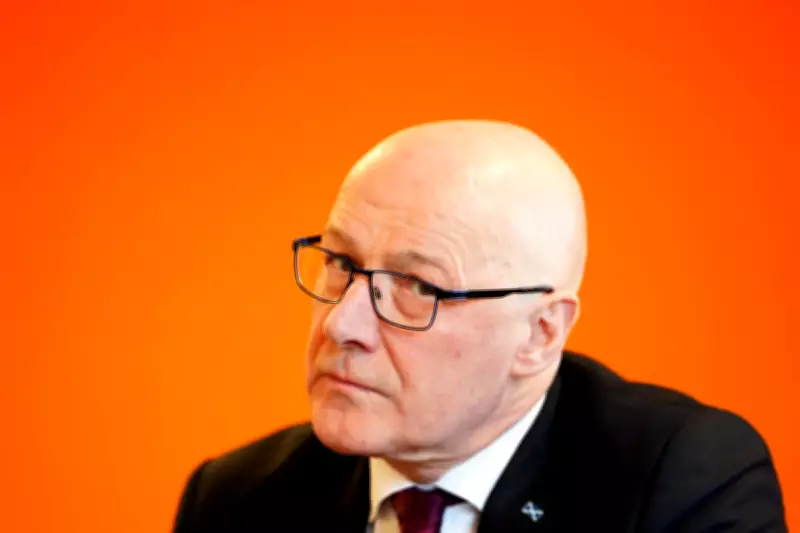
Swinney Pledges Respect for Judicial Independence Amid Murrell Charge Controversy
First Minister John Swinney has firmly committed to upholding "the independence of the criminal process within our country and within our courts" following revelations that he received advance notification of charges against former SNP chief executive Peter Murrell. The disclosure has ignited a political firestorm, with opposition parties demanding explanations about the timing and propriety of the communication.
Early Notification Sparks Opposition Outcry
During a visit to a mental health charity in Perth, Mr Swinney repeatedly declined to comment on why he was given sight of the indictment weeks before it became public knowledge. "This is a live criminal case and I'm not going to make any comment," he told reporters when questioned about the advance notification.
The controversy centers on an email from Lord Advocate Dorothy Bain to the First Minister on January 19, which detailed allegations that Mr Murrell had embezzled approximately £460,000 from the SNP between August 2010 and January 2023. These details remained confidential until February 13, creating a significant gap between governmental awareness and public disclosure.

Opposition Demands Parliamentary Accountability
Scottish Conservative leader Russell Findlay has been particularly vocal, stating: "There appears to be no good reason as to why the Lord Advocate should issue John Swinney with a private warning about the alleged scale of the SNP fraud case – while the public are told the bare minimum." He further suggested that "something is rotten at the heart of the relationship" between Mr Swinney and Scotland's independent prosecution chief.
Scottish Labour leader Anas Sarwar has taken formal action, writing to the Lord Advocate demanding her appearance before the Scottish Parliament. In his letter, Mr Sarwar emphasized: "This goes directly to public confidence in the independence of prosecution in Scotland and to the wider concern, long raised across politics and civic society, that the Lord Advocate's dual role is structurally vulnerable in high-profile or politically-sensitive cases."
Legal and Governmental Responses
The Crown Office has defended the Lord Advocate's actions, stating that her email was "in order to form part of the record and ensure transparency in due course." A spokesperson clarified that "the Lord Advocate provided the First Minister with an update to ensure it was understood she was not involved in the case, that it was active for contempt of court, and therefore it should not be commented upon."
Meanwhile, a Scottish Government spokesperson maintained that "it would not be appropriate for the Scottish Government to comment on live criminal proceedings," echoing Mr Swinney's position of non-interference in judicial matters.
Broader Implications and Political Fallout
The controversy has been amplified by several additional factors:
- Tory MSP Douglas Ross has submitted an urgent question in the Scottish Parliament, demanding the Lord Advocate explain "the motivation behind her extraordinary move"
- The Sun newspaper reported that the Lord Advocate's message was circulated to other Scottish Government officials after reaching the First Minister
- Mr Murrell's next court appearance has been postponed until May 25, after the Holyrood elections, raising further questions about timing
- Parliamentary business minister Graeme Dey emphasized that "scheduling of trials is a matter for the independent judiciary"
Mr Sarwar's letter contained particularly strong language, warning that "if it is established that your actions gave, or could reasonably be seen as giving, a political advantage to the governing party, then the question of your position is unavoidable." He argued that Scotland's top prosecutor "cannot be involved in conduct that allows any party to gauge political exposure from a live indictment, or appears to do so, and still expect public confidence to hold."

The First Minister's steadfast refusal to comment on the specifics of the case, while simultaneously affirming his commitment to judicial independence, has created a delicate balancing act. As opposition pressure mounts and parliamentary scrutiny intensifies, the controversy threatens to overshadow other governmental business and raise fundamental questions about the separation between political leadership and judicial processes in Scotland.