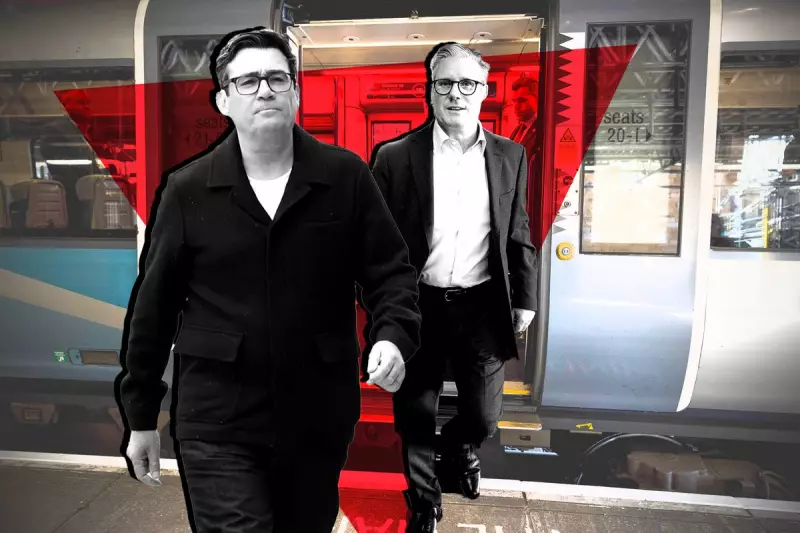
Starmer's Northern Rail Gamble: Can Infrastructure Win Back the Red Wall?
As Andrew Gwynne's resignation opens a potential parliamentary path for Andy Burnham, Prime Minister Keir Starmer faces a critical test of his authority in Labour's traditional northern heartlands. The announcement of a £45bn Northern Powerhouse Rail scheme represents a bold attempt to reclaim political ground, but with implementation timelines stretching into the 2030s and 2040s, many northern voters remain deeply sceptical.
The Commuter's Reality: Planning for Failure
At Bradford Forster Square station, lawyer Graham Sweeney encapsulates the daily frustrations of northern rail users. "You have to plan for things to go wrong," explains the 53-year-old, who regularly travels between Bradford, Huddersfield, Leeds and Manchester for work. "If you have a meeting at 3pm, you make sure you're on a train that gets you in at 1pm – because there's every chance there will be a cancellation."
His experiences mirror those of countless commuters: regular cancellations, constant delays, freezing platforms, unreliable wifi and chronic overcrowding. The 35-mile journey from Bradford to Manchester takes a full hour even when services run smoothly, highlighting the infrastructure deficit that has become symbolic of the north-south divide.

Burnham's Playbook: Delivery Versus Promise
Starmer's rail announcement follows a template perfected by Greater Manchester Mayor Andy Burnham, whose Bee Network has transformed local transport since buses were brought into public ownership in 2023. Under Burnham's leadership, the network has seen 14 per cent growth in user numbers, with more reliable services, preserved routes, night bus expansions and fare caps creating tangible improvements.
This delivery-focused approach has earned Burnham significant political capital. Martin Little, a 60-year-old market trader who commutes between Greater Manchester and Leeds, typifies the shifting allegiances. "After a lifetime with the mainstream parties, I feel I'll go for Farage next time out," he admits. "But Burnham has done a terrific job. He said he was going to do something and then he actually delivered on it. I would happily see him as prime minister."
The Political Calculus: Timing and Trust
With Gwynne's departure creating a potential Westminster return route for Burnham, Starmer faces dual threats from both his party's northern champion and Nigel Farage's Reform UK. The Prime Minister's international successes contrast sharply with domestic challenges, particularly in English provinces where Labour's support has eroded.
The Northern Powerhouse Rail proposal involves three phases: upgrading and electrifying lines between Leeds, Bradford, Sheffield, York and Manchester; constructing new stations in Bradford, Warrington and Rotherham; and building new Liverpool-Manchester and Birmingham-North West connections. "No more paying lip service to the potential of the north, but backing it to the hilt," declared Starmer, with Chancellor Rachel Reeves adding: "We're doing this properly and doing this right."
The Credibility Gap: 2030s Timelines and Historical Precedents
The scheme's Achilles heel lies in its extended timeframe. The earliest improvements won't materialise before the mid-2030s, with the Manchester-Birmingham connection slated for the 2040s. This has triggered widespread scepticism among northern communities who remember George Osborne first proposing Northern Powerhouse Rail in 2014, only to see it repeatedly delayed, cancelled and pared back.
At Leeds station, plumber Chris Hay and builder David Appleyard exemplify this distrust. Their cancelled train has forced them into a station pub, with Hay remarking: "I should be billing Northern Rail for this pint." Appleyard calculates the political reality: "That means five years of talking about it, doesn't it? Five years of talking about it before it gets cancelled anyway because it now costs too much."

The Economic Imperative: Productivity and Potential
Beyond politics lies compelling economic rationale. Improved northern transport could boost regional productivity to the UK average, injecting £40bn annually into the national economy according to government estimates. Transport for the North's 2021 calculations suggested NPR could eventually create 74,000 regional jobs.
Mandy Ridyard, finance director at Baildon aerospace engineering firm ASG Produmax, highlights the practical business impacts. "It takes me longer to get from Bradford to Manchester airport than it takes me to get from Manchester to Schiphol," she reveals. "That's off-putting for me, so what are our potential international customers thinking? Our ability to realise our potential is being limited."
The Political Crossroads: Reform's Surge and Labour's Response
As Reform UK continues gaining ground in former Labour strongholds, Starmer's rail strategy represents both defensive politics and economic necessity. The Prime Minister must demonstrate he can champion northern interests as effectively as he represents Britain internationally.
Yet for some voters, the announcement comes too late. "It's still Reform for me," states Hay. "There's nothing the others could do to change that now." This sentiment underscores Starmer's challenge: announcing infrastructure improvements represents only the beginning. Convincing sceptical northern communities that trains will eventually run on time – and that Labour can deliver where previous governments failed – constitutes the far more difficult political task ahead.
With Scottish, Welsh and English council elections approaching in May, and Labour anticipating difficult results, the northern rail gamble represents Starmer's attempt to reconnect with disillusioned voters. Whether this strategy can outpace Burnham's popularity and Reform's surge remains uncertain, but the political tracks have been laid for a crucial battle over Labour's northern future.