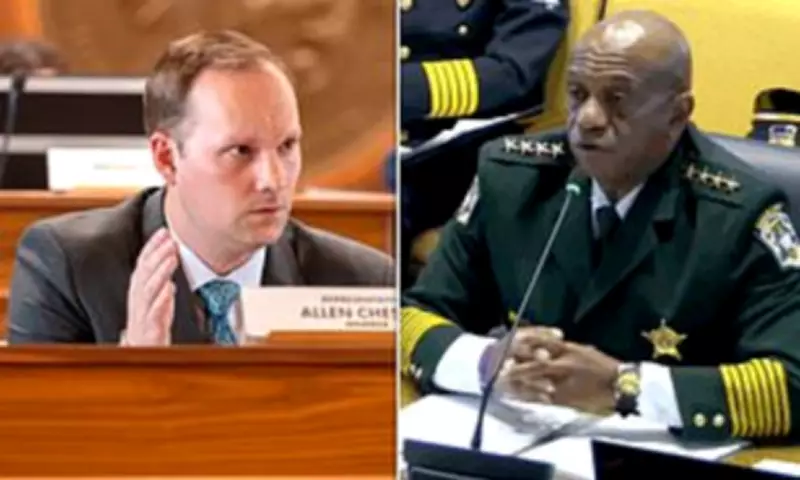
North Carolina Sheriff Stumbles on Basic Civics in Tense ICE Hearing
A North Carolina lawmaker publicly embarrassed a high-profile sheriff by asking elementary questions about the structure of the United States government during a contentious committee hearing. The exchange occurred on Monday when Mecklenburg County Sheriff Garry McFadden appeared before the North Carolina House Oversight Committee to discuss crime rates in the southern state.
Awkward Civics Lesson Unfolds
Republican Representative Allen Chesser seized the opportunity to test Sheriff McFadden's fundamental knowledge of American governance. Chesser began with a straightforward inquiry: "What branch of government do you operate under?" Confidently, McFadden responded, "Mecklenburg County." After a slow blink, Chesser repeated his question, prompting a lengthy pause before the sheriff offered, "The Constitution of the United States."
Chesser clarified, "Correct, that's what establishes the branches of government. I'm asking which branch you fall under." Unfazed, McFadden again cited his county affiliation, stating, "I'm a duly sworn Mecklenburg County sheriff. We answer to the people of Mecklenburg County."

The lawmaker then asked if McFadden knew how many branches of government exist in the United States. When the sheriff hesitated, Chesser supplied the answer: three—Executive, Legislative, and Judicial. "Of those three, which do you believe you fall under?" Chesser pressed. McFadden guessed "Judicial," to which Chesser corrected him, "That is incorrect, sir. You fall under the executive."
Underlying Immigration Policy Conflict
These questions were strategically leading toward a more significant issue: McFadden's refusal to cooperate with Immigration and Customs Enforcement (ICE). The sheriff has previously asserted that his deputies "do not have a role in enforcement whatsoever. We do not have to follow the rules and laws that are governed by our lawmakers in Raleigh." He later clarified this statement, explaining he meant his office does not assist ICE.
This stance has drawn scrutiny following the tragic stabbing death of Ukrainian refugee Iryna Zarutska on public transportation in Charlotte, located within Mecklenburg County. The alleged perpetrator, DeCarlos Brown Jr., brought McFadden's immigration policies into sharp focus.
New State Law Forces Cooperation
While local police and sheriffs typically do not operate under the executive branch, North Carolina recently enacted legislation mandating closer collaboration with ICE. House Bill 318, signed into law in July and effective since October 1, requires local law enforcement to:
- Determine the citizenship status of prisoners
- Notify Homeland Security if citizenship cannot be verified or if prisoners are here illegally
- Comply with ICE detainers and inform the agency when targeted individuals are released from custody
Democratic Governor Josh Stein vetoed the bill in June, labeling it unconstitutional. He expressed support for aiding ICE in cases involving serious crimes like sexual battery or armed robbery but opposed extending detainment periods. However, the State House and Senate overrode his veto with votes of 72-48 and 30-19, respectively.
Broader Implications for Local Autonomy
This legislative move challenges traditional norms where local enforcement cannot be compelled to cooperate with ICE and is not required to honor detainers. Federally, agencies like the FBI and ICE fall under the executive branch, as do state police at the state level, but local sheriff's departments typically enjoy more autonomy.
The hearing concluded with McFadden seen conversing with Democratic Representative Eric Ager, highlighting the partisan divide on immigration enforcement. The Daily Mail has reached out to Sheriff McFadden for further comment on the incident.