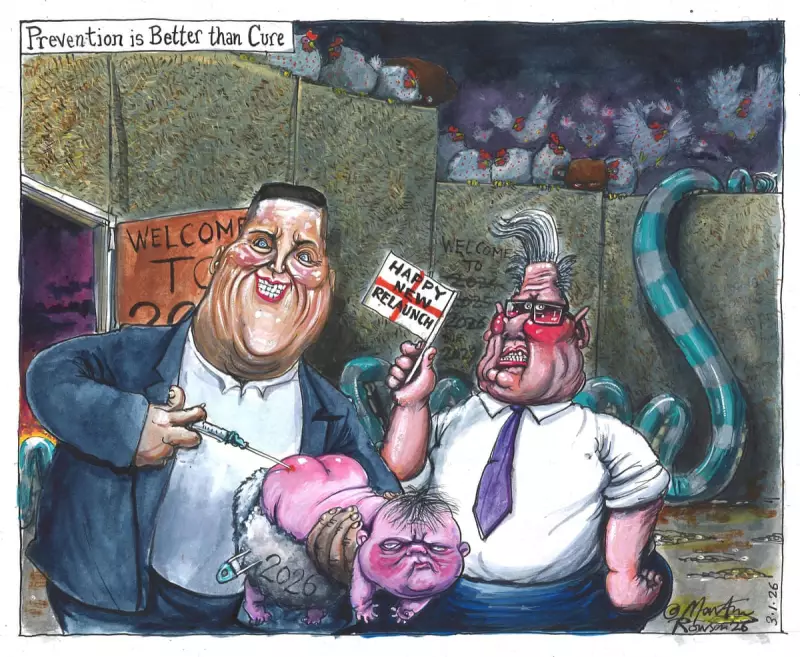
Acclaimed political cartoonist Martin Rowson has turned his incisive pen towards the future of the National Health Service under a potential Labour government, offering a stark and satirical glimpse into the year 2026. His latest work, published in The Guardian, features Labour leader Sir Keir Starmer and Shadow Health Secretary Wes Streeting in a grim tableau that questions their long-term plans for the nation's cherished health service.
A Grim Prognosis for the NHS
Rowson's cartoon, dated 2 January 2026, presents a deliberately bleak and cluttered scene. The setting appears to be a dilapidated NHS facility or a chaotic political office, symbolising the state of healthcare. Central to the image are Sir Keir Starmer and Wes Streeting, both depicted in Rowson's distinctive, caricatured style. Their expressions and posture are critical, suggesting a narrative of disappointment or failed promises.
The artwork is dense with symbolic detail, a hallmark of Rowson's approach. Scattered elements likely reference ongoing crises in the health service: long waiting lists, staff shortages, funding shortfalls, and the creeping influence of private sector involvement. The choice of the date 2026 is significant, projecting the viewer several years into a hypothetical first term of a Starmer-led government to interrogate the tangible outcomes of current Labour policy pledges on health.

Satire as Political Commentary
Martin Rowson, known for his sharp commentary on British politics, uses the cartoon not to report news but to offer a critical, artistic interpretation of political trajectories. His work asks the viewer to consider whether the Labour Party's current stance, particularly Streeting's much-discussed openness to reforming NHS workforce and service delivery, will lead to renewal or further decline.
The power of this satire lies in its ability to condense complex political debates into a single, potent image. It challenges the official narratives from both major parties by visualising a potential future consequence of today's decisions. The cartoon serves as a cautionary visual essay, questioning if a change in government will truly equate to a rescue mission for the NHS or merely a management of its struggles.
Reactions and Lasting Implications
While the immediate reaction to a single cartoon is often contained within media and political circles, Rowson's work contributes to a broader, vital public discourse. It visually frames the NHS as the central battleground for the next general election and beyond. For voters, it underscores the importance of scrutinising not just short-term electoral promises, but the long-term vision any party holds for the institution.
Ultimately, Rowson's 2026 scene is less a prediction and more a provocative tool. It holds a mirror to the political class, demanding accountability for the future they are shaping. The cartoon reminds the public that the health of the NHS remains the ultimate barometer of political success or failure, a fact that will undoubtedly dominate British politics from now until 2026 and well into the future.