Republicans Craft Contorted Definitions of 'War' to Defend Trump's Iran Operations
In a striking political manoeuvre, Republican lawmakers are grappling with a semantic dilemma: when does a conflict constitute a 'war'? As the United States engages in military operations against Iran, GOP figures are deploying tortured definitions to assert that the nation is not officially at war, despite escalating hostilities. This rhetorical gymnastics aims to shield President Donald Trump from political backlash, particularly given the unpopularity of prolonged foreign engagements among voters.
Senate Rejects War Powers Act Amidst Republican Semantics
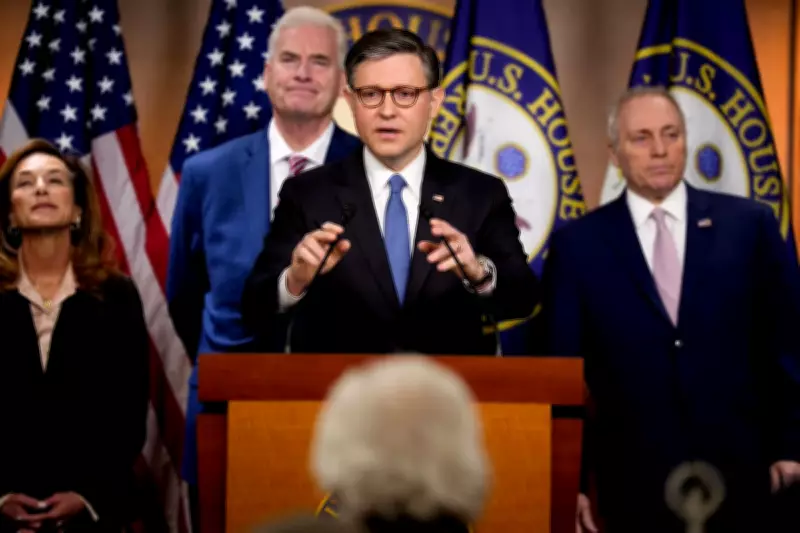
On Wednesday, the Senate voted down a War Powers Act resolution designed to curtail President Trump's actions in Iran. In response, Republicans have formulated a novel argument: the United States' operations in Iran do not qualify as a war. House Speaker Mike Johnson emphasised this point during his weekly press conference, stating, "We're not at war right now, we're four days into a very specific, clear mission and operation." This assertion persists even though Trump and Secretary of Defense Pete Hegseth have previously referred to the operation as a war on separate occasions.
The rationale behind this semantic shift is deeply political. Trump campaigned as a non-interventionist president, criticising party hawks like Jeb Bush and John McCain. His campaign leveraged fears that Kamala Harris would deploy young men to war, a strategy that resonated with voters. Now, with Trump's popularity waning and a cost-of-living crisis looming, Republicans are keen to avoid the label of 'war,' which could further alienate the electorate.

Graham's Hawkish Yet Contradictory Stance
Senator Lindsey Graham of South Carolina, a staunch Trump ally known for his bellicose views, offered a convoluted perspective. He told The Independent that the United States has been in an "undeclared state of war with Iran since 1979," adding, "You kill an American, you're at war with the people you're killing." This allows Graham to maintain his hawkish credentials without explicitly endorsing Trump's actions as a war. However, by his own definition, the U.S. is indeed at war with Iran, given the killing of Iran's Supreme Ayatollah Leader Ali Khamenei.
Senator Thom Tillis of North Carolina, a critic of Trump, echoed similar sentiments, suggesting that discussions about war should focus on timing, deployment, and alliances. Meanwhile, Senator Susan Collins of Maine opposed the War Powers Act by citing Iran's nuclear threats and sponsorship of terrorism, despite her role as Appropriations Committee Chairwoman, which involves funding Pentagon operations—effectively appropriating money for a conflict that is not officially termed a war.
Democratic Skepticism and Political Calculations
Democrats are not convinced by these semantic contortions. Representative Alexandria Ocasio-Cortez of New York remarked, "I don't know how tuned in Mike Johnson is with the president of the United States, but the president of the United States himself has said that we are at war and that would make his actions patently illegal." Senator Mark Kelly of Arizona also expressed disbelief, noting the inconsistency in Republican statements.
The underlying motive for this rhetorical strategy is clear: allowing Trump to proceed with military actions without congressional oversight enables Republicans to avoid a difficult vote. Supporting a War Powers Act resolution could lead to a formal declaration of war or authorisation of military force, a politically perilous move in an election year where Republicans are trailing in generic ballots. Most Americans oppose or are unaware of the reasons for the conflict, making such a vote akin to a political death sentence.
House Speaker Johnson hinted at this calculus, expressing trust that the American public would reward the administration politically. Consequently, Congress appears poised to let Trump navigate the crisis independently, avoiding accountability for potential failures. This episode underscores the lengths to which politicians will go to reframe reality for electoral gain, leaving the true nature of the conflict in Iran obscured by partisan semantics.