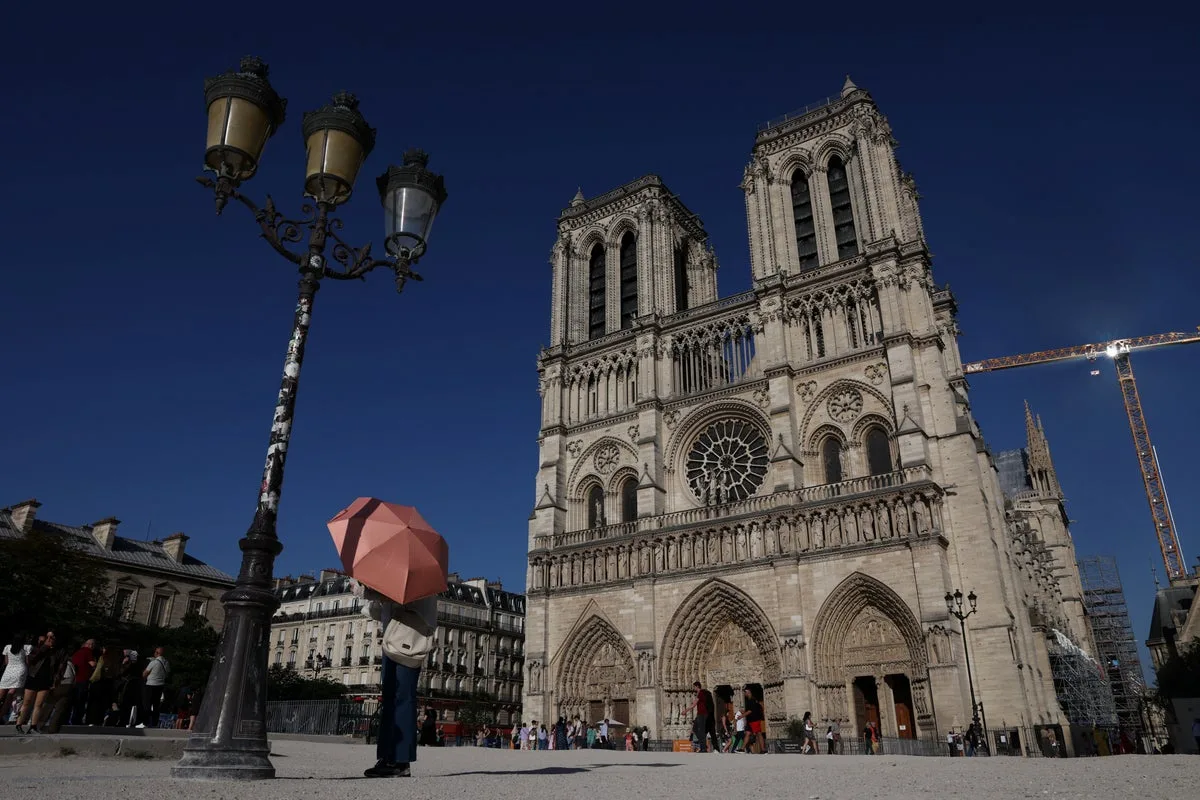
While tourists queue in the summer sun to ascend Notre Dame Cathedral and admire its iconic gargoyles, a remarkable archaeological excavation is unfolding just four metres beneath their feet. This deep dive into Paris’s past, reaching back 2,000 years to Roman times, is a direct consequence of the cathedral’s 2019 fire and the subsequent plans to revitalise its forecourt.
Following the devastating blaze that saw Notre Dame’s spire collapse, the cathedral reopened in late 2024. As part of wider urban renewal, Paris aims to transform the currently stark square into a shaded, tree-lined space. However, in a city steeped in history, no ground can be disturbed without first meticulously excavating what lies beneath. Consequently, a section of Notre Dame’s forecourt has been transformed into an active excavation site, which French media have already dubbed the “dig of the century”.
Among the hundreds of objects unearthed so far are a fourth-century coin bearing the image of Emperor Constantine and fragments of medieval pottery. These shards are particularly intriguing, featuring faint, undeciphered markings painted on their interior – a mystery that has led some to liken it to a “modern Da Vinci Code”. The first historical traces emerge just 50cm down, but the team is still unearthing history four metres deeper.

Camille Colonna, the lead archaeologist, explained that at the cathedral’s birth in 1163, the entire square was densely packed with medieval houses. As her team digs deeper, they have uncovered the cellars of these homes, below which lie Merovingian and Carolingian grain pits from the sixth to tenth centuries. Deeper still, a dense Roman quarter from the fourth and fifth centuries has been revealed. In total, 20 centuries of history are stacked within just four metres of earth.
Some of the richest finds have emerged from the deep pits beneath the medieval houses, which served as both latrines and rubbish dumps. From these, the team has retrieved entire jugs and cups, discarded centuries ago yet remarkably intact, alongside broken plates and animal bones. The soft, organic waste in these pits provided a cushioning effect, miraculously preserving the items whole over centuries.