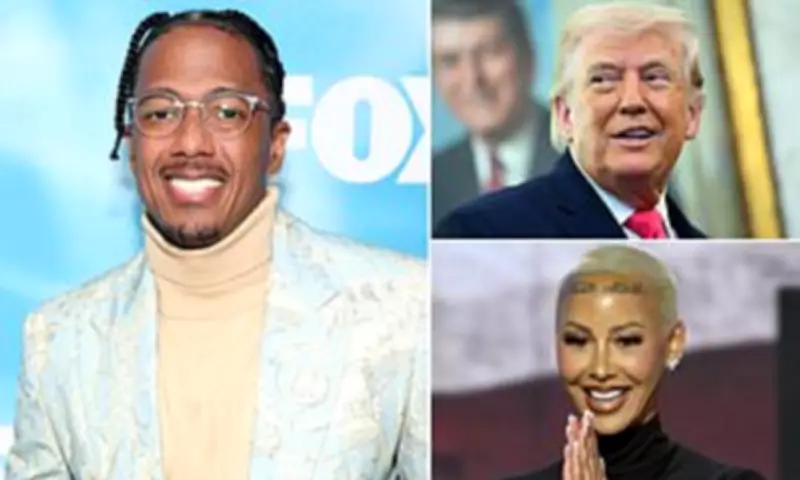
In a provocative interview on his web series Big Drive, comedian Nick Cannon delivered scathing criticism of the Democratic Party while offering praise for Republicans during a conversation with conservative figure Amber Rose. The 45-year-old entertainer made headlines with his bold political commentary, describing Democrats as "the party of the KKK" and acknowledging Republicans as "the party that freed the slaves."
Political Allegations and Historical Context
Cannon elaborated on his controversial statements by providing historical context during the interview with Rose, who has shifted toward conservatism in recent years. The comedian noted that the Democratic Party controlled the American South during the antebellum period when slavery was institutionalized, and maintained power during the post-Civil War era of racial segregation. He specifically referenced the Ku Klux Klan's origins among Confederate veterans and its connection to Southern Democrats who enforced apartheid policies.
Republican Historical Legacy
Conversely, Cannon highlighted the Republican Party's abolitionist platform established in the 1850s and its first president, Abraham Lincoln, who prosecuted the Civil War resulting in slave emancipation. The comedian emphasized that these historical facts represent what he considers misunderstood aspects of American political history that deserve greater public awareness and discussion.

Amber Rose's Political Evolution
During the interview, Rose, a 42-year-old former girlfriend of Kanye West who previously served as a figurehead for Los Angeles SlutWalk marches, explained her political transformation. She described herself as a "former Democrat, former liberal" who had been a "liberal Democrat my whole life" before changing her political alignment. Rose asserted that she crossed party lines because "Democrats don't care about black people and they don't care about people of color and the Republicans do, and that's the misconception."
Cannon's Personal Political Stance
Despite his criticism of Democrats and compliments toward Republicans, Cannon clarified that he maintains no formal allegiance to either major political party. He invoked the wisdom of renowned black intellectual WEB Du Bois, quoting his 1956 declaration that "no 'two evils' exist. There is but one evil party with two names, and it will be elected despite all I can do or say." Cannon explained that he personally subscribes to this perspective, viewing the American political system as fundamentally flawed in its current two-party structure.
Trump Commentary and Controversial Remarks
The conversation took a particularly colorful turn when discussing former President Donald Trump. Cannon enthusiastically declared, "Motherf***er's cleaning house!" and added with laughter, "I f*** with Trump." He praised Trump for following through on campaign promises, specifically mentioning border security policies with the joking observation that "He's like the club. He charging a $5 million bottle service fee to get into the country."
Rose's Support for Trump
Rose responded to Cannon's Du Bois reference by explaining her own voting rationale, stating, "I'm not married to any party. I voted for Donald Trump 'cause we had two options and he was definitely, by far, the better option for us, and as of now I agree with a lot of things that he's doing." This perspective aligned with her broader political evolution that culminated in her delivering a speech at the 2024 Republican National Convention, marking her formal emergence as a conservative voice.
Historical References and Intellectual Foundations
Cannon's invocation of WEB Du Bois represented a deeper intellectual engagement with political philosophy than typically expected from entertainment figures. He referenced Du Bois's 1956 essay "Why I Won't Vote," in which the 88-year-old intellectual explained his decision to abstain from that year's presidential election between Republican incumbent Dwight D. Eisenhower and Democratic challenger Adlai Stevenson. Du Bois argued that American democracy had deteriorated to the point where only "one evil party with two names" existed, with no viable third-party alternatives available to voters seeking meaningful reform.

Personal Dynamics and Interview Atmosphere
The interview featured moments of personal banter alongside serious political discussion, with Cannon slyly asking if Rose had switched parties because she had earned enough money to join the "elite." Rose denied this suggestion, maintaining that her political transformation stemmed from genuine ideological reconsideration rather than financial motivations. The exchange highlighted the complex interplay between personal experience, economic status, and political belief that characterizes contemporary political discourse.
Throughout the conversation, both Cannon and Rose emphasized their independence from strict party loyalty while expressing specific criticisms and compliments toward America's two major political parties. Their discussion touched on historical accuracy, contemporary political alignment, and the challenges of navigating political identity as public figures with diverse audiences and personal histories.