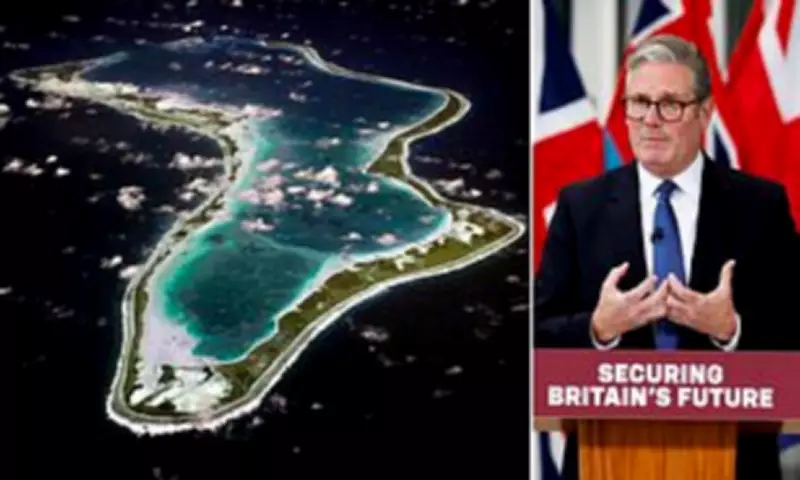
Labour Members of Parliament have issued a direct demand to the Prime Minister, urging him to completely abandon his government's contentious proposal to cede sovereignty of the Chagos Islands to Mauritius. The original plan involved transferring control of the Indian Ocean archipelago while maintaining a long-term lease for the strategically vital UK-US military base on Diego Garcia.
Strategic Base and Financial Implications
The proposed agreement would have allowed the United Kingdom to retain operational control of the Diego Garcia military installation through a ninety-nine year lease arrangement. This arrangement carried a substantial annual financial commitment, estimated at approximately one hundred and one million pounds per year on average. The base represents a critical asset for both British and American military operations in the Indian Ocean region.
American Political Reversal
Initial support for the sovereignty transfer came from former United States President Donald Trump. However, in a significant policy shift this past January, President Trump publicly reversed his position. He characterized the proposed handover as, in his words, 'an act of great stupidity'. This reversal has placed considerable diplomatic strain on the initiative and undermined its foundational international support.

Mounting Domestic Political Pressure
Confirmation that the legislation will not be included in the upcoming King's Speech has intensified pressure from within the Labour Party's own ranks. According to reports, backbench Labour MPs are now mobilizing to ensure the deal is terminated entirely. This internal dissent represents a further political challenge for Prime Minister Keir Starmer, who has already faced criticism for initially pausing the surrender process following the deterioration in relations with the Trump administration.
Dan Carden, the Member of Parliament for Liverpool Walton and a leading figure in the Blue Labour parliamentary caucus, stated unequivocally: 'It's clear the US administration doesn't support the Chagos deal, and the government should make the best of a bad situation and finally drop it.'
Graham Stringer, MP for Blackley & Middleton South, echoed this sentiment, adding: 'The government should ditch this financially and militarily unjustifiable policy. Hanging on will just lead to further embarrassment for our country.' Stringer has previously been vocal on other government policies, including plans for housing asylum seekers.
Wider Backbench Concerns and Electoral Fears
It is understood that a number of other Labour backbenchers share this viewpoint and have privately urged Sir Keir to formally drop the policy. There is reportedly widespread concern among party figures that pursuing the controversial handover could be a significant vote-loser. This anxiety is particularly acute as the Labour Party faces a potentially difficult set of local council elections in May, with fears of substantial losses.
Legal Imperatives and Security Rationale
The government's heavily scrutinized decision to proceed with ceding the Chagos Islands was originally driven by a desire to secure the long-term future of the Diego Garcia base. Officials concluded that without transferring sovereignty to Mauritius, the military site's operational viability would be threatened due to a series of adverse international legal rulings.
Mauritius bases its claim to the archipelago, located nearly six thousand miles southeast of the United Kingdom, on multiple United Nations judgments. These rulings focus on the illegality of separating the islands from Mauritius when it was still under British colonial administration. The legal position was significantly strengthened in 2019 by an advisory opinion from the UN's International Court of Justice, later reinforced by a ruling from the Special Chamber of the International Tribunal for the Law of the Sea.

Faced with the prospect of these rulings becoming legally binding, the government assessed that retaining the Chagos Islands posed a greater long-term threat to UK security interests than ceding the territory, while excluding the crucial Diego Garcia base from the transfer. Defence Secretary John Healey articulated this stark choice to MPs, warning: 'Without this deal, within weeks, we could face losing legal rulings and within just a few years the base would become inoperable.'
Diplomatic Fallout and Expert Commentary
The Prime Minister's room for manoeuvre was severely constrained by President Trump's policy about-turn. The former US leader, once supportive of the lease arrangement, changed his stance amid deteriorating relations between the two allies over Middle Eastern policy. Tensions escalated earlier this month when Sir Keir refused to permit US forces to use Diego Garcia or other UK airbases for initial raids on Iran, citing legal doubts about the strikes. President Trump expressed being 'very disappointed' by what he termed a 'very woke thing'.
Simon McDonald, the former head of the UK diplomatic service, stated on Saturday that the Prime Minister had 'no choice' but to abandon the Chagos plan in the face of an 'openly hostile' President Trump. Lord McDonald, who was in charge at the Foreign and Commonwealth Office when the initial advice to hand back the islands was formulated, said the proposals would now go 'into the deep freeze'. He explained the dual objectives had been to comply with international law and reinforce the US relationship, but the latter was now unattainable.
Conflicting Signals and International Resolve
Despite the hostility from within his own party's ranks, some senior government ministers, such as Health Secretary Wes Streeting, insist the proposals have not been formally ditched. They suggest a deal could potentially be resurrected under different political circumstances. Meanwhile, the Mauritian government remains determined. Foreign Minister Dhananjay Ramful has pledged to 'spare no effort' to regain control of the islands, vowing to pursue every diplomatic and legal avenue to complete what he terms the decolonisation process, following Starmer's decision to shelve the legislation.