The Unlikely Star of the 2016 Presidential Debate
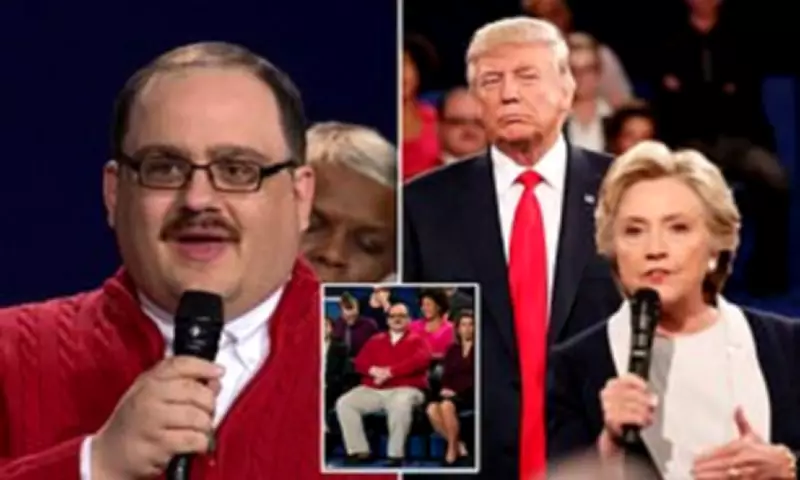
Following the second presidential campaign debate on October 9, 2016, America delivered an unexpected verdict regarding the clear winner. Amid the chaos and bitter exchanges, it was not Donald Trump or Hillary Clinton who captured the nation's attention, but rather an unassuming, bespectacled father wearing a bright red knitted sweater. This ordinary citizen managed to win the hearts of the 67 million viewers by posing a straightforward and sensible question about America's future energy needs.
A Stark Contrast to Political Mudslinging
His avuncular, round-faced appearance and pleasant demeanor provided a refreshing contrast to the vitriolic exchanges occurring on stage. Endearingly, he was later spotted happily taking photographs of the venue with a disposable camera, further cementing his status as a relatable figure in a divisive political climate.
'The Red Sweater Guy' became an overnight internet sensation. Memes featuring his image spread rapidly across social media platforms. CNN declared him 'awesome,' while Jimmy Kimmel appointed him as a special correspondent. Some commentators even suggested he should be president instead of either major candidate. His newfound fame led to invitations to Hollywood premieres, celebrations on Saturday Night Live, and inspired merchandise ranging from T-shirts to themed restaurant menus and even a 'sexy Red Sweater Guy' Halloween costume.

The Man Behind the Sweater
The individual inside the famous red sweater was Ken Bone, then a 34-year-old power plant control room trainer from Belleville, Illinois, a city of approximately 40,000 people located outside St. Louis where the debate took place. He had been selected as one of the 'uncommitted voters' to ask a question, receiving the floor from CNN's Anderson Cooper.
Ten years later, when contacted by the Daily Mail, Bone expressed mild surprise, having long returned to normal life after his whirlwind fifteen minutes of fame subsided. It proved reassuring to discover he still resided in the same house, continued working in a similar role at a power plant, and maintained his polite, common-sense approach to discussing political matters that many candidates across the political spectrum could learn from.
'When I received your email, my initial thought was, 'Oh, I suppose the Daily Mail wants me to subscribe!'' Bone revealed. 'Then I noticed it was an interview request - it nearly caught me off guard.'
Life After Viral Fame
Describing his professional trajectory, Bone explained: 'I began as an operator in the field, progressed to become a control room operator similar to Homer Simpson's character, managing the plant from computers, and eventually became the trainer.'
Beyond the pleasantries, the first noticeable detail during the interview was Bone's attire - he was not wearing the iconic red sweater. The famous knitwear had been sold for charity, raising $10,000 for Greater St. Louis Honor Flight, an organization that facilitates visits for military veterans to Washington DC. The sweater now resides in the New York headquarters of Izod, the mid-range clothing manufacturer that produced it.
Bone does possess a 'knock-off' version purchased from Walmart that he occasionally dons to send humorous pictures to friends. Otherwise, it remains stored in his wardrobe. 'Never,' he stated regarding wearing it publicly. 'I believe it would simply appear as a cry for attention. It would feel almost pathetic, like, 'Hey, remember me? I was somewhat famous for a week ten years ago.''
The Accidental Fashion Choice
Interestingly, the red sweater was not his initial choice for the debate. He had planned to wear an olive suit selected with his grandfather's assistance but split the trousers while entering his car. His wife suggested the red sweater as an alternative. 'The Red Sweater Guy' informed the Daily Mail that neither Donald Trump nor Hillary Clinton adequately addressed his question in 2016, and he would pose the same inquiry again in 2028.
Reflecting on his brief encounter with fame, Bone recalls it as 'tremendous fun.' He utilized his platform to raise tens of thousands of dollars for charitable causes, supported voter registration initiatives, and sold approximately 4,000 T-shirts featuring his likeness.

'I earned about as much money selling T-shirts for a week as I typically make in seven or eight months at the power plant, which was pretty fantastic. That paid off my car and other expenses,' he shared. 'I have one of the T-shirts stored somewhere. It no longer fits me. I think the one we kept for my wife fits her - but she doesn't wear a shirt with my face on it. She can see my face whenever she wishes.'
Lasting Impact and Personal Growth
He still occasionally receives recognition and believes his experience in the spotlight positively influenced his personal development. 'Life has mostly returned to normal now, but I discovered I'm considerably more comfortable expressing myself and meeting new people,' Bone reflected.
'By nature, I'm somewhat introverted. I enjoy spending time alone in quiet settings, and at social gatherings like parties or barbecues, I would typically converse only with the two people I felt comfortable around. However, now I feel much more outgoing because, for several years, people would approach me, introduce themselves, and want to talk and take photographs. I gradually became accustomed to that over time.'
'I believe it genuinely helped me as an individual, broadening my horizons because I encountered numerous people from diverse backgrounds and lifestyles different from my own. It has simply made me, I suppose, a better person, capable of interacting with these individuals.'
Political Evolution and Current Concerns
Before the debate, Bone had merely seven Twitter followers, two of whom were his grandmother following him twice. Afterwards, his phone notifications exploded. He became one of the rare individuals celebrated at both Republican and Democrat events, attending both CPAC, the annual conservative gathering in Washington, and the left-wing Netroots Nation conference in Atlanta.
He can still recite his debate question verbatim: 'What steps will your energy policy take to meet our energy needs while at the same time remaining environmentally friendly and minimizing job loss for fossil power plant workers?'
Bone told the Daily Mail: 'People inquired if I felt nervous. I did not. Reportedly, the most common fear in the United States is public speaking. I don't experience that. I'm afraid of spiders. I'm not afraid of public speaking.'
He believes the question resonated precisely because the answers proved unsatisfactory. 'The Trump and Clinton campaigns had become nasty and hateful,' he observed, 'and then people witness this individual dressed in bright colors, who simply resembles your goofy uncle telling bad jokes at barbecues, possessing a humorous name, appearing somewhat amusing. Let's discuss that for a while instead of the depressing nature of this election.'
'As I walked back to the car, I thought, 'Well, I suppose that was enjoyable. That's concluded.' Then I returned home, and my face appeared on television as they discussed it on CNN. It felt extremely surreal.'
Political Journey Over the Decade
Throughout the past ten years, Bone has undergone his own political evolution. In 2016, he voted for Clinton, though without particular enthusiasm. In 2020, he supported Andrew Yang during the Democratic primary, describing him as 'the only candidate genuinely anticipating future problems.'
'It appears, with as much as he expressed concern about data privacy and artificial intelligence, he identified significant issues, though not everyone listened,' Bone noted. With Yang eliminated, he cast a 'protest vote' for Libertarian candidate Jo Jorgensen in the general election because he remained unconvinced by either Trump or Joe Biden.
Then, in 2024, he voted for Kamala Harris, feeling compelled to return to a major party choice. Currently, he harbors numerous concerns as a voter, including the escalating cost of living.
'My wife and I discuss it every time we visit the grocery store,' he admitted. 'Working in the utility industry represents a solid career. I earn well above the median income, a very comfortable middle-class salary, but it feels slightly diminished each time I shop for groceries. We wonder how individuals near the poverty line, who might not even qualify for assistance, manage to survive?'
Policy Perspectives and Future Hopes
He also criticizes what he describes as 'Trump's private ICE army on the streets' and the healthcare system, now advocating for a form of single-payer care. 'I previously doubted the government could efficiently administer it,' he confessed. 'But then you examine other nations globally and realize we're spending more per capita on healthcare than any other country.'
'Perhaps we should adopt a system somewhat similar to the NHS in the United Kingdom or the Canadian healthcare system. And, if we're truly exceptional, we should be capable of implementing it more effectively.'
He maintains an unambiguous stance on the Iran conflict. 'I detest it,' he stated firmly. 'With the funds we expended on the Iran war, we could have financed countless social programs in the United States, or perhaps contributed slightly less to our national debt.'
'Will the ceasefire even endure? And, if it does, what have we gained? We now have an Iran capable of charging tolls for ships traversing the Strait of Hormuz, which they couldn't previously. We possess no guarantee they'll cease uranium enrichment. We currently have a worse arrangement than under the Iran nuclear deal from the Obama administration that was simply discarded.'
Looking Toward 2028 and Beyond
Looking ahead to the 2028 election, Bone expressed desire for younger candidates to emerge. 'I wouldn't necessarily assert directly that it should be Alexandria Ocasio-Cortez, but I'd appreciate seeing someone with youthful energy. I simply want the public to receive additional choices, and if they reject them, then they reject them.'
Just as he was a decade ago, he remains an uncommitted voter awaiting inspiration. 'Now, I believe I'm still somewhat in the same position where I don't particularly favor either major party,' he acknowledged.
He also advocates for reduced partisanship, arguing that people should feel empowered to criticize their own political affiliations for poor behavior. 'I participated in recreational sports since childhood, and when someone on my team acted foolishly, we weren't hesitant to inform them.'
'I don't understand why we're reluctant to tell our own political affiliates when they're engaging in self-destructive or foolish actions.'
The Unanswered Question and Its Relevance
If invited back to a debate stage in 2028, he confirms he would pose the same energy question again, hoping for a satisfactory response this time. 'We still have numerous individuals working in coal and natural gas utilities wondering, 'Will this facility remain operational indefinitely? Where will I go? What will I do, and how will the grid maintain power if we retire this asset?''
'I believe we require genuine answers to that, especially with all these new large-load data centers being constructed. We must guarantee that average citizens can still afford to operate their heating and air conditioning systems. We need to maintain affordable rates, ensure continuous electricity, prevent rolling blackouts, and simultaneously preserve well-paying blue-collar jobs like those of the individuals I train.'
Brief Political Aspirations and Darker Experiences
Bone briefly considered running for Congress in 2018 but ultimately decided against it. He didn't want to subject his wife and son, now 23, to the publicity scrutiny. His moment in the spotlight also included darker aspects, such as death threats that prompted police and even SWAT team visits to his home searching for explosives.
'Certainly, it was probably all just internet trolls, but authorities must treat it seriously,' he explained. 'Someone contacted the police station claiming, 'I killed Ken Bone, and I'm in his house with a bomb.' Consequently, the SWAT team arrived at my residence. The individual turned out to be approximately a 15-year-old adolescent. I indicated I didn't wish to pursue any action. I'm uncertain what happened to that youth, but it proved extremely frightening. It genuinely makes one hesitant to remain in the public eye.'
'It saddened me but didn't surprise me. I simply understood that's how circumstances unfold - if you gain recognition on the internet, those sorts of incidents occur.'
Final Message to Fellow Americans
Today, his message for fellow Americans remains straightforward. 'First, treat others well, even if they disagree with you. Second, it's acceptable to demand better from your leadership.'
'Additionally, vote. Not solely in presidential elections, not merely in midterms, but vote for your city council representative, vote for dog catcher. Pay attention. When we genuinely focus on issues and communicate with each other, I don't believe we can avoid improvement.'
His post-debate experiences taught him that everyone can contribute to positive change. 'I managed to engage with numerous people, shake many hands, and remind individuals that it's acceptable to become acquainted with other human beings,' he reflected.
'You can interact beyond screens, and we can treat each other respectfully. Then you make the world marginally better, just within a ten-foot radius surrounding you. That accumulates if everyone participates.'