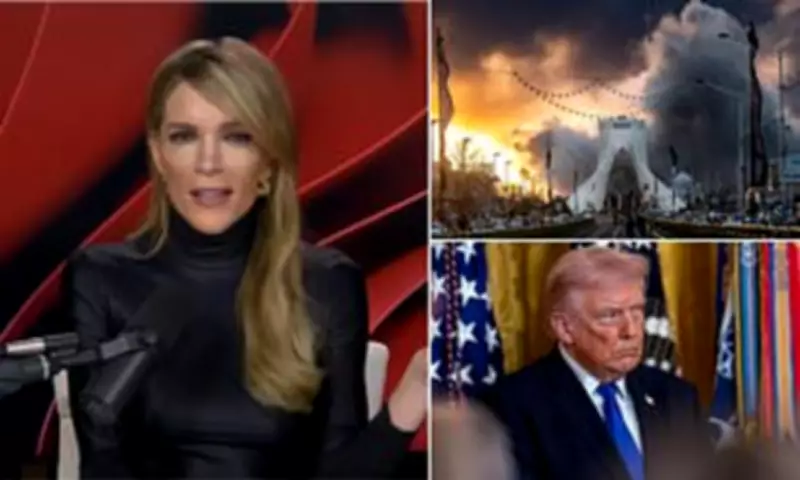
Megyn Kelly Issues Stark Warning Over Trump's Iran Policy
Former Fox News host Megyn Kelly has once again voiced strong criticism of President Donald Trump's decision to launch military strikes against Iran, cautioning that the escalating conflict could significantly erode his support among female voters. Kelly pointed to recent polling data that reveals a sharp partisan divide, with Republicans largely backing the president's actions while independents and Democrats stand firmly opposed.
Gender Divide Emerges in War Sentiment
'What you're seeing now is support falling basically along partisan lines,' Kelly stated during her analysis. 'Republicans, a majority, support the president. Independents and Democrats are totally against the President on this war, which makes some sense.' She emphasized her own position as a registered Independent for over two decades, aligning herself with skeptical voters.
'As I told you yesterday, most of my Republican audience is supporting the president on it, although a lot aren't,' Kelly continued. 'Actually, there's an interesting poll showing it's breaking down more severely along gender lines, where a hefty majority of women are against it, and men are split almost 50/50. There is no question that the American people don't understand why we're doing it.'

Conflict Intensifies Across the Region
Kelly's comments come as the war between the United States, Israel, and Iran enters its fourth day, with military strikes intensifying and retaliation spreading rapidly. President Trump has defended the actions, stressing that crippling Iran's nuclear and military capabilities is essential for U.S. security. He claimed that coordinated U.S. and Israeli strikes have significantly degraded Iran's military infrastructure.
On Tuesday, U.S. and Israeli forces targeted locations across Tehran, sending columns of smoke billowing over the Iranian capital. Local media reported attacks on one of the city's airports and buildings linked to the committee responsible for selecting a new supreme leader, following Ayatollah Ali Khamenei's death in earlier assaults.
Trump Adopts Hardline Stance
President Trump, who had previously signaled openness to diplomatic talks, has now taken a far more aggressive posture. In a social media post, he declared: 'Their air defense, air force, navy, and leadership is gone. They want to talk. I said: 'Too late!'' During a meeting with Germany's chancellor in Washington, Trump noted that 'most of the people we had in mind' as potential successors to Khamenei were now dead after waves of strikes.
He also acknowledged the uncertainties of regime change, stating, 'the worst case would be, we do this, and then somebody takes over who's as bad as the previous person.' Iran has denied seeking negotiations, with its ambassador to the United Nations in Geneva rejecting claims that Tehran approached Washington despite mounting damage.
Regional Escalation and Global Impact
The conflict has quickly expanded beyond Iran's borders. Hezbollah's involvement has forced Israel to expand operations into southern Lebanon, with Defense Minister Israel Katz authorizing troops to 'take control of additional strategic positions.' Iranian drones and missiles have targeted U.S. diplomatic sites across the Gulf, including strikes near the U.S. consulate in Dubai and damage to the embassy in Riyadh.
Qatar reported intercepting missiles aimed at Hamad International Airport, while Oman faced drone attacks on the port of Duqm. In the United Arab Emirates, falling debris from an intercepted drone caused a fire at an oil storage zone. Iran's Revolutionary Guards warned of further escalation, with General Ebrahim Jabbari threatening to hit 'all economic centres in the region' if main Iranian centers were attacked.
Humanitarian and Economic Consequences
Inside Tehran, the atmosphere has turned surreal as the capital, normally home to around 10 million people, has emptied out after authorities urged residents to flee. 'There are so few people that you'd think no one ever lived here,' said Samireh, a 33-year-old nurse. Police and security forces have established checkpoints at major intersections amid ongoing bombardment.

Global markets have reacted sharply to the turmoil, with energy prices surging. QatarEnergy halted LNG production and announced stoppages in downstream output, including urea, polymers, methanol, and aluminum. India warned that disruptions to trade and energy supply chains could have 'serious consequences' for its economy, highlighting the widespread ripple effects of the conflict.