
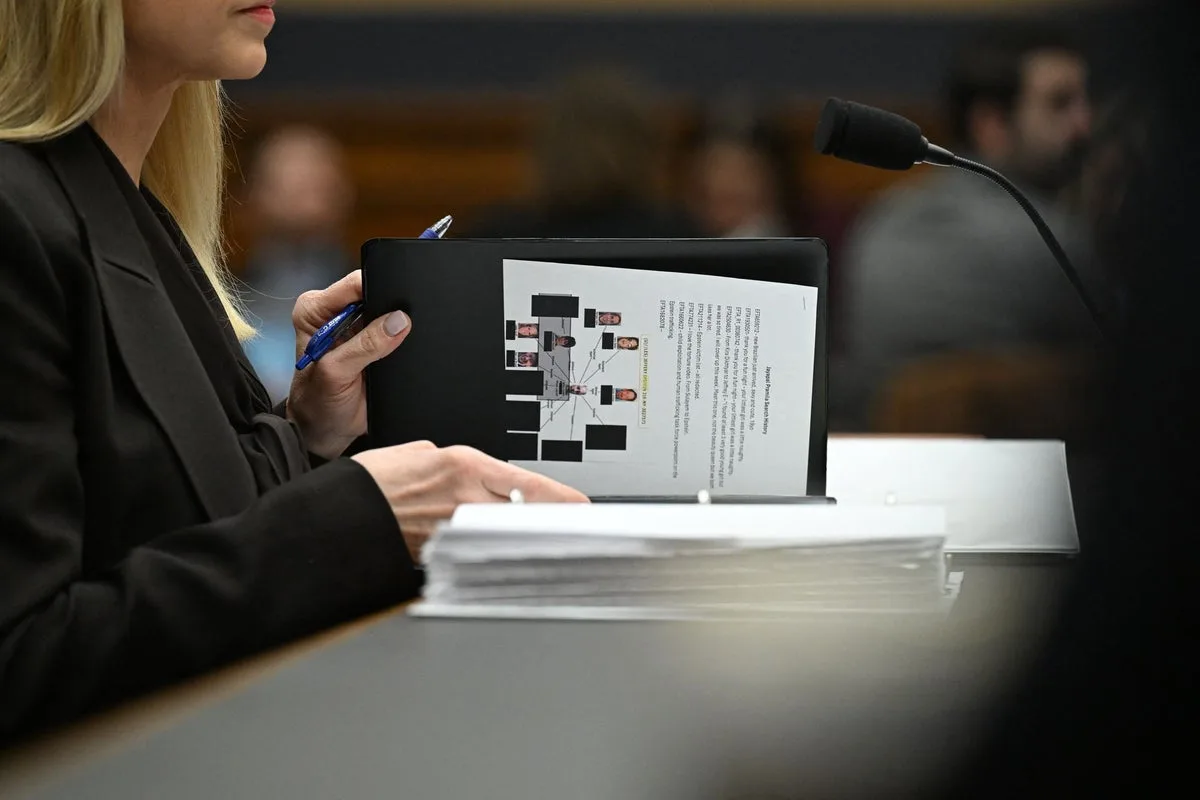
House Speaker Mike Johnson has warned that he is investigating allegations that the Department of Justice under Attorney General Pam Bondi is tracking the search histories of members of Congress who have looked up files related to Jeffrey Epstein. The claims surfaced after a photographer captured an image from Bondi's briefing binder during her testimony before the House Judiciary Committee on Wednesday, which appeared to show a document detailing files searched by Representative Pramila Jayapal on a DOJ computer.
Members of Congress are permitted to access unredacted versions of files related to Epstein, the convicted paedophile and sex trafficker who died by suicide in 2019 while awaiting trial. However, the photograph of Jayapal's apparent search history raised concerns among lawmakers. Johnson told The Independent on Thursday: 'I've heard the allegations I'm looking into that myself. It would obviously be an important line that's crossed, and obviously we can't allow for that.'
The image sparked immediate outrage. Representative Jamie Raskin, the top Democrat on the House Judiciary Committee, said: 'We're out there trying to do our investigative oversight, and they've structured a situation where they're basically spying on our every move. So the attorney general knows what material we've looked at.' He added that he would have liked to know what material Bondi was reviewing before her testimony.
Bondi's appearance before the committee was contentious, with exchanges marked by personal sniping against Democrats. Although she acknowledged survivors of Epstein's abuse in her opening remarks, she did not turn to face them when many stood behind her. The controversy over Epstein files dates back to Bondi's claim on Fox News last year that she had a 'client list' related to Epstein, but the DOJ and FBI later released a memo effectively closing the investigation, stating Epstein likely killed himself and had no such list.
A bipartisan coalition in Congress subsequently forced a vote to release the files, which passed almost unanimously in the House and by unanimous consent in the Senate. Many members have since criticised the heavily redacted nature of the released files, which some say obscure co-conspirators' names or reveal survivors' identities. Representative Deborah Ross of North Carolina said Bondi's tracking of search histories is 'wrong' and has changed her strategy, adding that Bondi is monitoring members 'for the same reason that she has a burn book.'
Democrats noted a contrast with Republican outrage over special counsel Jack Smith's access to phone records during his investigation into President Donald Trump. Senator Lindsey Graham had inserted a provision allowing senators to sue over such searches, though the House later repealed it. Representative Mary Gay Scanlon described the tracking as having 'a chilling factor' and wondered if she could log in under Donald Trump's name. The episode has heightened tensions between Congress and the DOJ over oversight and transparency.




