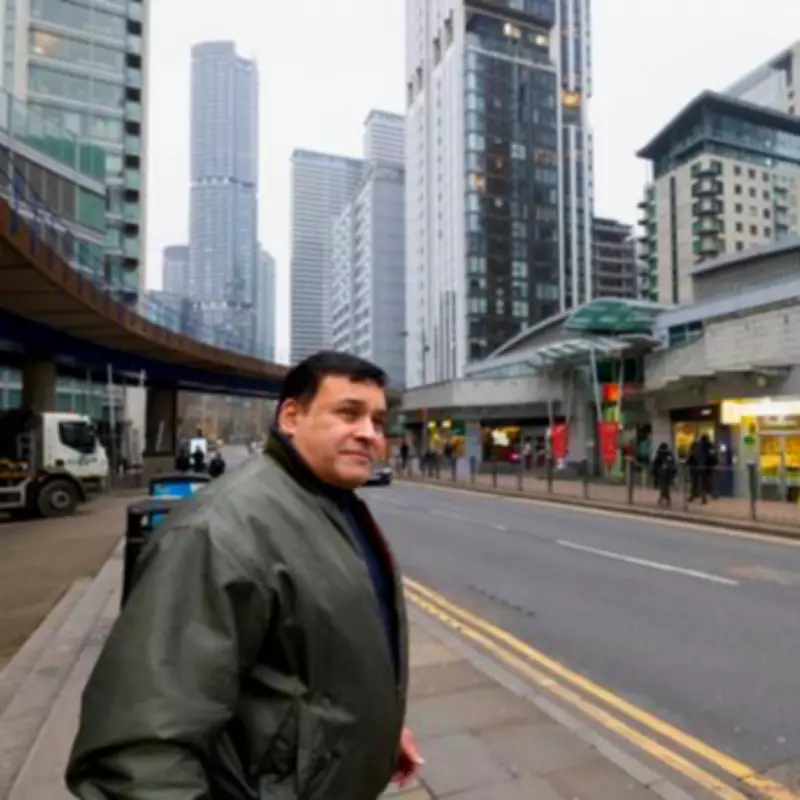
In a remarkable twist of fate, one of the IRA bomb survivors taking legal action against Gerry Adams in a landmark court case is a proud Irishman with direct family ties to republican legend Eamon de Valera. Jonathan Ganesh, who was severely injured in the 1996 London Docklands bombing, is preparing to face Adams in the Royal Courts of Justice this week, seeking justice rather than financial compensation.
Historic Legal Battle Over IRA Leadership
The unprecedented court proceedings will examine whether Gerry Adams, the former Sinn Féin president, was ever a member of the IRA and exercised command and control within the organization during the turbulent periods of the 1970s and 1990s. Adams is being sued for a nominal £1 in what promises to be a highly charged legal confrontation that will see him appear in an English courtroom for the very first time.
Family Connection to Republican History
In an extraordinary revelation, it has emerged that Jonathan Ganesh's great aunt was the mother of Eamon de Valera, one of the towering figures of Irish republicanism who played a pivotal role in leading the 1916 Easter Rising against British rule and later served as President of Ireland. This family connection adds profound historical resonance to Ganesh's legal battle against the man he believes bears responsibility for IRA atrocities.
"I'm actually related to Eamon de Valera," Mr. Ganesh stated emphatically. "That's the sort of person the IRA tried to kill with one of their bombs. They attempted to murder an Irish relative of the Republican legend who bravely participated in the leadership of the Easter Uprising. How misguided and contradictory is that?"
Personal Background and Motivation
Jonathan Ganesh, 53, from east London, is an Irish citizen who holds an Irish passport and spent his early childhood in Bruree, County Limerick. A devout Catholic who once received a personal blessing from the Pope in Rome, Ganesh represents what he describes as Adams' "worst nightmare" - an Irishman seeking accountability for violence perpetrated in the name of Irish republicanism.
"Gerry Adams won't want to meet me," Ganesh declared. "In a way you could say I'm his worst nightmare. I'm an Irish citizen, I'm an Irish passport holder, my mum and all her family were Irish. I went to school and grew up in the village of Bruree in County Limerick. I lived there from the age of one to six. It was my home."
The Docklands Bombing and Its Aftermath
The 1996 IRA Docklands bomb attack left Jonathan Ganesh with life-changing injuries while claiming the lives of his friends Inam Bashir, 29, and John "JJ" Jeffries, 31. Now, nearly three decades later, Ganesh joins two other bombing survivors - John Clark, injured in the 1973 Old Bailey explosion, and Barry Laycock, a victim of the 1996 Arndale Centre bombing in Manchester - in pursuing legal action against Adams.
Legal Proceedings and Expected Testimony
The trial, expected to last seven days, will be heard by Mr. Justice Soole without a jury. According to Matt Jury, solicitor for the three complainants, "Finally, after five decades, Adams, for the first time, will appear in person in an English court to be cross-examined by the victims of his alleged leadership of the IRA's terror campaign."
Adams' spokesperson has characterized the case as unfolding in a "febrile political atmosphere" and noted that it comes "decades after the incidents took place and decades after the Good Friday agreement." The defense anticipates testimony from former British Army and intelligence services witnesses who maintain that Adams was a senior republican figure who must bear responsibility for specific violent events.
Broader Political Context
The spokesperson further suggested that "some veterans of the British Army and security services remain deeply hostile to republicans, to Sinn Féin, and to Mr. Adams personally" and view republicans as "the enemy they failed to defeat, rather than people with whom they can build a shared and peaceful future."
Jonathan Ganesh remains resolute in his pursuit of justice, describing Gerry Adams as "a highly dangerous man" who is "very cunning" and "highly intelligent." He referenced the adage that "The bigger the lie the more people believe it" and suggested this principle applies directly to Adams' public persona and political career.
This historic legal confrontation represents more than just a personal quest for accountability - it symbolizes the complex, often contradictory nature of Irish republicanism, where a relative of one of its founding fathers seeks justice from a man accused of perpetuating violence in that same political tradition's name.