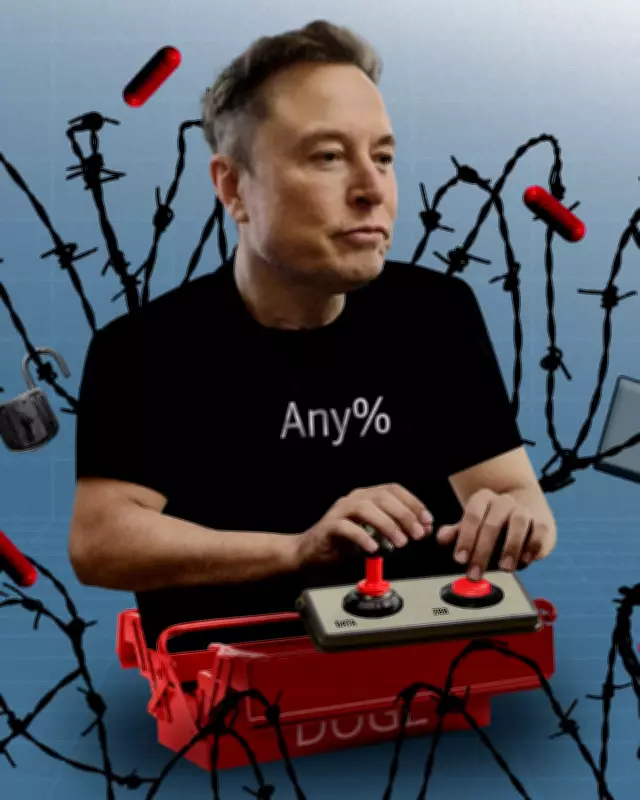
Elon Musk's Doge Initiative: A Gamified Overhaul of US Government
In 2025, Elon Musk assumed a de facto leadership role in a newly formed "department of government efficiency," branding governments as inefficient "big dumb machines." He explained to Senator Ted Cruz that reconciling databases and eliminating waste required direct intervention in computer systems. This marked the advent of Muskism in Washington, a movement steeped in memes, adolescent boasts, and a ruthless approach to bureaucratic reform.
The Birth of Doge: Memes Meet Governance
Doge, named after the popular Shiba Inu meme and its associated cryptocurrency, was launched via an executive order on January 20, 2025. Its stated goal was to modernize federal technology and software to boost governmental efficiency and productivity. Musk, calling himself the "Dogefather," led a team of teenage coders and mid-level managers from his companies, aiming to rewrite regulations and budgets from within the government's codebase.
He envisioned dragging the paper-pushing bureaucracy into the digital age by scanning filing cabinets and integrating data into a single interoperable system. This undertaking blended private equity restructuring with startup management, infused with gaming culture and rightwing ideology. To succeed, Musk believed he needed "God mode"—a comprehensive overview of the entire governmental apparatus.

Gaming Principles and Surveillance Expansion
Musk's office featured a gaming rig with an oversized curved screen, and the Doge website included a leaderboard to track budget cuts in real time. Beneath the playful exterior lay a serious conviction: viewing the state as a database where inefficiencies stemmed from bad data, such as undocumented immigrants or "ghost employees." These were seen as bugs to be quarantined and purged.
Over time, Doge's reality shifted toward strengthening state surveillance capacities. Musk had grown convinced that people, particularly non-white immigrants, were the real flaws in the system—pawns in what he termed a liberal scheme fueled by "suicidal empathy." He framed empathy as a software exploit, a vulnerability requiring hardening against humanitarian sentiment.
Speedrunning and Zero-Based Budgeting
Musk described Doge as a "speedrun" to fix the federal government, drawing parallels to video games where players complete tasks as fast as possible, often using glitches. This aligned with his managerial style, prioritizing speed through unrealistic deadlines. In practice, Doge operatives quickly accessed systems like the US Office of Personnel Management, taking files on millions of federal workers and sending mass emails urging resignations.
The initiative embraced zero-based budgeting (ZBB), requiring departments to justify every expense anew, aided by AI tools. While touted for cutting costs, ZBB primarily concentrated power, assuming all expenditures were wasteful. Agencies like USAID were dissolved, with Musk referring to the process as feeding them into "the wood chipper."
Data Integration and AI Deployment
Doge pursued unprecedented data integration, aiming to pool all government information into a single repository. This eliminated privacy guardrails, with silos seen as obstacles rather than safeguards. Partnering with Palantir, which received over $113 million in contracts, Doge worked on projects like a "master database" to track immigrants by combining records from Homeland Security, the IRS, and other agencies.
AI played a central role, with tools deployed to cancel contracts, identify diversity language in policies, and automate deregulation. The "Doge AI Deregulation Decision Tool" promised to cut 100,000 regulations in six months, analyzing public comments instantly. This shift toward governance by AI treated the state as executable code, blurring lines between efficiency drives and political agendas.

Nativism and the "Matrix" Analogy
Musk's rhetoric often merged coding concepts with nativist politics. He falsely claimed borders were open, asylum seekers were unvetted, and undocumented immigrants could vote, promoting anti-immigrant conspiracies that garnered billions of views online. Doge's data integration efforts accelerated mass deportations, aligning with Trump administration policies like adding individuals to social security death files to force "self-deportation."
Musk framed his mission as "reprogramming the matrix," inspired by The Matrix film, where taking the "red pill" means seeing through societal illusions. Unlike manosphere figures who seek to escape the matrix, Musk aimed to build a better one, applying gaming logic to governance. He posted images of himself as Neo from the movie, symbolizing his fight against what he called the "woke parasite in the government."
Legacy and Limits of Muskism
Musk left Doge after a 130-day tenure, with the project claiming $170 billion in savings—a figure largely unverified. His popularity and Tesla sales plummeted as Americans feared cuts to social security and Medicare. Doge exposed the limits of treating society like a factory, highlighting that humans are not programmable units and public sectors provide essential goods markets ignore.
Structurally, Doge embedded contractors like Palantir deeper into government, expanding domestic surveillance capacities. Musk's companies continued securing defense contracts, such as xAI's "Grok for Government" AI suite for the Pentagon. By 2026, themes of Muskism persisted, with AI deployed on military networks and gaming aesthetics blending with real-world governance, erasing lines between digital and political power.
In summary, Doge represented a bold but flawed experiment in gamifying government, revealing both the allure and dangers of applying Silicon Valley logic to democratic institutions.