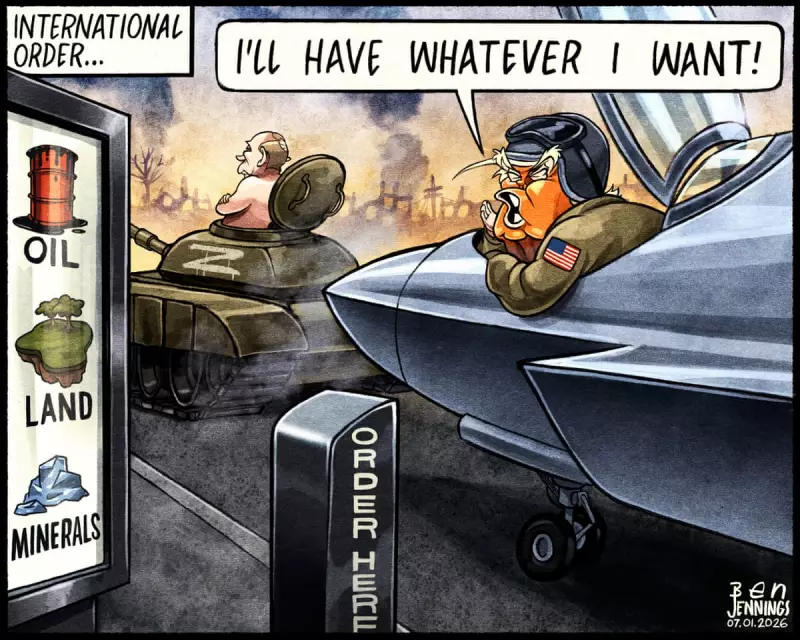
A powerful new editorial cartoon by the acclaimed British satirist Ben Jennings has captured the global political zeitgeist, offering a stark visual critique of former US President Donald Trump's perceived attitude towards international law and order.
The Cartoon's Stark Imagery
Published on Monday, 6th January 2026, the cartoon presents a characteristically defiant Donald Trump figure. The central image is a potent symbol of his approach to global diplomacy and legal frameworks. Jennings, renowned for his sharp and incisive commentary in publications like The Guardian, uses his art to distill complex geopolitical tensions into a single, unforgettable frame.
The artwork moves beyond mere caricature to deliver a pointed statement about power, accountability, and the rules-based international system. It visually encapsulates a political philosophy that has frequently placed Donald Trump at odds with traditional allies and multilateral institutions.

A Commentary on Power and Norms
While the cartoon does not reference a specific contemporary event, its publication date in early 2026 suggests it serves as a broader commentary on Trump's enduring political legacy and ongoing influence. The piece engages with themes that have defined his political career: a populist challenge to established elites, a transactional view of foreign policy, and a sceptical stance towards binding international agreements.
Jennings' work implicitly questions the sturdiness of international law and diplomatic norms when confronted by a figure who has consistently portrayed them as constraints on national sovereignty rather than pillars of global stability. The cartoon's power lies in its ability to provoke discussion about the resilience of these systems in an era of resurgent nationalist politics.
The Role of Political Satire
This illustration stands as a prime example of how political cartoonists act as vital commentators and critics. Ben Jennings employs visual metaphor and satire not just to mock, but to analyse and challenge. In an age of dense political reporting and complex legal arguments, a successful cartoon can cut through the noise and frame the debate in universally understandable terms.
The publication of this cartoon in The Guardian's Comment is Free section underscores its role as a form of argument and opinion, using artistry to make a persuasive point about a world figure whose actions continue to shape global politics. It serves as a cultural artefact, reflecting widespread anxieties and debates about the future of international cooperation and the rule of law.
Ultimately, Jennings' creation is more than just a drawing of a politician; it is a sophisticated critique of an ideology. It challenges viewers to consider the consequences when a major global power is led by someone perceived to hold the foundational rules of the international community in contempt.