

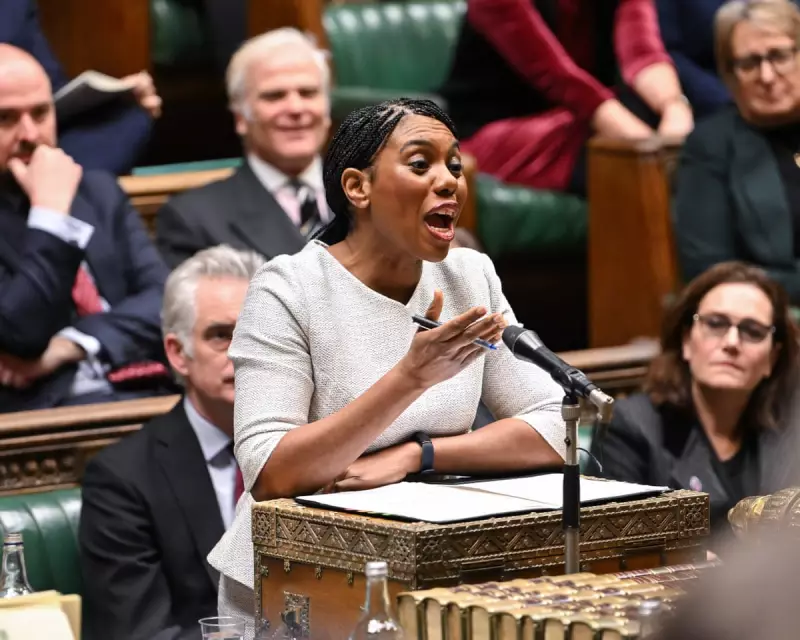
Badenoch's PMQs Performance Criticised for Trump Alignment on Chagos
In a prime minister's questions session that highlighted deepening political divisions, Conservative leader Kemi Badenoch faced sharp criticism for her approach towards Labour counterpart Keir Starmer. Observers noted that Badenoch appeared unable to resist taking what many described as a cheap shot at the opposition leader, particularly when she invoked Donald Trump's position on the Chagos Islands dispute.
A Departure from Bipartisan Tradition
The session began with what appeared to be rare common ground between the two leaders, as both agreed that Greenland's future should be determined solely by Greenlanders and Denmark. This moment of consensus recalled previous instances when Starmer, during Labour's time in opposition, had demonstrated willingness to support the government on matters of national importance, such as during critical moments of the Ukraine conflict under Boris Johnson's leadership.
However, this bipartisan spirit proved short-lived. Badenoch quickly pivoted to challenge Starmer on what she portrayed as inconsistency regarding self-determination principles. "If Starmer believes in self-determination for Greenland," she questioned, "how come he doesn't extend the same rights to the Chagossians?"

Trump's Changing Position Becomes Political Fodder
What made Badenoch's line of attack particularly controversial was her alignment with Donald Trump's recently expressed views on the UK-Mauritius agreement regarding Chagos. The US president had reportedly criticised the deal, despite having given it his approval just nine months earlier.
Political analysts noted the inherent risk in Badenoch's strategy. "Almost everyone who hitches their wagon to something the US president has said gets burned sooner or later," observed one commentator, referencing Trump's notorious unpredictability on foreign policy matters.
Starmer responded forcefully, accusing Badenoch of lacking judgment by supporting "an out-of-control US president who was hellbent on destroying Nato and Europe." He suggested Trump was merely using the Chagos issue as a wedge after failing to achieve his objectives regarding Greenland.
Questionable Policy Consistency
Critics pointed out that Badenoch's sudden concern for Chagossian self-determination represented a significant departure from longstanding Conservative policy. For over fifty years, the Tory party had not prioritised this issue, raising questions about whether the intervention represented genuine policy development or opportunistic point-scoring.
The practicalities of Badenoch's position also came under scrutiny. As Starmer noted during the exchange, most Chagos Islands apart from Diego Garcia remain uninhabitable, and the United States shows no indication of relinquishing its strategic military base on that island to facilitate any potential return of displaced islanders.
Broader Leadership Questions Emerge
The Chagos exchange proved to be just one element of a difficult PMQs session for the Conservative leader. Badenoch attempted to shift focus to Starmer's handling of Chinese embassy matters, but found herself defending her own leadership record instead.
Starmer highlighted what he characterised as a pattern of questionable decisions, including:
- Her alignment with Trump on Chagos
- Her previous support for Liz Truss's controversial budget
- Ongoing defections from Conservative ranks
The session concluded with Starmer delivering what many considered his strongest rebuke yet of Trump's foreign policy approach, while maintaining that the UK must continue engaging with the US administration despite its unpredictability, particularly given ongoing security concerns in Ukraine.
As parliamentarians dispersed, the consensus among political observers was that Badenoch's attempt to score quick points through alignment with Trump's latest position had backfired, raising broader questions about judgment and strategic thinking at the highest levels of British politics.






