Arizona Governor Rejects Charlie Kirk Memorial License Plate Proposal
Arizona's Democratic Governor Katie Hobbs has vetoed legislation that would have created a specialty license plate honoring the late right-wing commentator Charlie Kirk, stating that the proposal does not "bring people together." The decision has sparked significant controversy among Republican lawmakers who have condemned it as an act of partisan politics.
Governor's Statement on Political Violence
In a statement released on Friday, Governor Hobbs addressed the tragic assassination of Charlie Kirk, who was shot and killed while speaking at an event on the Utah Valley University campus on September 10, 2026. "Charlie Kirk's assassination is tragic and a horrifying act of violence. In America, we resolve our political differences at the ballot box," Hobbs said. She emphasized that political violence, regardless of its target, endangers everyone and undermines democratic institutions.
Hobbs further explained her veto by stating, "I will continue working toward solutions that bring people together, but this bill falls short of that standard by inserting politics into a function of government that should remain nonpartisan." Kirk, a co-founder of Turning Point USA (TPUSA), resided in Arizona with his wife, Erika Kirk, and their children. Following his death, Erika Kirk assumed the role of CEO at TPUSA, pledging to continue her husband's legacy.
Details of the Proposed License Plate
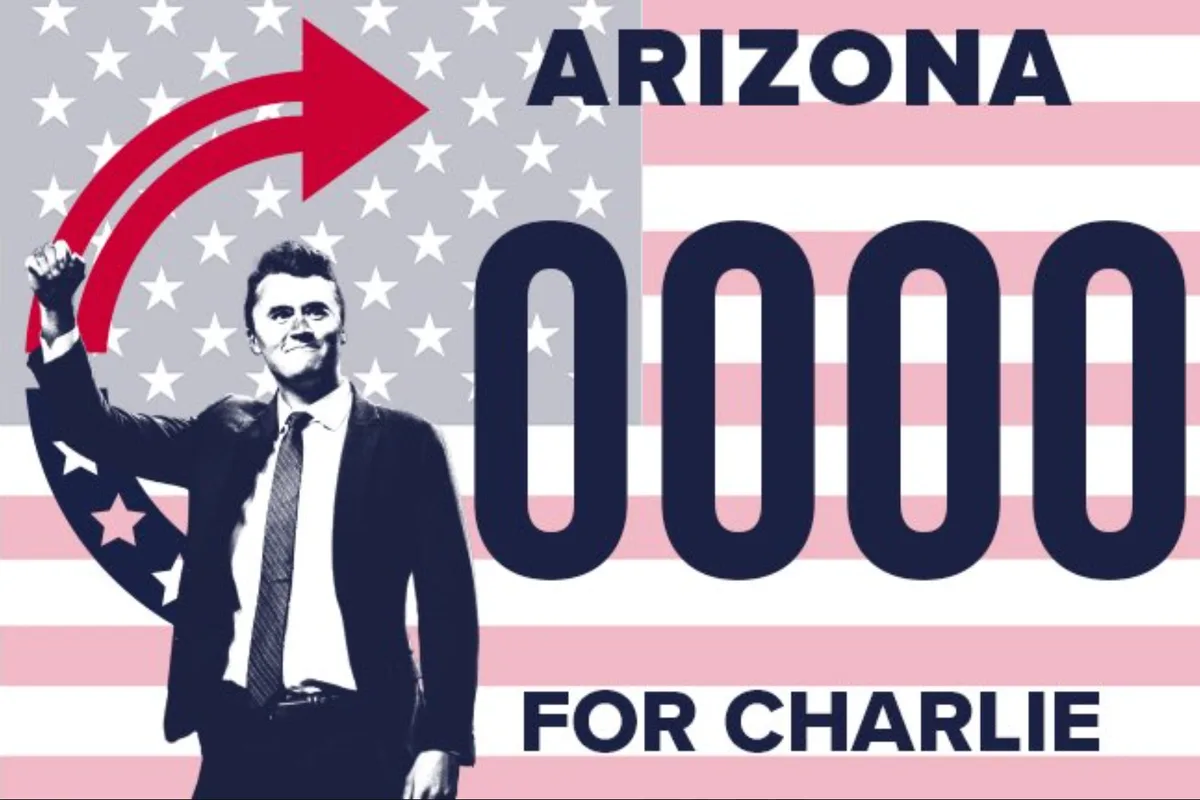
The proposed "Charlie Kirk memorial" license plate, outlined in legislation SB 1439, featured a photograph of Kirk with his fist raised alongside the TPUSA logo against the backdrop of an American flag. The phrase "For Charlie" was positioned below the license number. The bill aimed to authorize an optional specialty plate to recognize Kirk and support civic engagement efforts.
According to the legislation, the plate would have cost $25, with $17 designated as an annual donation to the Conservative Grassroots Network Special Plate Fund. While the specific recipient of the fund was not named in the bill, it stipulated that funds must go to a non-profit organization founded in 2012 that focuses on restoring traditional values, maintains a grassroots activist network on high school and college campuses, and assists college students with voter registration and absentee ballots. TPUSA, founded by Kirk in 2012, aligns with these criteria.
Republican Outrage and Broader Memorial Efforts
Governor Hobbs' veto has provoked strong reactions from Republican legislators, who have labeled it "grotesque partisanship." Arizona Senator Jake Hoffman, a co-sponsor of the bill, criticized Hobbs in a written statement, accusing her of lacking human decency and allowing far-left extremism to overshadow the opportunity to honor a constituent assassinated for defending the First Amendment. Hoffman asserted that Hobbs would be remembered as a stain on Arizona's history.
This specialty plate is not the only memorial initiative for Kirk across the United States. In Florida, several roads have been renamed in his honor, including "Charlie Kirk Memorial Avenue" in Miami-Dade County and "Charlie Kirk Memorial Highway" in Collier County, the latter designated as a memorial. Additionally, the Florida House recently passed a bill establishing October 14 as Charlie Kirk Day annually.
Other states, such as Tennessee and Oklahoma, have introduced legislation to construct memorial plazas dedicated to Kirk. For instance, Tennessee's HB 2025 proposes that every public university in the state erect a 40-by-40-foot courtyard to promote civil discourse. These courtyards would display historical documents like the Bill of Rights, the Declaration of Independence, the Tennessee Constitution, and the Ten Commandments, along with Kirk's name and date of death.
The debate over these memorials highlights ongoing tensions in American politics, particularly regarding how to commemorate polarizing figures while fostering unity in a divided climate.