Trump's 'Midas Touch': A Year of Gold Leaf and Demolition at the White House
Trump's Gilded White House Makeover After One Year

One year after his return to the presidency, Donald Trump has left an indelible, glittering mark on the White House, drawing comparisons to the mythical King Midas for his prolific use of gold leaf and a maximalist design ethos. His tenure has been defined not just by policy but by a sweeping physical transformation of America's most famous residence, an effort that has extended from lavish interior redesigns to the controversial demolition of a historic wing.

The Oval Office's Gilded Transformation

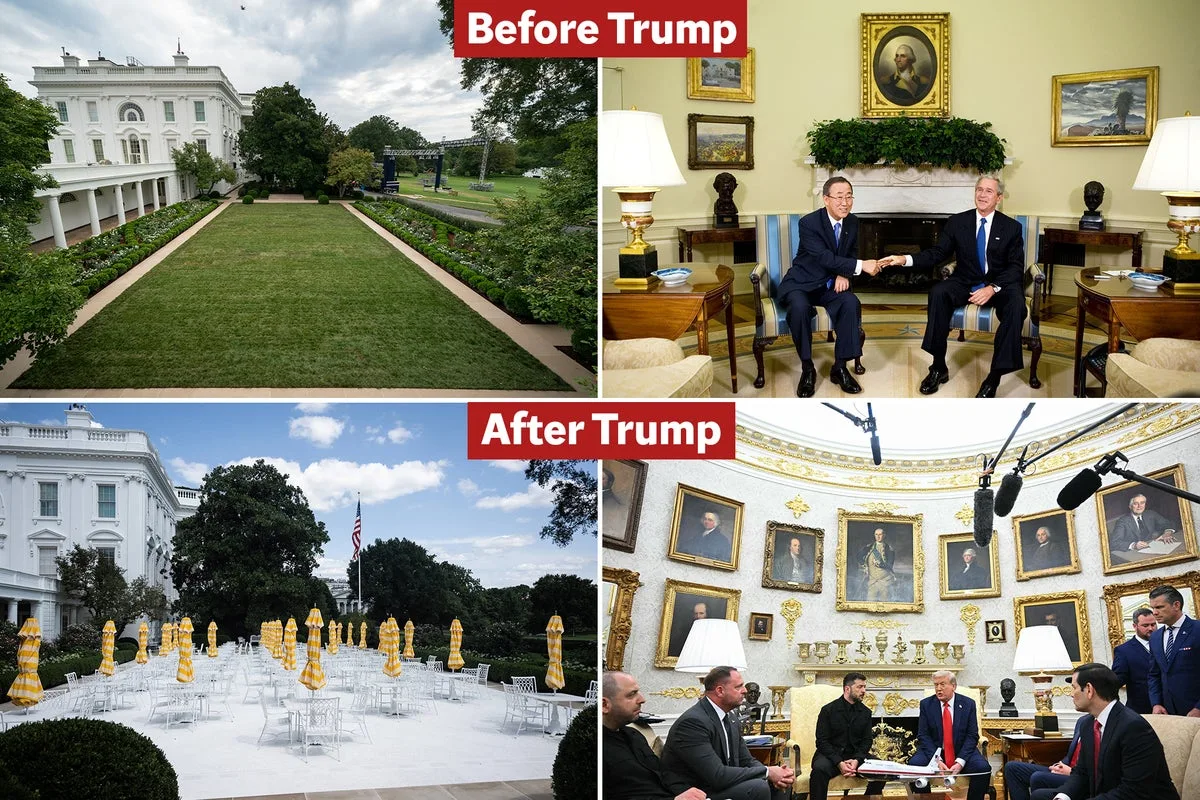
Since its construction over a century ago, the Oval Office has been a symbol of presidential power, with each occupant adding personal touches. However, Trump's approach has been unprecedented in its scale and opulence. Following the hurried transition in January 2026, the room was swiftly returned to its prior state under Trump, with the taupe rug used during his first term replacing Joe Biden's blue one and the flags of all five U.S. military branches reinstated.

But the changes soon escalated. Pure gold leaf paint, reportedly paid for by the president himself, began appearing on doorways, crown moulding, and even the Great Seal on the ceiling. The precious metal spread like ivy across the room's surfaces. Picture frames multiplied, including one holding a centuries-old copy of the Declaration of Independence, hung despite preservation warnings from the National Archives.

An analysis by the New York Times found that roughly 33 percent of the Oval Office's walls, doorways, moulding, and ceiling is now covered in gold. The work is attributed to Florida-based craftsman John Icart, whom Trump calls his "gold guy." The room's new aesthetic, heavy on gilded appliqués, statuettes from Mar-a-Lago, and numerous flags, marks a stark departure from the more spartan, utilitarian style favoured by previous presidents.

Beyond the Oval: Flags, Patios, and a 'Walk of Fame'

Trump's redesign ambitions were not confined to his workspace. In June 2025, he oversaw the installation of two 100-foot flagpoles on the North and South Lawns, flying massive American flags. Two months later, he ordered contractors to dig up the iconic Rose Garden lawn, a fixture since the Kennedy administration, replacing it with a white stone patio complete with tables and umbrellas reminiscent of his Mar-a-Lago club.

He has since hosted partisan allies at the space, dubbing it the "Rose Garden Club." Adjacent to it, on the colonnade leading to the West Wing, Trump installed what he calls the "Presidential Walk of Fame." This features photos of all his predecessors, with plaques detailing their records—often in demeaning and partisan terms for recent Democrats. Notably, a portrait of Joe Biden was omitted, replaced by a photograph of an autopen signing his signature.

The East Wing Demolition and 'Ethics Nightmare' Ballroom

The most dramatic alteration, however, lies on the opposite side of the 18-acre complex. Contrary to initial assurances from Press Secretary Karoline Leavitt and Trump himself, the historic East Wing—built in 1902 and expanded in 1942—was completely razed to the ground in late 2025. The demolition made way for a planned 90,000-square-foot ballroom, a project that has sparked legal and ethical controversy.

The $400 million structure is being funded by corporate entities and GOP donors, including tech giants like Amazon, Apple, Google, and Microsoft, as well as cryptocurrency firms and other corporate interests. Richard Painter, George W. Bush's chief ethics lawyer, labelled the fundraising an "ethics nightmare," stating it leverages access to the White House. The National Trust for Historic Preservation filed a lawsuit, arguing the White House bypassed legally mandated reviews before demolition.

Administration renderings suggest the new ballroom, which could dwarf the White House itself, will continue the president's favoured aesthetic, promising yet more lavish, gilded interiors. As Trump's second term continues, the physical legacy of his "decorator-in-chief" role appears set to be as contentious and eye-catching as his political one.