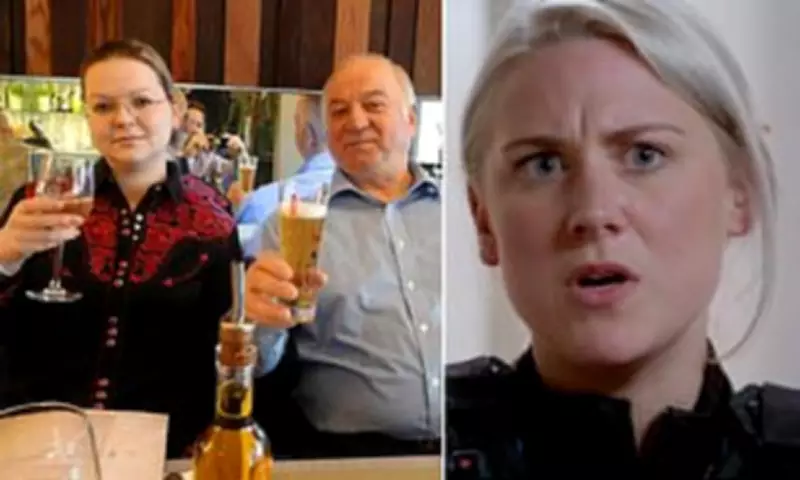
The first police officers on the scene of the Salisbury poisonings have described the dramatic moment they found Sergei and Yulia Skripal slumped on a park bench. The former Russian spy, his daughter, and police officer Nick Bailey were poisoned with military-grade nerve agent Novichok in an attempted murder in March 2018. They survived, but Dawn Sturgess, 44, died that July after being exposed to the chemical weapon left in a discarded perfume bottle in Amesbury, Wiltshire.
Now, a new Channel 4 documentary has revealed the first 999 call made by a man who found the Skripals unconscious and what police officers witnessed soon after. In a clip from 'Salisbury Poisonings: The Untold Story' exclusively shared with the Daily Mail today, PC Alex Collins said: 'We were the first police officers at the scene. The first thing I saw was a white female aged in her 30s. She looked like she was fitting. She had gritted teeth, a lot of saliva coming out of her mouth.'
PC Alexandra Way added: 'I noticed a male in his 60s on the bench sat upright with his hands sort of here and he was rigid. His pupils were tiny, they were like pinpricks. I was thinking, what's happened, who are these people? I checked his trouser pocket and found a wallet which had a driving licence. His name was Sergei Skripal.'

The 999 call is also featured in the programme, which begins with a man telling the call handler: 'Can I get police officers and an ambulance to The Maltings please?' Asked by the handler what has happened, the man replies: 'There are two people on the bench. He is very upset but not saying anything and she looks semi-conscious.' The man confirms he is in Salisbury, as another voice is heard saying: 'Do you speak English, are you OK, sir?' The man then pleads: 'We need urgent medical help.'
The documentary hears from several key figures in the investigation who have never spoken and also looks into the full scale of the attack, which is claimed to have had the potential to kill more than 10,000 people if the threat had not been contained. Among those interviewed is Neil Basu, who was the head of Counter Terrorism Police leading the investigation into the poisoning and became the public face of the probe. He recalled a comment made by a senior government member in a Cobra meeting – who is not named – in response to false reports about Ms Sturgess's background. Mr Basu said the politician claimed that the government did not need to worry too much about a press backlash over this because 'at least she's a drug addict'. Mr Basu described the comment as the most shocking and callous thing he has ever heard from a senior official in his working life.
Also in the series is Detective Superintendent Ben Mant of Wiltshire Police, the first officer at the scene of the poisoning. Mr Bailey accompanied him and came into contact with Novichok when he opened the front door of the Skripals' house. Mr Bailey received treatment in intensive care following the poisoning, and DS Mant talks about his sense of guilt and how the experience changed his colleague's life. A further interview comes from Group Captain Jason 'Chez' Davies, a senior military officer in the Royal Air Force who ran a unit specialising in defending against chemical warfare, the '20 Wing'. His team were responsible for decontaminating crime scenes, and he describes how surreal it was to work in a normal UK city having previously worked in war zones.
Professor Tim Atkins, chief scientist at the UK's Defence Science and Technology Laboratory, led the scientific response and also explains his involvement. He first identified Novichok then ran analysis into thousands of samples to trace contamination across the city, and talks about the work by Porton Down. Another figure in the documentary is Dr Stephen Jukes, an intensive care consultant at Salisbury District Hospital who looked after Ms Sturgess who later died. He talks about having to operate - without any guidance - a Novichok detecting machine left by Porton Down that confirmed Ms Sturgess had been infected.

Last December, an independent inquiry concluded that Russian President Vladimir Putin was 'astonishingly reckless' and bears 'moral responsibility' for the death of Ms Sturgess. The Skripals and Mr Bailey were harmed when members of a Russian GRU military intelligence squad smeared the nerve agent on Mr Skripal's door handle in a 'public demonstration of Russian power'. In the Dawn Sturgess Inquiry's final report, chairman Lord Hughes of Ombersley concluded that the attempted assassination of Mr Skripal 'must have been authorised at the highest level, by President Putin'. The chairman of the inquiry, which cost £8.3 million, said GRU agents Alexander Petrov, Ruslan Boshirov, and Sergey Fedotov were 'acting on instructions' when they carried out the attack. The pair gave an interview with Russian state media in which they said they were only in the UK, briefly, to visit Salisbury Cathedral. The chairman rejected the claims made by the pair that they were visiting Salisbury as tourists, describing the interview as 'not credible'.
The Skripals fell ill on the afternoon of March 4, 2018 after eating lunch at a branch of Zizzi in Salisbury. They were showing symptoms consistent with both nerve agent poisoning or organophosphate poisoning and an opiate overdose. Paramedics treated Mr Skripal with an anti-opioid drug, which had no effect. The inquiry previously heard 87 people were admitted to A&E after the Novichok was discarded in a Nina Ricci perfume bottle. Russia has previously denied any involvement in the attack on the Skripals. 'Salisbury Poisonings: The Untold Story' airs on Channel 4 at 9pm tomorrow.