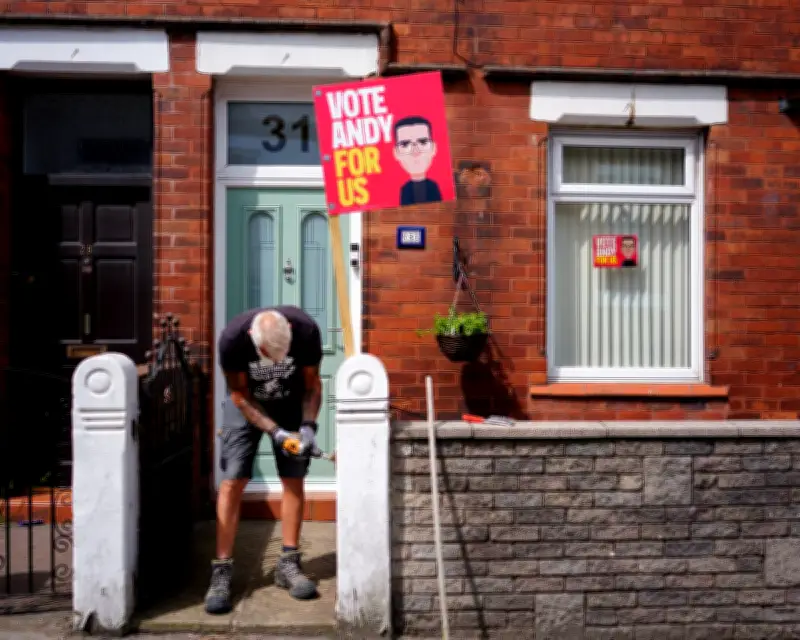
Tactical voting could be fundamental to a Labour victory in Makerfield, with Green and Liberal Democrat supporters willing to back Andy Burnham to stop Reform UK from winning.
Conversely, Reform’s main competitor for votes on the right is Rupert Lowe’s Restore Britain party. Polling experts have said current data suggests the size of their vote share is roughly similar to Labour’s poll lead.
But while left-leaning voters were willing to lend their vote to Burnham, Restore Britain voters appeared to be less willing to support Robert Kenyon, Reform’s candidate.

The Guardian also found Green voters in the constituency were willing to back Burnham, while recent polling by Opinium found that more than half of those who said they would vote Green or Lib Dem in a general election, “if it was held tomorrow”, were planning to vote for Burnham in the byelection.
In contrast, the polling found that only about a third of those who said they would vote Restore in a general election were willing to switch their vote.
At the last general election, in July 2024, the Lib Dems won 7% of the vote, and the Greens 4.5%, which combined is significantly more than Andy Burnham’s narrow poll lead.
In May’s council election in Wigan, the Greens won 10.5% and Lib Dems 3.5%. Voting intention for the byelection gives figures of less than 1% and less than 2% respectively.
In contrast, the polling for Opinium put Restore on 6.5%, having not stood in either the general election or the Wigan council elections.
Rob Ford, a professor of political science at the University of Manchester, said: “In Makerfield, all of the other parties are so far out of contention that the tactical logic here is stark.
“You’re not going to get a Green MP in Makerfield, you’re not going to get a Lib Dem MP in Makerfield,” he said. “So it’s really obvious what you’ve got to do.”
Burnham “clearly is popular” in Manchester, “so I’d have to say on balance, polling, context of the race, nature of the candidates, you’d think it’s advantage Andy at this point,” he added. “But not in the bag by any means.”
On the Restore side, Ford said: “Their campaign is like the opposite of tactical voting.
“It is explicitly focused on splitting off Reform voters and mobilising people who are really far right and discontented with Reform.”
He said: “The tactical voting logic is very obvious that they shouldn’t do that, but clearly there are some Reform voters who aren’t necessarily enamoured of a bunch of conservative defectors coming in.
“And perhaps the idea that Reform are just part of the same establishment, they’re not going to respond to you, might be a more resonant message in a seat like Makerfield.”
He cautioned that voting blocks “are not like Lego blocks” and that you cannot necessarily add them together to draw conclusions.
Rather than necessarily backing Reform, Restore voters “might well just refuse to vote if there wasn’t a Restore option available”, which he suggested may be “one of the reasons the tactical squeeze isn’t working so well on the right”.
The Opinium research was carried out on behalf of Forward Democracy, which runs the tactical voting website www.StopReformUK.vote, and has written to hundreds of its subscribers in the constituency.
“These figures confirm what we’ve long argued,” said Tom de Grunwald, the founder of Forward Democracy. “Tactical voting works, and it’s happening in Makerfield.”
He added: “Our polling shows progressive voters are not waiting to be told. Green and Lib Dem supporters are already lending their votes to Andy Burnham in large numbers, recognising that a split progressive vote could let Reform UK in through the back door.”
The situation is in stark contrast to the last parliamentary byelection in Gorton and Denton, where both Labour and the Greens put themselves forward as the party to stop Reform.
The seat was ultimately won fairly comfortably by the Greens, despite apparent widespread tactical voting.
Separately, research from the Social Market Foundation found that the share of local Facebook posts classified as misinformation had increased fourfold during the campaign.

The SMF analysed more than 1,800 posts across four local Facebook groups, representing different towns and settlements within the constituency, with 66,000 members across them in total.
Researchers found a flood of misinformation, driven by what appeared to be fake accounts and fake news organisations, including AI-generated images of council blocks and streets lined with Reform flags, and Labour and Green hot air balloons flying over the constituency.
While Burnham remains popular in Greater Manchester, separate polling from Ipsos has found that his favourability nationally has dropped during the campaign, with 26% of Britons viewing him as favourable, and 33% unfavourable, dropping 7% overall since May.
However, Burnham remains the most popular of current Labour politicians that pollsters asked about, among the public as a whole and among Labour’s supporters.
“Andy Burnham enters the final week of the Makerfield byelection campaign ahead, but narrowly so,” said James Crouch, the head of policy and public affairs research at Opinium.
“Labour’s five-point lead is smaller than Restore Britain’s current vote share, suggesting that a divided anti-Labour vote may be enough to deliver victory this time, but could leave Burnham vulnerable in future general elections.”
“This is not just about Makerfield,” said the political commentator Peter Kellner. “This will be important nationally at the next general election because in a way, in the past, elections have been a clear contest between two top parties within the side issue of tactical voting.
“For the next election, there are in effect going to be two quite separate contests going on. One is within the left and the other is within right.”
He added: “What we’re seeing in Makerfield is a sort of a dummy run at that, which is, which side is most successful at cleaning up their side of the left-right divide.”