

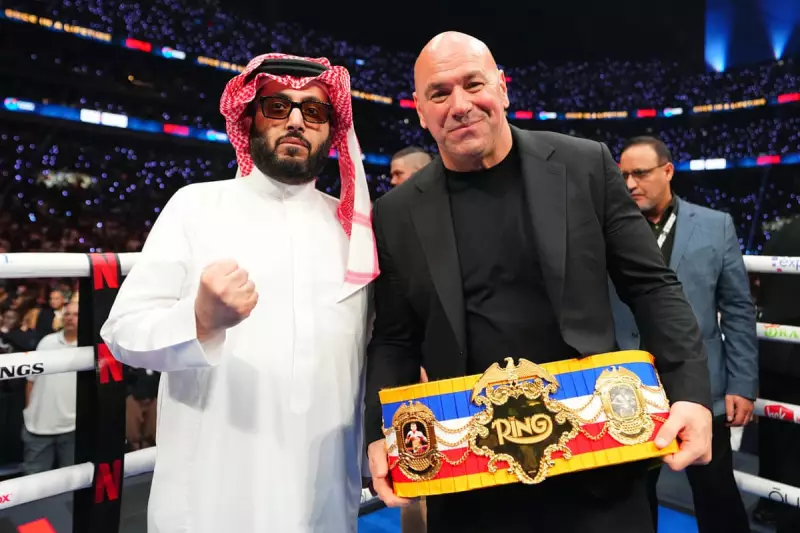
Turki al-Sheikh, the influential Saudi figure, was photographed alongside UFC president Dana White at the super-middleweight title clash between Terence Crawford and Canelo Álvarez last September. The event, held at Allegiant Stadium in Las Vegas, symbolised the growing alliance between Saudi financial muscle and American combat sports expertise. This partnership has now crystallised into Zuffa Boxing, a joint venture poised to reshape professional boxing, but not without significant controversy.
The Birth of Zuffa Boxing and Its Ambitious Vision
Zuffa Boxing emerged as a collaborative enterprise between TKO Group Holdings, the Saudi Arabian General Entertainment Authority, and Sela, a live-experiences company owned by Saudi Arabia's Public Investment Fund. Announced in August last year, the venture plans to promote approximately twelve league fight cards annually over a five-year period, alongside several high-profile super-fights. Dana White, the charismatic UFC chief, has been entrusted with overseeing this ambitious project, declaring his intention to "rebuild boxing in the United States."
The financial backbone of Zuffa Boxing appears robust. A media rights agreement with Paramount, valued at an estimated $100 million annually, secures exclusive distribution for Zuffa events across the US, Canada, and Latin America via Paramount+ from January 2026. However, this promising venture faces a substantial legal hurdle: compliance with existing federal boxing legislation.

The Legislative Battle: Amending the Muhammad Ali Act
Zuffa Boxing's operational model, as currently conceived, conflicts with the Professional Boxer Health and Safety Act and the Muhammad Ali Boxing Reform Act. These laws, collectively known as the Ali Act, were enacted to protect fighters from exploitation by promoters and other influential entities. In response, Zuffa and its allies have launched a concerted lobbying campaign to amend the legislation, proposing the creation of "unified boxing organizations" (UBOs).
Critics argue that the proposed amendments would significantly dilute fighter protections. Under the changes, UBOs like Zuffa could assume multiple roles—acting as promoter, manager, sanctioning body, and ranking authority simultaneously—effectively dismantling the firewalls the original Ali Act established. This consolidation of power raises alarm bells among many within the boxing community.
Oscar De La Hoya, the legendary fighter and promoter, has been particularly vocal, stating: "The bill would allow promoter-controlled Unified Boxing Organizations to own rankings, titles and fighters essentially duplicating the UFC's single-entity model inside boxing. It would legalize the very conflicts of interest the original Ali Act was written to outlaw."
Contractual Concerns: A Window into Zuffa's Approach
The Guardian has reviewed a copy of the standard contract Zuffa Boxing is offering to fighters, revealing terms that many describe as excessively restrictive. The agreement grants Zuffa exclusive worldwide rights to promote all of a fighter's bouts and related activities, prohibiting participation in any other combat sports during the contract term. Fighters are obliged to accept opponents designated by Zuffa, with refusal potentially counting against their guaranteed bout offerings.
More concerning are clauses that allow Zuffa to terminate contracts if a fighter loses a bout or draws, potentially incentivising mismatches. The contract also includes extensive ancillary rights, granting Zuffa control over a fighter's identity for marketing, merchandise, video games, and even virtual reality experiences, often in perpetuity. Financial terms for merchandise sales offer fighters as little as 15% of gross revenue, a figure that pales in comparison to deals in other major sports.
Medical examination costs are explicitly borne by the fighter, and the contract includes mechanisms that can extend the original term significantly—potentially up to six years under proposed legislative changes. Arbitration clauses further limit fighters' ability to seek redress through courts, echoing practices that have led to substantial legal settlements in UFC's history.

Mixed Reactions from the Boxing World
The boxing community remains divided on Zuffa's entrance. Some state athletic commission officials and arena operators support the proposed Ali Act amendments, citing potential for streamlined operations. However, many fighters and promoters express deep reservations.
Evander Holyfield, the former heavyweight champion, remarked: "The loudest voices pushing for this rewrite aren't boxers but the promoters of mixed martial arts—the people who made 'business first, fighters last' a mega-sport." Chris Algieri, former WBO champion, acknowledged the Ali Act needs updating but warned against weakening protections: "Fighters—and I speak from experience—get exploited enough as it is."
Frank Warren, one of boxing's leading promoters, stated unequivocally: "I'm still not putting any of my fighters in it. And if you're a responsible manager, you wouldn't put a young prospect in it. That's simply not how you build a prospect as an attraction or as a fighter."
The Road Ahead: Legislative Process and Industry Impact
The proposed amendments have already cleared the House Education and Workforce Committee, with a full House vote considered likely. The Senate has yet to hold hearings, leaving a narrow window for opposition. The outcome will significantly influence boxing's future landscape.
Zuffa's initial event, "Zuffa Boxing 01," streamed on Paramount+ in January, received mixed reviews. While Dana White praised the bouts, critics noted the card's quality fell short of the standards set by Saudi-backed Riyadh Season events. Upcoming fights feature questionable matchups, raising doubts about Zuffa's commitment to competitive parity.
As the legislative battle intensifies, concerns persist about Zuffa's long-term impact. One promoter familiar with both White and Sheikh noted: "Dana has built UFC at the expense of the fighters. And once Zuffa has control, he'll do the same thing here. Anybody who thinks differently doesn't have a clue. It's UFC 2.0."
The financial disparity between UFC's revenue split with fighters (17-20%) and those in major team sports (up to 50%) or elite boxing (often around 80%) underscores these worries. With UFC recently settling a $375 million antitrust lawsuit, Zuffa's contractual approach suggests a continuation of contentious business practices.
Ultimately, the debate over Zuffa Boxing and the Ali Act amendments reflects broader tensions between commercial innovation and athlete protection. As Congress deliberates, the boxing world watches closely, aware that the outcome could redefine the sport's economic foundations for generations of fighters to come.





