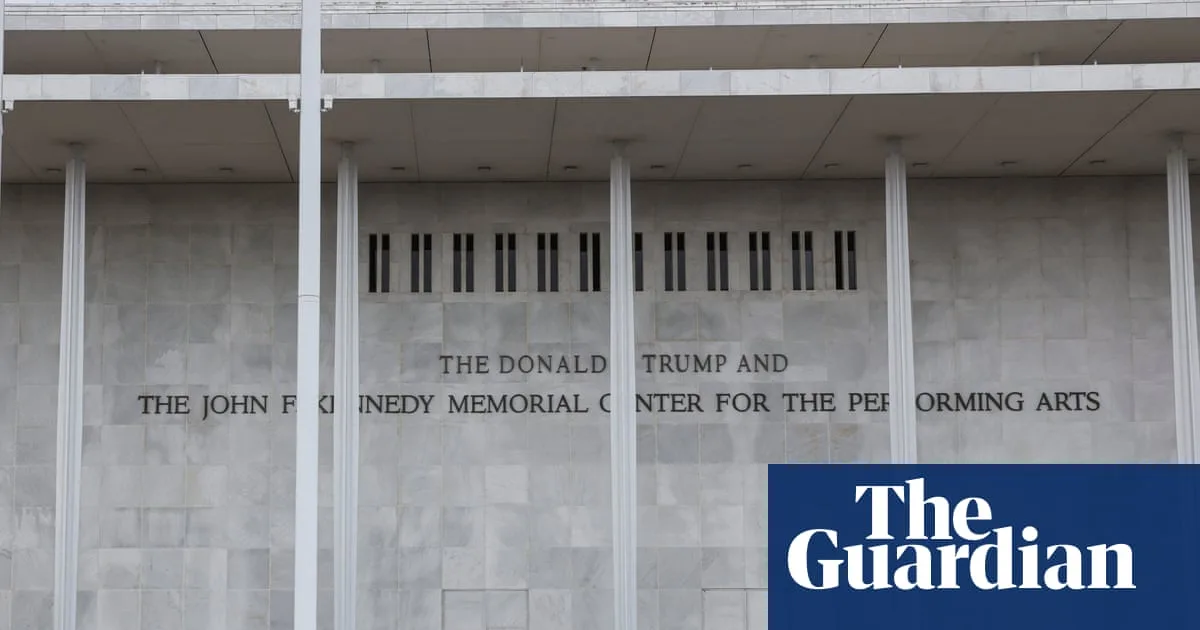
A second jazz band has pulled out of performing at the controversially renamed 'Trump-Kennedy' center in Washington DC, giving just two days' notice before their New Year's Eve gig was set to take place. The Cookers, a Grammy-nominated, all-star septet of legendary post-bop jazz musicians, have not given an explicit reason for their decision but in a statement posted on their website said: 'Jazz was born from struggle and from a relentless insistence on freedom: freedom of thought, of expression, and of the full human voice.'
The band's decision to pull out of 'A Jazz New Year's Eve' booking comes after the board of the John F Kennedy Center for the Performing Arts voted earlier this month to rename the institution the Trump-Kennedy Center. The decision provoked outcry – and legal challenges – and the signage outside the Washington DC arts center was quickly amended with Trump's name. Soon after, drummer and vibraphonist Chuck Redd cancelled a Christmas Eve gig.
Richard Grenell, the Kennedy Center president, a Trump appointee, threatened to sue Redd for $1m in damages for what he called a 'political stunt'. 'Your decision to withdraw at the last moment – explicitly in response to the Center's recent renaming, which honors President Trump's extraordinary efforts to save this national treasure – is classic intolerance and very costly to a non-profit Arts institution,' Grenell said in a letter obtained by the Washington Post.
The latest jazz cancellation comes after folk singer Kristy Lee announced she had cancelled a concert at the center scheduled for next month. Lee said on social media that 'when American history starts getting treated like something you can ban, erase, rename, or rebrand for somebody else's ego, I can't stand on that stage and sleep right at night'. A dance company, Doug Varone and Dancers, has also said it is pulling out of two performances scheduled for April, stating on social media that after 'the latest act of Donald J Trump renaming the Center after himself, we can no longer permit ourselves nor ask our audiences to step inside this once great institution'.
Grenell responded to the string of cancellations, saying: 'The arts are for everyone and the left is mad about it.' He said on social media that the acts cancelling shows had been booked by 'the previous far left leadership'. 'Their actions prove that the previous team was more concerned about booking far left political activists rather than artists willing to perform for everyone regardless of their political beliefs,' he said. 'Boycotting the Arts to show you support the Arts is a form of derangement syndrome.'
The Cookers apologized to their audience, saying 'we understand and share your sadness' and remained 'committed to playing music that reaches across divisions rather than deepening them'. A former band member, saxophonist Billy Harper, went further in comments to a Facebook group, Jazz Stage, saying he 'would never even consider performing in a venue bearing a name (and being controlled by the kind of board) that represents overt racism and deliberate destruction of African American music and culture'. The Cookers are a band of primarily African-American musicians and their statement about 'jazz was born from struggle' signals historical context. Washington DC is a once majority-Black city that has been long known as a center of Black arts and culture, historically earning the nickname 'Chocolate City', as well as the birthplace of Duke Ellington, Marvin Gaye and members of the hardcore band Bad Brains. Harper, who played with Max Roach and others, evoked the long history of jazz musicians taking a stand against racism. He said: 'I know they would be turning in their graves to see me stand on a stage under such circumstances and betray all we fought for, and sacrificed for.'