

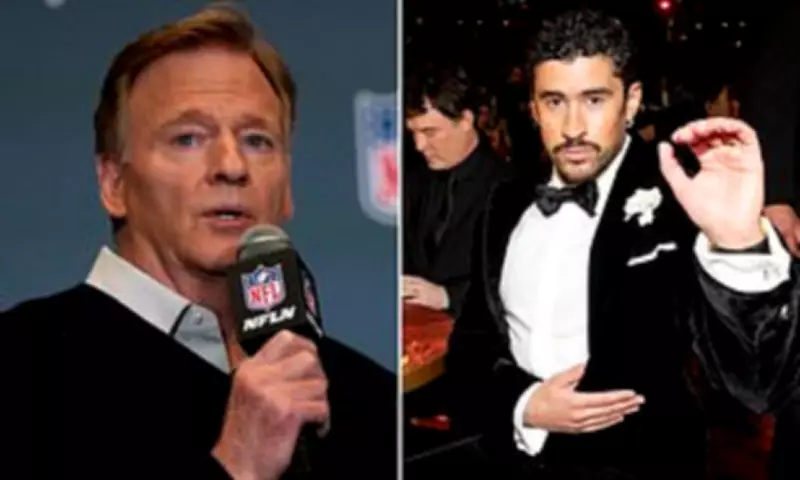
NFL Commissioner Sidesteps Bad Bunny's ICE Criticism Ahead of Super Bowl Performance
NFL Commissioner Roger Goodell remained notably evasive when questioned about Puerto Rican superstar Bad Bunny's recent criticism of U.S. Immigration and Customs Enforcement (ICE) at the Grammy Awards. The artist's pointed remarks came just days before his scheduled performance at the Super Bowl halftime show, setting the stage for a politically charged spectacle.
Grammy Speech Sparks Controversy
During his acceptance speech after winning three awards, including the prestigious Album of the Year, Bad Bunny made a powerful statement. "Before I say thanks to god, I'm going to say, ICE Out," he declared to a cheering audience. The artist, whose real name is Benito Antonio Martínez Ocasio, continued with an emotional appeal: "We are not savage. We are not animals. We are not aliens. We are humans, and we are Americans."
He elaborated on his message of unity, stating: "The hate gets more powerful with more hate. The only thing that is more powerful than hate is love. So, please, we need to be different. If we fight, we have to do it with love." This public condemnation of immigration enforcement policies immediately placed Bad Bunny at the centre of a political firestorm, particularly given his impending Super Bowl appearance.

Goodell's Diplomatic Response
Speaking at his annual Super Bowl week press conference, Commissioner Goodell carefully navigated questions about the controversy. While praising Bad Bunny as "one of the greatest artists in the world," Goodell avoided direct commentary on the ICE criticism. Instead, he focused on the platform itself, remarking: "He understood the platform he was on. This platform is used to unite people and to be able to bring people together with their creativity, with their talent, and to be able to use this moment to do that."
Goodell added: "I think artists in the past have done that. I think Bad Bunny understands that and I think he'll have a great performance." This diplomatic response highlights the NFL's delicate position balancing entertainment with political sensitivities.
Political Backlash and Security Concerns
The announcement of Bad Bunny's Super Bowl performance in late September immediately drew criticism from prominent political figures. Former President Donald Trump was among those who condemned the selection, later revealing he would not attend the game due to the Puerto Rican artist's involvement. The Trump administration has indicated plans to deploy ICE agents to the Bay Area ahead of the Seattle Seahawks versus New England Patriots matchup.
Secretary of Homeland Security Kristi Noem previously vowed: "We'll be all over that place," while a Department of Homeland Security official stated: "Those who are here legally and are not breaking other laws have nothing to fear." However, recent reports suggest there are no specific plans for ICE operations at Levi's Stadium or NFL-sponsored events leading up to Super Bowl Sunday.
Broader Context of Immigration Tensions
The controversy unfolds against a backdrop of heightened immigration tensions across America. Recent fatal shootings involving ICE officers have sparked widespread protests, with some administration officials accusing local authorities of insufficient support for federal law enforcement. Last year, Trump ally Corey Lewandowski issued a stark warning: "There is nowhere that you can provide safe haven to people who are in this country illegally, not the Super Bowl, and nowhere else."
Noem even suggested people should avoid the Super Bowl "unless they are law-abiding Americans who love this country," emphasising: "We're gonna enforce the law." Despite these strong statements, DHS maintains that their security plans for the Super Bowl remain unchanged despite recent unrest in Minneapolis.
As the sporting world's biggest event approaches, the intersection of entertainment, politics, and immigration policy creates a complex narrative far beyond the football field. Bad Bunny's performance promises to be one of the most politically significant halftime shows in recent memory, testing the NFL's ability to navigate increasingly polarised national debates.






