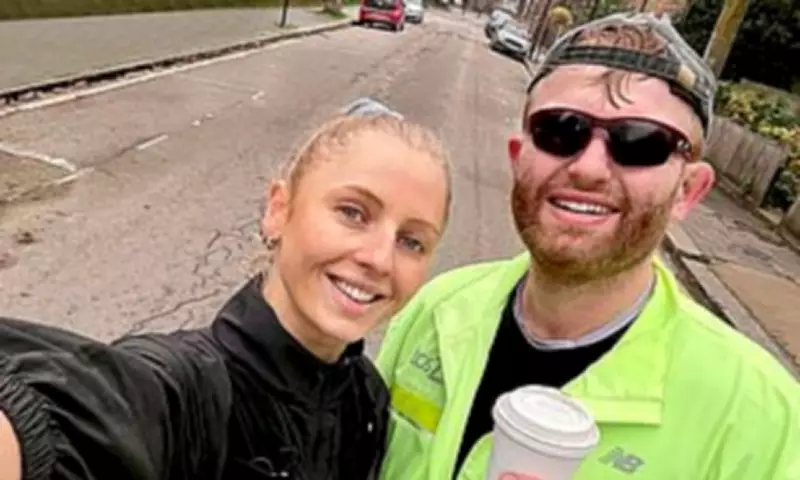
At 9am on a Saturday morning, the common in Southwest London buzzes with fitness enthusiasts, but among them, a unique pair stands out. Hannah Skelley is running laps, tethered at the wrist to her 6ft 3in, 115kg brother, Chris Hunt-Skelley. They are in sync, arms swinging in unison, preparing for next Sunday's London Marathon. Chris is visually impaired, and Hannah is learning to be his guide runner, a role that requires coordination, trust, and a shared sense of purpose.
A Test of Courage and Resilience
This marks Hannah's third marathon, an endeavor she describes as requiring courage, a touch of madness, and plenty of blister plasters. Approximately 60,000 runners will participate in the event, but only around 230 will be blind or partially sighted. For Chris, running without sight adds an extra layer of challenge. 'Taking in my surroundings is hard enough. To do it at speed when you can't see is risky and very taxing,' he explains.
The Onset of Visual Impairment
Chris's journey began after his 17th birthday when he noticed his eyesight deteriorating. Initially subtle, he struggled with tasks like reading bus numbers and watching TV. Within months, it escalated, forcing him to use a magnifying glass as an apprentice car mechanic. A near-fall into a garage pit due to poor depth perception signaled something was seriously wrong.

Medical consultations in the UK proved frustrating. When Chris, who is fair-haired and pale-skinned, asked if his pigmentation might relate to his eye condition, a consultant laughed it off as 'highly unlikely.' After endless NHS appointments yielded no answers, a psychiatric nurse attributed his sight loss to mental health issues, exacerbating his distress.
A Diagnosis Delayed and a Life Transformed
Without a proper diagnosis or job, Chris's mental state deteriorated, leading him to contemplate suicide. 'I was utterly heartbroken. I didn't know what was happening to me and I couldn't see a clear path ahead,' he recalls. The incorrect psychological diagnosis only deepened his turmoil, resulting in PTSD from his teenage years.
Amid this crisis, judo became his salvation. Starting at age five at Haltemprice Judo Club in Hull, under coach Jeff Brady, Chris found a constant in his life. As his light sensitivity worsened, requiring Polaroid sunglasses indoors, Brady adapted by blindfolding him for training. Chris learned to fight in the dark, relying on touch, and surprisingly, he began winning.
Paralympic Success and a Long-Awaited Answer
At 18, Chris joined the Paralympic Pathway, launching a 15-year international career with the Paralympic Judo Team, earning a gold medal at Tokyo 2020, a bronze at Paris 2024, and an MBE. Paralympics GB also provided Polaroid contact lenses, allowing him to compete without a blindfold.
In 2013, a breakthrough came when Basil El-Baz, CEO of Carbon Holdings and a Harvard alumnus, organized a trip to the US. Dr. Guy Rochman and a team at Mount Auburn Hospital diagnosed Chris with oculocutaneous albinism type 2 (OCA2) and Bell's phenomenon, an incurable condition affecting his vision and dreams. 'It was the greatest relief. Having a firm diagnosis helped me build the life I lead now,' says Chris.
Training for the Marathon: A Tether of Trust
Training for the London Marathon has been a miraculous experience for Hannah and Chris. They run to support Fight For Sight, a charity funding research into eye diseases. The 20-inch tether, stiff and with loops for their hands, keeps them connected, allowing Hannah to guide Chris over any terrain.
'I can't anticipate uneven surfaces,' Chris notes, 'so my body must adapt quickly. But I feel safe on the tether. It's an honour to run for a cause so close to my heart.' Hannah carries the weight of responsibility, knowing if Chris falls, she likely will too, but so far, they've stayed upright.

Overcoming Additional Challenges
Chris also lives with 30% hearing ability, adding complexity to their communication. Inspired by Visually Impaired Judo, they've developed tactile signals: a push to the right indicates a turn, a downward arrow on his palm means slow down for obstacles. 'You really don't appreciate the true rise and drop of a speed bump until you're sprinting over it at great velocity with a partially sighted Goliath of a man,' Hannah remarks.
For cobbles, their plan is to shout 'BRACE! COBBLES! BRACE!' Their tops will read BLIND RUNNER and GUIDE RUNNER to alert other participants. Humor has been key, with Chris's large sense of fun helping them navigate the challenges.
A Bond Beyond the Race
Running has become a coping mechanism for both, offering quiet, cathartic time to process life's events. As race day approaches, Hannah cherishes their moments together, whether chatting, laughing, or moving in silence with the tether between them. 'Perhaps we will do a triathlon next...' she muses.
Reflecting on their journey, Hannah realizes that no matter how uneven the road gets, an unbreakable tether has always connected them. This marathon is not just a physical test but a testament to their enduring sibling bond and resilience in the face of adversity.