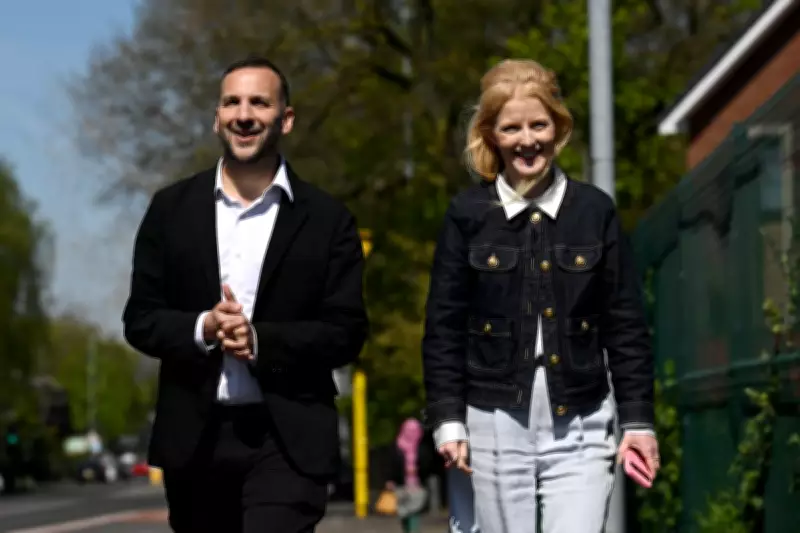
The air will come out of the Green balloon just as it did Reform's. Zack Polanski's party will make stunning gains in the English local elections next month, but it will then face many of the same problems afflicting Nigel Farage and Reform.
Starmer Will Have to Resign After May Elections, Says Polanski
Nigel Farage's enemies have watched the opinion polls over the past six months with some satisfaction, as air has escaped from the Reform balloon. From the peak of 31 per cent in October, average support for Reform has fallen to 26 per cent now. The party is still comfortably in the lead in a five-way contest, but the projections of what the House of Commons would look like have shifted from a landslide Reform majority to a hung parliament in which Farage would need Conservative support to govern. Meanwhile, Zack Polanski has seen his party's support double since he became leader in September, and is looking forward to making stunning gains in the English local elections in 12 days' time. YouGov projects that the Greens will win four London councils and are within five points of a majority in seven more. It is possible that the Greens will match Labour across England in the number of council seats won and in share of the vote, lending credibility to Polanski's ambition for the Greens to “replace” Labour.
Challenges Ahead for the Greens
But just as Farage's ambition to replace the Tory party has stalled in the face of a determined fightback by Kemi Badenoch, Polanski's trip in the hot-air balloon is also going to lose altitude. Some treasured possessions will have to be thrown overboard. These may include several policies that are unpopular with persuadable voters, or which, in Polanski's way of thinking, can be “weaponised” by the Greens' opponents. Decriminalising drugs is most often cited, although allowing more asylum-seekers to settle in Britain, for example, is even less popular. But if policies are to go, the way the Green Party makes policy will have to change, which is tricky in a party with a history of all-member policy-making. Polanski told the New Statesman in an interview this week that he would be “supportive of people bringing forth proposals as to how we can make sure that our process is even more democratic”. In public, he says: “I don't think it should be up to the leadership to decide. I think it should be a kind of grassroots movement of the party to decide what the future looks like.” In private, however, his advisers hint to the New Statesman that a different kind of change is on its way.

Polanski's Missteps
Polanski is still making elementary mistakes. In that New Statesman interview, he apologised to Jeremy Corbyn for once saying that, as “a pro-European Jew”, he had “two reasons” he couldn't vote for Labour under him. He now believes that complaints of antisemitism were weaponised – that word again – to damage Corbyn. Thus, he has fallen into exactly the same error that Corbyn did. Corbyn sincerely believes that the problem of antisemitism in Labour was exaggerated by his opponents, without understanding that as soon as he said that out loud, it sounded as if he was trying to minimise the evils of anti-Jewish prejudice. This will become more of a problem for the Greens with the election of hundreds of paper candidates as local councillors. We will discover that many of them have not been vetted. Labour cabinet minister Steve Reed has claimed that, given the influx into the Greens of Corbyn-supporting refugees from Labour – some of them expelled from Labour for antisemitism – there will be a major cleanup operation to follow.

Similarities with Reform
Rooting out members with histories of racist posts on social media will not be the only similarity between the Greens and Reform. Just as Reform has struggled to avoid coming back to earth with a bump after winning control of several councils, the Greens will face similar problems. Inexperienced councillors and impossible promises are not the best guarantees of effective local administration – and the Greens' record of running Brighton council a few years ago was discouraging. What is striking is that Reform has been losing support despite a concerted and well-funded effort to professionalise the party. Farage has junked his entire manifesto from the last election, ended the party's status as a private company, and set up a media operation that compensates a little for his lack of impact in parliament. And yet the party is still losing ground – possibly because immigration has slipped down the news list. Small boat arrivals are down on last year and the headlines have been dominated by war and Peter Mandelson.
Professionalising the Greens
Professionalising the Green Party will be much harder. Its longstanding members are deeply resistant to top-down control, and even to the idea of a single leader. Its new members, the Corbynite entryists, even more so – just look at the art installation known as Your Party for an illustrative parable. Politics is a long haul, and it is hard for new parties to establish themselves in the British parliamentary system. Especially if the old parties refuse to lie down and die. Polanski and Farage have more in common than either would like to admit.