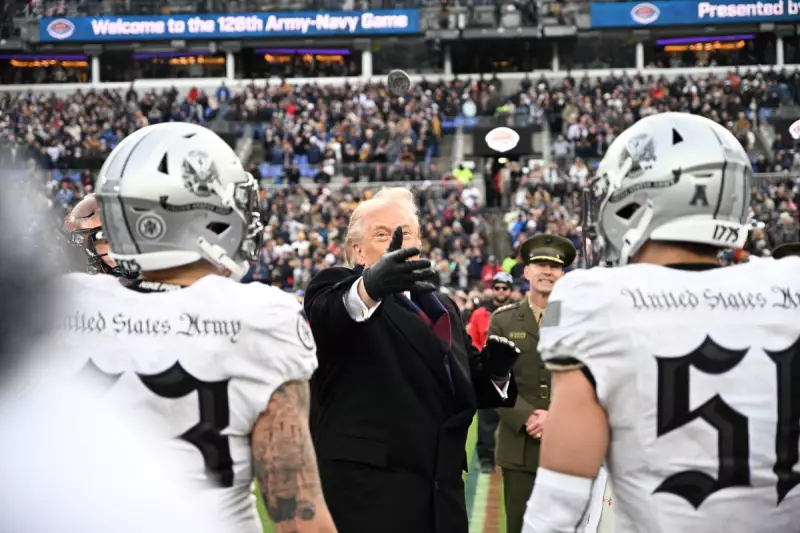
President Donald Trump has announced a controversial plan to use executive authority to protect the annual Army-Navy college football game, a move that legal experts suggest may overstep presidential power and face significant legal hurdles.
An Unprecedented Intervention in Sports Broadcasting
In a post on his Truth Social platform on Saturday, President Trump declared that tradition is now at risk of being pushed aside by more College Playoff Games, and Big TV Money. He vowed that this would end, promising an upcoming executive order.
The proposed order would mandate that all television networks, stations, and outlets reserve the second Saturday in December for a four-hour broadcast window dedicated solely to the historic rivalry game between the U.S. Military Academy at West Point and the U.S. Naval Academy at Annapolis. This game has been played for over a century.

Trump framed the action as a defence of patriotism, stating, On the field, they are rivals, but on the battlefield they are America’s unstoppable Patriots. He argued the move was necessary to protect a great American tradition from being displaced by an expanded College Football Playoff schedule.
Legal and Practical Enforceability in Doubt
However, the announcement has been met with immediate scepticism regarding its legality and enforceability. Media law experts cited by The Washington Post have indicated the order is likely illegal, pointing to potential First Amendment violations among other concerns.
A major practical obstacle is the jurisdiction of the Federal Communications Commission (FCC), which regulates broadcast television but not cable or streaming services. It remains unclear how the administration would compel compliance across all modern media platforms.
FCC Chairman Brendan Carr offered no substantive comment, merely reposting Trump's message. The order would notably benefit CBS, which has held the broadcast rights to the Army-Navy game since 1996 under a contract extending to 2038.
Broader Context of Media Influence
This intervention into sports scheduling follows a pattern of the Trump administration exerting influence over media entities. Last year, the administration approved the merger of Paramount, CBS's parent company, with Skydance, a firm owned by Trump ally David Ellison.
Subsequently, Ellison installed conservative commentator Bari Weiss, founder of The Free Press, as editor-in-chief of CBS News. Critics have accused Weiss of capitulating to the Trump administration's agenda.
While some lawmakers have urged College Football Playoff officials to preserve a day for the Army-Navy game to honour military service, using an executive order to mandate broadcast schedules is seen as a dramatic escalation. The next game is scheduled for 12 December 2026 at the MetLife Stadium in East Rutherford.