

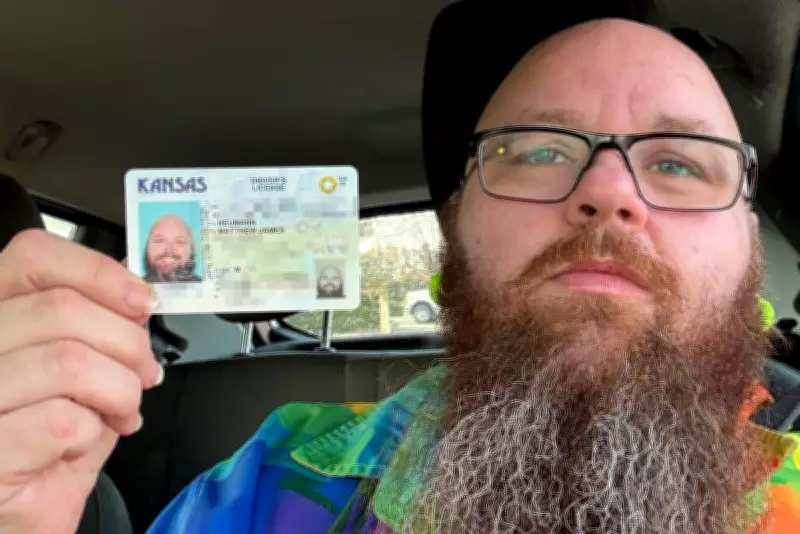
Kansas Transgender License Revocations Spark Chaos and Fear
With minimal warning and no grace period, Kansas Republicans have invalidated an estimated 1,800 transgender people's identity documents, including driver's licenses and birth certificates. The sudden implementation of Senate Bill 244 has created widespread confusion, fear, and logistical nightmares for the transgender community across the state.
Confusion and Chaos at Government Offices
When Iridescent Roney arrived at the Kansas Office of Vital Statistics on February 26 to surrender her birth certificate, she encountered staff who were completely unprepared for the new requirements. "The folks were terribly kind, and I appreciate them for that," said Roney, a 29-year-old college career adviser from Lawrence. "However, they didn't know what to do. There was no plan of action for what was going to happen."
The law, passed eight days earlier by the Republican supermajority over Democratic Governor Laura Kelly's veto, requires all identity documents to reflect the gender assigned at birth rather than an individual's lived gender. Those who attempt to drive with their old licenses face potential fines, arrests, and even jail time for repeated offenses.

Inadequate Notification Creates Impossible Situation
Many transgender Kansans received notification letters just one day before the law took effect, while others never received any official communication at all. Matthew Neumann, founder of the LGBTQ Foundation of Kansas, told The Independent: "I have not received a letter, still, over a week later."
This lack of proper notification has made it impossible for many to renew their licenses by the deadline in America's 15th largest state, where public transportation options are minimal. Some individuals have been left stranded, unable to drive to work or even travel to Department of Motor Vehicles offices to obtain new documents.
Financial and Practical Burdens
Replacing invalidated documents comes with financial costs that many cannot easily afford. While Kansas charges an $8 fee for license reissuance, the total expenses including travel and time off work can be substantial. Roney spent approximately $50 in fees and gas money during her "all-day adventure" to update her documents.
"Not everyone gets that same privilege," Roney noted about her ability to take paid time off from her salaried job. "What's gonna happen the first couple days you miss work? What if you want to go vote?" Kansas has strict voter identification laws that require valid driver's licenses or other approved documents.
Legal Challenges and Resistance
Despite an ACLU-backed legal challenge, a Kansas court declined to block the law's implementation on Tuesday. Matthew Neumann has taken a defiant stance, refusing to comply with what he calls an illegal measure. "This law is not legal, and until a judge tells me that it is legal, I'm not going to follow it," he declared.
Neumann's organization is offering financial assistance of up to $100 for document replacement costs through a partnership with the Democratic Socialists of America, along with organizing transportation assistance from cisgender volunteers with valid licenses.
Document Discrepancies Create Schroedinger's Gender Situation
Roney now finds herself in what she describes as "Schroedinger's gender" situation after obtaining conflicting documents from different states. While Missouri issued her a female-designated license, Kansas provided a birth certificate branding her as male. "According to the state of Missouri I'm female. According to the state of Kansas, I'm Schroedinger's gender," she explained, referencing the famous quantum mechanics thought experiment.
This discrepancy could create serious problems if she ever needs to present both documents together for official purposes. "I'm doing everything I can to follow the law," Roney lamented, expressing frustration at having to replace documents she legally obtained through proper channels in 2023.

Broader Implications and Community Impact
The law's implementation has forced transgender individuals to out themselves to employers when submitting new identification with incorrect gender markers, potentially opening them to discrimination. According to the 2022 U.S. Transgender Survey, 22 percent of respondents reported experiencing harassment, assault, or denial of services after showing identification that didn't match their appearance.
Jayme Johnson, a 40-year-old academic who had avoided changing her documents specifically to avoid government targeting, now feels her worst fears have been realized. "It's like, which piece of information is gonna be the landmine that explodes on you?" she asked. The situation has left her feeling "really alone and isolated" and questioning her future in Kansas.
Political Context and Future Concerns
Senate Bill 244 represents part of a broader Republican campaign against transgender rights that includes restrictions on healthcare access, bathroom use, military service, and gun ownership. Supporters describe the measure as restoring "biological reality and common sense" to Kansas documents.
For Claven Snow, a 47-year-old trans father of two, the current situation feels like "a harbinger of more sinister things on the horizon." He worries about potential future attempts to invalidate court documents verifying his paternity or other legal recognitions of his identity.
The law's spotty enforcement has added to the uncertainty, with some transgender individuals reporting that their licenses still show as valid in state systems weeks after receiving revocation letters, while others have received new licenses with their preferred gender markers despite the law's requirements.





