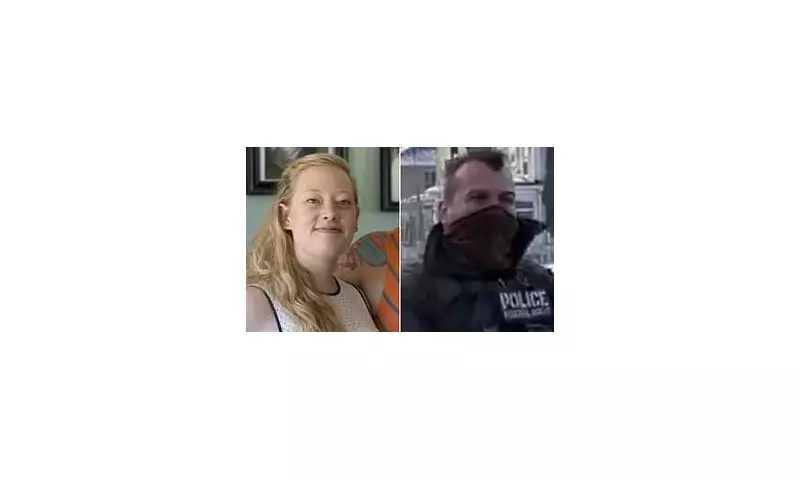
An Immigration and Customs Enforcement (ICE) agent who fatally shot a mother-of-three during protests in Minneapolis is unlikely to face criminal prosecution, according to legal analysts, despite widespread public outrage and political condemnation.
The Fatal Encounter and Legal Justification
Renee Nicole Good, aged 37, was killed on Wednesday while driving an SUV that was blocking a residential street during demonstrations against an ICE operation. The agent involved has been named in local reports as Jonathan Ross, an experienced officer who was seriously injured in a previous incident in June.
Video footage of the event shows agents approaching Good's stationary vehicle and instructing her to exit. As one agent tugs at the door handle, Good begins to reverse. Agent Ross positions himself in front of the car, draws his weapon, and points it at Good as she starts moving forward. The vehicle strikes Ross, who then opens fire. Good's Honda Pilot subsequently crashed nearby, and she was pronounced dead at the scene.

Amy Swearer, a senior legal fellow at the conservative nonprofit Advancing American Freedom, explained the legal perspective to the Daily Mail. She stated that under US law, the use of deadly force is justified when an officer reasonably perceives a threat of serious bodily harm or death. "You have an officer who is trying to conduct a lawful detention of a driver who is blocking the road," Swearer said. "That driver is not being compliant with these lawful commands, and, in fact, seems to be trying to escape that situation."
Public Outrage vs. Legal Technicalities
The shooting has ignited fierce political backlash, with some Democratic lawmakers branding it 'murder.' However, legal specialists argue that criminal liability hinges on narrow technicalities within deadly force statutes, not on public sentiment.
Swearer addressed online speculation about the direction of the car's wheels and the agent's decision to stand in front of the vehicle, stating these points are largely irrelevant legally. "The driver's subjective intent doesn't matter," she emphasised. "It matters what the officer can reasonably perceive. He can't read her mind. He just knows that you have someone who's ignoring lawful commands, who is moving the car toward him. That is deadly force." She added that officers do not have a duty to retreat in such circumstances and are not required to wait until they are actually struck or shot before responding.
Jurisdictional Hurdles and Political Challenges
While federal charges are seen as improbable, some analysts note that Minnesota state prosecutors are not legally barred from pursuing the case. Ian Millhiser, a legal correspondent for Vox, highlighted the jurisdictional complexities. He wrote that while there is "virtually no chance" the Trump-era Justice Department would bring federal charges, furious local officials like Minneapolis Mayor Jacob Frey could push for state action.
However, a state prosecution would face significant legal obstacles. A federal statute allows criminal charges against a US officer to be removed from state court and heard by a federal judge. This would likely place the case before the US Court of Appeals for the Eighth Circuit, where 10 of the 11 active judges are Republican appointees, with further appeal possible to the conservative-majority Supreme Court.
Minnesota civil rights attorney Paul Applebaum noted the unclear prosecution path, suggesting a state attempt to charge the officer would create a constitutional conflict between state and federal authorities. Meanwhile, the Trump administration has labelled Good a 'professional agitator' who had been stalking federal agents.
The FBI is currently investigating the shooting. Despite demands from state and local officials for ICE to leave Minnesota following the death, Department of Homeland Security leadership has stated its agents are not going anywhere.