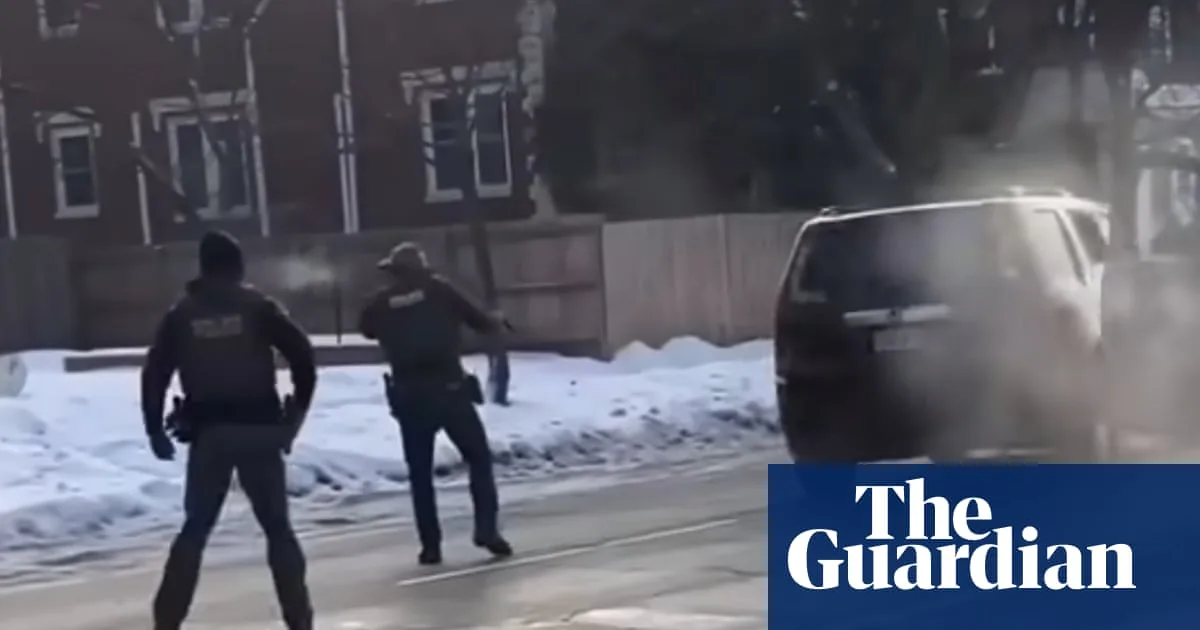
A US Immigration and Customs Enforcement (ICE) agent who fatally shot a mother-of-three during protests in Minneapolis is unlikely to face criminal prosecution, according to legal analysis, despite sparking nationwide fury and political condemnation.
The Fatal Incident and Immediate Aftermath
Renee Nicole Good, 37, was killed on Wednesday while driving an SUV that was blocking a residential street during demonstrations against an ICE operation. The agent involved has been identified by local media as Jonathan Ross, an experienced officer who previously suffered serious injuries requiring 20 stitches in June after being dragged 100 yards by a car during an arrest attempt.
Video footage of the incident shows agents approaching Good's stationary vehicle and instructing her to exit. As one agent tugs at the driver's door handle, Good begins to reverse. Agent Ross positions himself in front of the car, draws his weapon, and points it at Good as she starts moving forward. She strikes Ross with the car as he opens fire. Good's Honda Pilot subsequently crashed nearby, and she was declared dead at the scene, having been shot three times in the face.
Legal Analysis: Why Criminal Charges Are Unlikely
Despite furious condemnation from Democratic lawmakers who have branded the shooting 'murder', legal experts indicate that the question of criminal liability hinges on narrow technicalities under deadly force statutes, not public outrage.
Amy Swearer, a senior legal fellow at the conservative nonprofit Advancing American Freedom, explained to the Daily Mail that under US law, the use of deadly force is justified when an officer can reasonably perceive a threat of serious bodily harm or death. "You have an officer who is trying to conduct a lawful detention of a driver who is blocking the road, trying to impede law enforcement," Swearer stated. "That driver is not being compliant with these lawful commands, and, in fact, seems to be trying to escape."
She emphasised that the officer's perspective in the moment is paramount. "The driver's subjective intent doesn't matter. It matters what the officer can reasonably perceive. He can't read her mind. He just knows that you have someone who's ignoring lawful commands, who is moving the car toward him. That is deadly force." Swearer added that Ross, as a federal officer, had no duty to retreat.
Online speculation about the direction of the car's wheels or the agent's decision to stand in front of the vehicle is legally irrelevant, according to this analysis.
Jurisdictional Hurdles and Political Context
Other legal experts point to significant jurisdictional barriers. While Minnesota state prosecutors are not legally barred from pursuing the case, any attempt would face steep challenges. Ian Millhiser, a legal correspondent for Vox, noted that federal law allows charges against a US officer to be moved from state to federal court. This would place the case before the US Court of Appeals for the Eighth Circuit, where 10 of the 11 active judges are Republican appointees, with further appeal possible to the conservative-majority Supreme Court.
Minnesota civil rights attorney Paul Applebaum said it was unclear who would prosecute, noting that the ability to sue federal officers for civil rights violations has been narrowed to the point of being "almost an empty exercise." He warned that state charges would trigger a constitutional conflict between state and federal authorities.
The political divide is stark. The Trump administration has labelled Good a 'professional agitator' who had been stalking federal agents. Meanwhile, state and local officials in Minnesota have demanded that ICE leave the state following the killing. Department of Homeland Security leadership has stated its agents are "not going anywhere."
The FBI is currently investigating the shooting.




