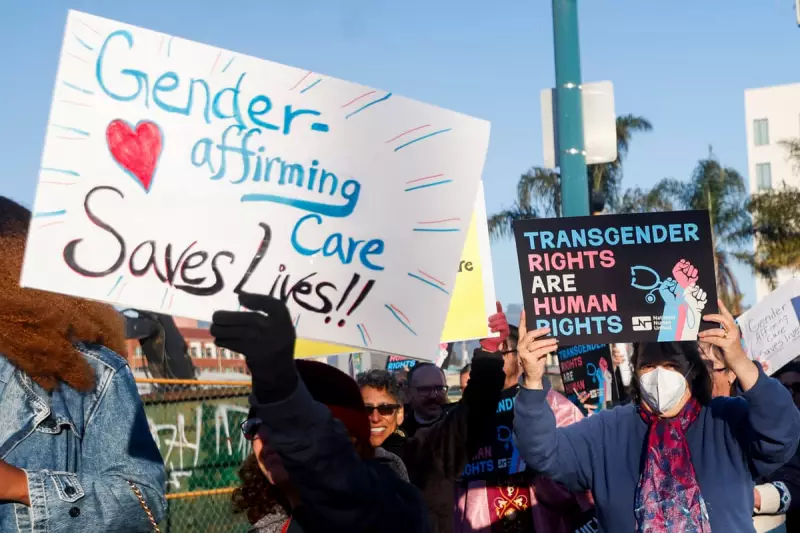
Health professionals in the United States have issued stark warnings against two hastily introduced congressional bills that seek to ban gender-affirming medical care for children, marking the first time Congress has voted on national prohibitions.
A Last-Minute Lobbying Effort on Capitol Hill
As an unusual cold snap eased in Washington DC on Tuesday 9 December 2025, activists made a final push to lobby lawmakers. Among them were Nicholas Mitchell, a psychiatrist, and Odile Saint-Flour, a nurse, from the advocacy group Bulletproof Pride. They visited congressional offices, including that of their representative, Steny Hoyer, to express opposition to the proposed legislation.
The two bills, HR 498 and HR 3492, were scheduled for a vote on Wednesday 10 December. Their introduction represents a significant escalation in anti-trans rhetoric from conservative US lawmakers.

The Content of the Controversial Bills
One bill, introduced by Republican Marjorie Taylor Greene as one of her final acts before retiring from the House, aims to criminalise healthcare providers who offer gender-affirming care to anyone under 18. The proposed law would make providing such care a federal felony, punishable by up to ten years in prison.
The second bill, put forward by Republican Dan Crenshaw, seeks to ban Medicaid coverage for gender-affirming care for children. This would mean transgender children on the government healthcare programme would lose access to puberty blockers, hormone therapy, and surgical care, while cisgender children would retain access to equivalent treatments.
"Both of the bills would be causing a lot of needless suffering. Morally, it’s the right thing to do – to stand up against it," Mitchell stated during the lobbying effort.
Healthcare Professionals Sound the Alarm
Mitchell and Saint-Flour, who is nonbinary and uses they/them pronouns, emphasised the devastating mental health consequences such bans could trigger. Saint-Flour, who has worked with psychiatric patients, highlighted the disproportionate impact on trans youth.
"Trans people make up a very small percentage of the population, but they’re very over-represented in psychiatry because the suicide rate is incredibly high," they said. "Based on the research we have, it’s pretty obvious that it’s society that tells people they shouldn’t exist, and that really has a profound effect on the whole community."
Data from a 2024 survey by the Trevor Project underscores the crisis: nearly half (46%) of transgender and nonbinary young people seriously considered suicide, and 12% of LGBTQ+ youth attempted suicide. This compares to 20.4% of high school students who seriously considered suicide and 9.5% who attempted it in 2023.
Mitchell, who left Texas after its restrictive abortion laws created a climate of fear for providers, drew a direct parallel. He warned of the "ripple effects" of narrowly targeted healthcare bans, referencing how anti-abortion laws in Texas also blocked care for miscarriage management and life-threatening infections.
"We’ve seen repeatedly that good, open access to gender-affirming care has been extremely effective in lowering the rates of suicide amongst trans youth," Mitchell told lawmakers.
Defining Gender-Affirming Care and its Impact
The professionals clarified that gender-affirming care is a broad term. While it can include medication and, very rarely for minors, surgery, it most often involves simpler acts of support: using correct pronouns and offering respect.
Losing that support, they argued, is devastating to patients' wellbeing. Research indicates trans youth are at higher risk for anxiety, depression, and suicide, likely due to a lack of societal acceptance. Studies show healthcare interventions significantly lower these mental health risks.
"Bills like this are dangerous," Saint-Flour concluded. "They hurt people. They say that it’s to protect children, but they’re trying to prevent people from getting healthcare that actually lowers the rate of suicide for trans youth and trans people in general."
Mitchell's final plea to Congress was unequivocal: "Even at its most basic level, even if these things are practiced in their most narrow way, it will still be hurting people. That suffering by itself is reason to not pass these bills."