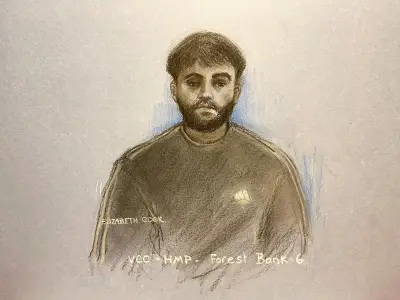
A psychotherapist has provided a chilling analysis of the "lethal" dynamic between the father and son who carried out a deadly terrorist attack at Sydney's Bondi Beach, shedding light on a rare and disturbing power imbalance.
The Horrific Attack on Hanukkah Celebrations
On the evening of December 14, 2025, a joyous Hanukkah celebration at Bondi Beach was shattered by gunfire. Sajid Akram, 50, and his 24-year-old son Naveed Akram, an unemployed bricklayer, opened fire on the crowd in what authorities have declared an antisemitic terrorist incident.
The attack left at least 16 people dead and dozens more requiring hospital treatment. Police shot Sajid dead at the scene, while Naveed was arrested and remains hospitalised with critical injuries. New South Wales Police Commissioner Mal Lanyon confirmed the younger Akram is expected to survive to face criminal charges.

A Twisted Family Dynamic and Ideology
Prime Minister Anthony Albanese confirmed that Naveed Akram, an Australian-born citizen, had previously come to the attention of the Australian Security Intelligence Organisation (ASIO) in 2019. At the time, he was assessed but deemed not to pose an ongoing threat of violence.
Mr Albanese stated that while the duo acted alone, they were "clearly" driven by an "extremist ideology". This revelation raises profound questions about how Naveed's worldview became so warped, and how his father apparently condoned his involvement in such an atrocity.
Psychological Insight into a 'Potent Mix' of Motives
Psychotherapist Shelly Dar from Therapy Health, who has extensive experience in criminal psychology, told The Mirror that such father-son attacks are exceptionally rare. "Most serious violent acts are committed either by individuals acting alone or by peers of a similar age," Ms Dar explained.
She highlighted the critical role of a profound "power imbalance" in such relationships. "When a parent is involved in planning or leading violence, the child is not a free and equal participant," Ms Dar said. "This can make it very hard to step back and question what is happening."
Ms Dar suggested the dynamic likely involved a "potent mix of admiration, fear and a wish to prove oneself". She posited that younger participants in such plots are often driven less by deep ideology and more by "attachment, obedience and a deep need for approval".
"Involving a child in lethal violence is a profound failure of care," she concluded. "It suggests that a parent’s beliefs, grievances or need for control have been placed far above their child’s wellbeing and future."
Neighbours' Shock and a Mother's Defence
Neighbours in Bonnyrigg, Sydney, where the younger Akram lived, expressed utter shock, having perceived the pair as unremarkable. Lemanatua Fatu, who lived on the same street, described seeing a large police presence throughout the night. "They just come and go every day. And they never say hello or anything. They're just … normal. We thought they were normal people," she told the ABC.
In a stark contrast, Naveed's mother defended her son to the Sydney Morning Herald, speaking to him just hours before the attack. She described him as a "good boy" who didn't own firearms, drink, or smoke, and whose routine consisted of work, exercise, and home.
The Bondi Beach massacre continues to be investigated as a terrorist act, leaving a community in mourning and a nation grappling with the complex, devastating psychology behind one of its darkest days.