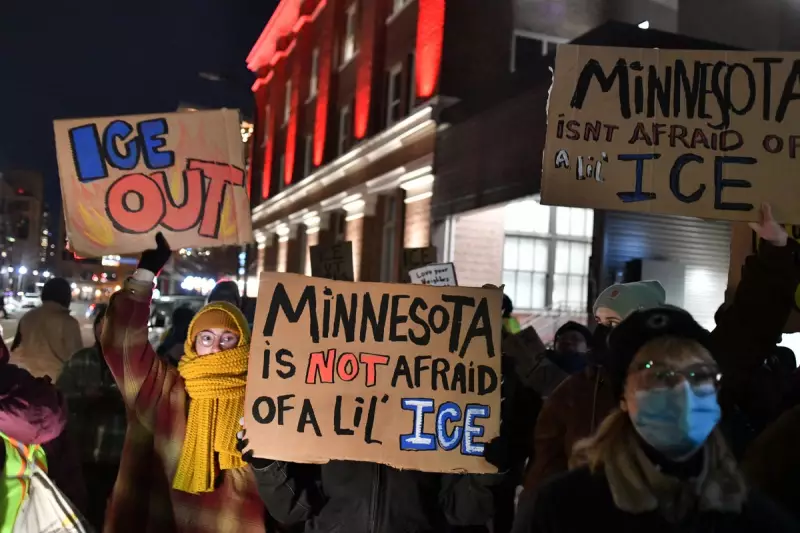
When thousands of federal agents descended upon Minnesota earlier this month, executing what the Trump administration described as "the largest immigration operation ever," they encountered a response that has fundamentally reshaped the state's famous cultural identity. The concept of 'Minnesota Nice'—often characterised by polite, pragmatic, and sometimes passive-aggressive behaviour—has been transformed into a powerful, unified front of community mobilisation and direct action against Immigration and Customs Enforcement (ICE) and Border Patrol activities.
A Community Mobilises in the Face of Tragedy
The catalyst for this profound shift followed the tragic killings of Renee Good and Alex Pretti, both 37 years old, at the hands of federal immigration agents in Minneapolis. These incidents galvanised residents across the North Star State, moving them from traditional Midwestern reserve to visible, organised resistance. There has been nothing subtle or passive about the response; instead, Minnesotans have demonstrated collective strength through practical support and public protest.
Practical Support Networks Emerge
Across the Twin Cities and beyond, community initiatives have sprung up to support migrant families affected by the crackdown. Residents have raised thousands of dollars to help families falling behind on rent because fear prevents them from going to work. Full-time employees are organising food and clothing drives, while local businesses have implemented economic blackouts and barred federal agents from their premises.
Sade Young, a Minnesota native and social media influencer, observed that the community response has "completely blown [her] mind." She told The Independent, "This is the 'Minnesota Nice' that I've always wanted to see. This completely turned it around, seeing how people are showing up, how people are caring for their neighbors." Young has utilised her platform to organise a coat drive for individuals released from detention centres and created a centralised Instagram page, Minnesota Neighbors, to direct support to local causes.
Businesses Take a Stand
Local enterprises have played a crucial role in the resistance. Vanessa Beardsley, owner of Catzen Coffee in Saint Paul, has made her establishment a hub for constitutional education and protest materials, while explicitly banning ICE agents from the property. "We've been handing out constitutions and now we have full-on whistle kits that we give out," Beardsley explained. "We have signage in our window regarding the Fourth Amendment, and regarding the fact that ICE is not welcome on the property."
This principled stance has come with significant risk. Beardsley reported intimidation from pro-ICE supporters who visited her coffee shop, questioning staff and filming the premises. Other businesses acting as donation drop-off points have experienced vandalism, with windows smashed in apparent retaliation for their opposition to the federal operations.
Redefining 'Minnesota Nice' Through Action
The traditional interpretation of 'Minnesota Nice' as neighbourly assistance—shovelling driveways or borrowing sugar—has evolved into something more profound. Maddie Flom, another Minnesota native, articulated this shift: "Our whole thing is 'Minnesota Nice' and it's really just about helping your neighbor. We need to do this. We need to stand up. We need to protect our neighbors and our community. And it's been truly beautiful to see."
Flom, who works in hospitality, has been organising fundraisers for families impacted by the Department of Homeland Security's operations. She arranged an event at a local restaurant where volunteers create activity kits for children too frightened to attend school amid the ICE presence. "A lot of families have had to take shelter with neighbors because they're too scared to even be in their houses," Flom noted. "I am very heartbroken for the kids who are stuck at home and scared."
The Psychological Toll and Ongoing Anxiety
Despite the Trump administration's recent announcement removing immigration enforcement leadership from Minnesota—an apparent de-escalation—residents remain apprehensive. Young, who carries her passport everywhere despite being a U.S. citizen, described constant vigilance: "I can't drive without looking over my shoulder constantly, I don't like commuting anywhere."
Beardsley expressed similar skepticism about the withdrawal of some federal agents: "On the other hand, if it could just take the pressure off for a week so we could catch our breath. But it’s not over. It means they're going somewhere else."
A Silver Lining in Community Solidarity
Amid the tension and tragedy, residents have found strength in unprecedented community cohesion. Beardsley observed, "We've all come together and we're all becoming helpers in the best way that we each can. If there's anything that's like a silver lining, it’s seeing the amount of people that show up at each planning meeting, at each constitutional observer meeting, the number of neighbors that we've gotten to know."
This sentiment was echoed by Democratic Governor Tim Walz, who summarised the prevailing mood in a social media statement: "I’ve never been prouder to be a Minnesotan." As the state navigates this challenging period, the redefinition of 'Minnesota Nice' from passive politeness to active protection and resistance represents a significant cultural transformation with lasting implications for community organising and political engagement.