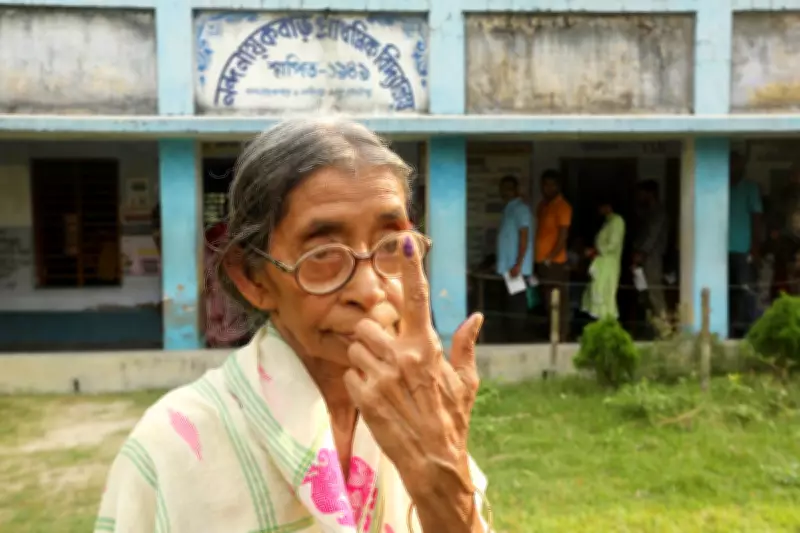
Voting has commenced in a pivotal state election in India's West Bengal, where millions of citizens have been denied the right to vote due to a contentious voter list revision. Among those affected are retired government workers and even security personnel assigned to election duty.
Voter List Revision Sparks Controversy
The Election Commission of India's Special Intensive Revision (SIR) exercise has led to the deletion of approximately nine million names from the electoral roll in West Bengal. This process, intended to remove ineligible voters, has been widely criticized for disproportionately impacting minority communities, particularly Muslims, who constitute around 27% of the state's population and are key supporters of the ruling Trinamool Congress (TMC).
Makbul Rahman, a 73-year-old retired government employee from Murshidabad district, has been trying to restore his name to the voter list for months. "I have all the documents, yet they deleted my name from the voter list. How is this possible?" he lamented. Despite attending appeal hearings, his case remains unresolved.

The SIR exercise has been implemented across 13 states, but West Bengal is the only one where tribunals have been established to hear appeals. However, of the 2.7 million appeals filed, only 138 cases have been settled as of polling day, with 98.5% resulting in name restoration.
Political Reactions and Allegations
Chief Minister Mamata Banerjee, seeking a fourth term, has approached the Supreme Court to halt the process, accusing the Election Commission of overreach. "What right does the EC have in determining who is a citizen and who isn't?" she questioned.
The Bharatiya Janata Party (BJP), led by Prime Minister Narendra Modi, has defended the SIR as a measure to remove "infiltrators," a term often used for illegal immigrants from Bangladesh. Modi stated, "The TMC is opposed to SIR as they want to save the infiltrators from being struck off the electoral rolls."
Disproportionate Impact on Women and Minorities
Data from the Sabar Institute reveals that women account for 61.8% of those deleted from the rolls. Dr. Sampurna Bhattacharya, an academic from North 24 Parganas, had her name removed despite presenting a passport. "They have not only snatched my right to vote but also put me through so much harassment," she said.
Sheikh Najrul Islam, a paramilitary officer on election duty, discovered his name missing from the voter list. "The Election Commission has deputed me to ensure free and fair polls. Yet, it does not consider me a citizen of this country," he remarked.
Broader Implications
Analysts warn that the deletions could have long-term consequences for citizenship rights. "Losing one's place in the electoral roll is not only about voting rights; it is about dignity, recognition, and the assurance that one counts as a citizen," said political analyst Iman Kalyan Lahiri.
The election in West Bengal is being closely watched as a test of the BJP's ability to unseat the TMC, with results expected on 4 May. Voting is also taking place in Tamil Nadu, part of a series of state elections that will gauge the BJP's strength in opposition strongholds.