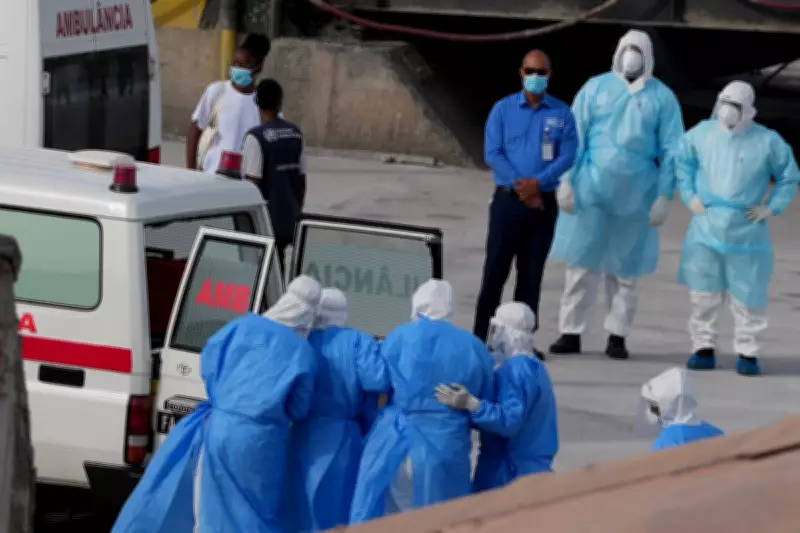
Three people from a cruise ship at the center of a deadly hantavirus outbreak, including the ship's doctor, are being flown to the Netherlands for medical care on Wednesday as the ship with some 150 passengers prepares to head to Spain's Canary Islands.
Three people have died, and the World Health Organization says eight cases have been recorded in all. Passengers on the Dutch ship, the MV Hondius, are isolating in their cabins as the ship remains near the Cape Verde islands off West Africa. The ship left Argentina on April 1 for a weekslong polar cruise.
The rare virus usually spreads when people inhale contaminated residue of rodent droppings. It can spread person-to-person, although the WHO says that is rare. WHO chief Tedros Adhanom Ghebreyesus said “the overall public health risk remains low.”

Latest Developments
Oceanwide Expeditions, the cruise company, confirms that three patients have left the ship. They are being taken by specially equipped planes to “locations able to provide specialized care and appropriate medical screening.”
A Dutch hospital has confirmed it will take one of the people, and German authorities say they are preparing to pick up a second from the Netherlands.
The Dutch company says two of the people medically evacuated “remain in a serious condition.” The third has no symptoms but was “closely associated” with a passenger who died May 2.
The company also says that it is “expanding medical care on board with two infectious disease physicians, arriving today by plane from the Netherlands.”
Hospital Preparations
The Leiden University Medical Center says the department where the patient will be seen is well prepared. In a statement posted on its website, the hospital said, “In addition to isolation rooms for patients, all protective equipment for our staff is available. Treatment takes place in strict isolation, following the applicable protocols. The LUMC has specialized isolation facilities.”
It also seeks to reassure other visitors to the hospital, saying patients or visitors “run no risk of infection. You do not need to take any special measures. You can continue to visit as usual.”
In Germany, the Düsseldorf University Clinic said that one of the three passengers who was evacuated from the ship and is being flown to the Netherlands, who was in contact with one of the hantavirus cases on board, would be brought to the hospital for testing later Wednesday. It said in a statement that the person would be brought to Düsseldorf from an unspecified Dutch airport with the help of specialists from the city’s fire service. The hospital stressed that the patient is asymptomatic and that the testing is a precaution.
Spanish Officials Respond
Spanish Health Minister Mónica García said the arrival of the boat “won’t represent any risk for the public.” She said that the boat will arrive at a secondary port on the island of Tenerife, located 10 minutes from an airport. From there, the roughly 140 passengers will be repatriated to their home countries. García said that the operation to send the passengers and crew home will be overseen by the European Union’s civil protection program. The 14 Spaniards on board will be flown by military plane to the mainland, where, if necessary, they will be kept in quarantine.
However, the regional president of Spain’s Canary Islands, Fernando Clavijo, expressed surprise that the passengers were being forced “to travel for three days” instead of flying to their homes from the airport in Praia. He also complained that central authorities in Madrid had not informed him of the details of the circumstances on board the vessel, limiting local health officials’ ability to prepare for its arrival. “We still don’t know the status of all the passengers,” he said. “There is no protocol for this.”

Evacuation Plans
Oceanwide Expeditions said Tuesday evening that two specialized aircraft were flying to Cape Verde to evacuate two people who need urgent medical care and one person who was traveling with a German woman who died on board Saturday. They were to be taken to the Netherlands, though exactly when that would happen was not immediately clear. Once the medical evacuation happens, the ship plans to sail to the Canary Islands, either Gran Canaria or Tenerife, a voyage of some three days, the company said in its statement, adding that “discussions are ongoing with relevant authorities.”
Spanish health officials had said in an earlier statement that they were monitoring and that “the most appropriate port of call will be decided. Until then, the Ministry of Health will not adopt any decision, as we have informed the World Health Organization.”
Altered Journey
The World Health Organization has said the ship had an itinerary that included stops across the South Atlantic Ocean, including mainland Antarctica and the remote islands of South Georgia, Nightingale Island, Tristan da Cunha, St. Helena and Ascension. The cruise company has only announced some details of two stops: at St. Helena, where the body of the Dutch man suspected to be the first hantavirus case on board was taken off the ship. His wife also left the ship at St. Helena and flew to South Africa, where she died. The company said a British man was later evacuated from the ship at Ascension Island and taken to South Africa, where he is in an intensive care unit. The company has not said if other people left the cruise ship at those or other locations.
Virus Strain Identified
South African health authorities said they identified the Andes strain of hantavirus in two passengers who were on the ship, and Swiss authorities said they identified the same virus in their affected patient. The World Health Organization says the Andes virus, a specific species of hantavirus, is found in South America, primarily in Argentina and Chile. The Andes virus can be spread between people, though this is rare and the spread of the disease is typically contained because it would spread only through close contact, such as by sharing a bed or sharing food, experts say. The South African Department of Health said its results came from tests performed on the passengers after they were removed from the ship and flown to South Africa. One of the passengers, a British man, is in intensive care in a South African hospital. Tests were performed on the other passenger posthumously after she died in South Africa.