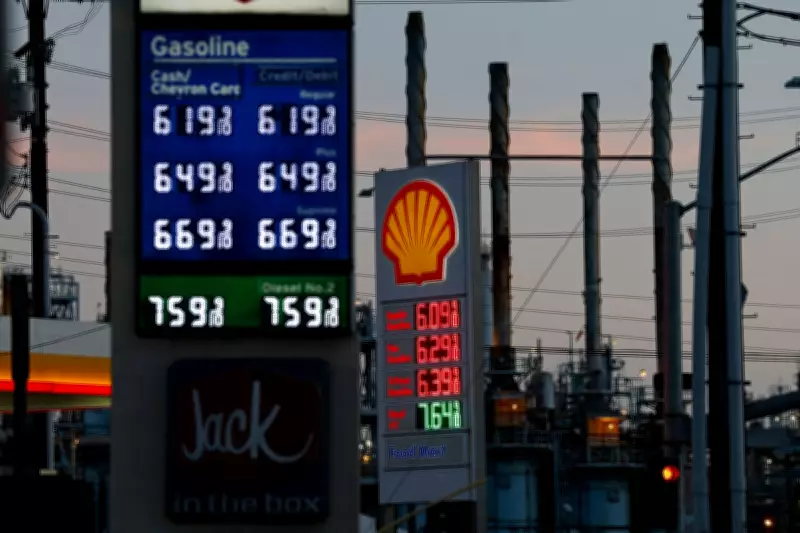
A significant majority of American voters are pointing the finger at President Donald Trump for the recent spike in gas prices, according to a new national poll. The survey, conducted by Quinnipiac University, found that more than half of registered voters hold the president largely responsible for the financial pain at the pump.
Stark Partisan Divide on Blame
The poll of 1,028 registered voters revealed a deep political split in assigning blame. Approximately 51 percent of respondents stated they blame President Trump "a lot" for the rising costs, while an additional 14 percent said they blame him "some." However, the figures diverge sharply along party lines.
Among Democratic voters, a overwhelming 91 percent place "a lot" of blame on the president. In contrast, only 9 percent of Republican voters share that view, with 53 percent of Republicans saying they do not blame Trump at all. Independent voters largely fall in the middle, with most blaming Trump "a lot" or "some" for the price increases.

Gas Prices Exceed $4 Per Gallon
The national average for a gallon of regular gasoline recently surpassed $4, marking the first time it has reached that threshold since 2022, according to data from AAA. This surge is largely attributed to oil production disruptions stemming from the ongoing conflict involving Iran.
The United States and Israel initiated coordinated attacks on Iran at the end of February, leading to retaliatory actions that have disrupted the critical Strait of Hormuz. This waterway facilitates the passage of roughly 20 to 25 percent of the world's oil and liquefied natural gas, causing fears of shortages and driving global oil prices upward.
Campaign Promises Versus Reality
President Trump campaigned on a platform of "unleashing American energy" to lower gas prices for voters. In January, the national average for a gallon of regular gas was around $2.81, but this relative stability was short-lived following the escalation of hostilities with Iran.
Despite Trump's assurances that price increases would be temporary, Energy Secretary Chris Wright has expressed uncertainty about whether prices could drop below $3 per gallon in the near future. The administration's optimistic projections have collided with the complex realities of global oil markets disrupted by war.
Voter Concerns and Electoral Implications
The cost of gasoline remains a top concern for many Americans as the 2026 midterm elections approach. A March survey by the Pew Research Center of 3,000 adults found that 69 percent were "extremely" or "very" concerned that the Iran war would cause higher oil and gas prices.
Political analysts suggest that if gas prices remain elevated through the summer and into the fall, voters who supported Trump in the 2024 election may reconsider their allegiance in the midterms. Some Republican lawmakers are reportedly anxious about their party's chances of retaining power, with the issue becoming a potential liability.
Uncertain Timeline for Resolution
Republican Representative Tom Barrett of Michigan told the New York Times this month that oil prices would likely decrease once the conflict concludes. "I am hopeful that we can bring this to a close in the next few weeks," Barrett said. "Once there is stability in the region, oil prices and subsequently gas prices will come down, while Americans will be safer because we've neutralized one of our most determined enemies."
However, the duration of the conflict remains unclear. President Trump initially insisted the military operation would last only four to five weeks, but eight weeks into the engagement, neither side has agreed on terms for a peace deal. Such an agreement would need to prevent Iran from building a nuclear weapon and allow global oil trade to resume without disruption.
Most voters, regardless of party affiliation, anticipate the conflict will persist for months. In the Quinnipiac poll, 36 percent of respondents predicted the war would continue for "months," 13 percent said it could take "about a year," and 19 percent believed it might last even longer than a year. This prolonged uncertainty continues to fuel anxieties about energy costs and economic stability.