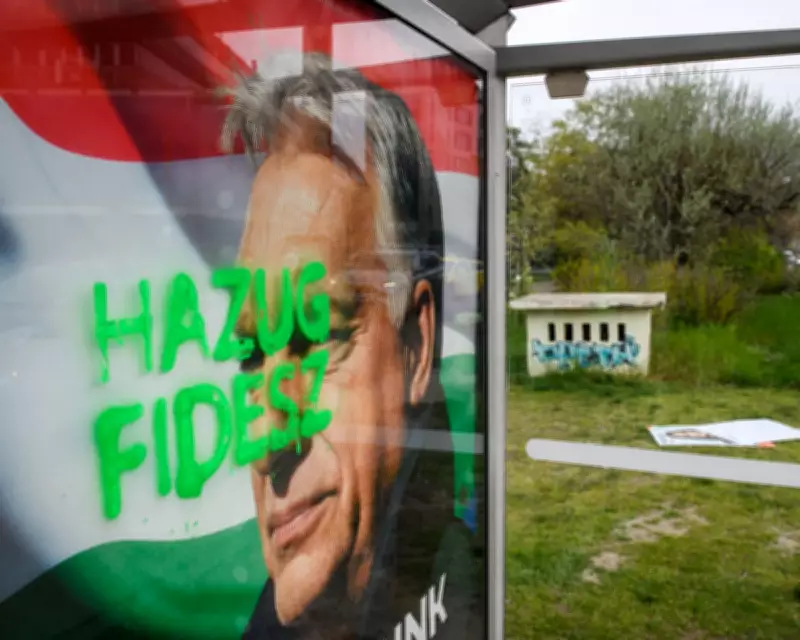
An election poster for Viktor Orbán has been defaced with the words 'Liar Fidesz', referencing the prime minister's political party, which faced voter rejection due to widespread corruption and frustration over soaring prices. This act of protest underscores the deep-seated discontent that contributed to Orbán's defeat after 16 years in power.
Leaders Hail a Turning Tide, But Analysts Urge Caution
For Poland's Donald Tusk, the crushing defeat of Hungary's illiberal prime minister, Viktor Orbán, signifies that the world is no longer 'condemned to authoritarian and corrupt governments'. Germany's chancellor, Friedrich Merz, also views the two-thirds majority secured by Orbán's centre-right challenger, Péter Magyar, in Sunday's elections as 'a clear signal against rightwing populism', indicating that 'the pendulum is swinging back'.
However, experts caution that while the result of Hungary's parliamentary ballot may have dealt Europe's far right a temporary setback, it does not mark a definitive turn of the national-populist tide. Opponents would be unwise to interpret it as such.

Symbolic Yet Limited Impact
'Of course there is a symbolic element,' said Sarah de Lange, an expert on the far right at Leiden University in the Netherlands. 'Europe's longest-serving far-right leader, the inspiration for many, was defeated – even when the system was rigged in his favour.'
But de Lange emphasised that Orbán's defeat, despite public rallies by fellow nationalists in Budapest, was 'not the defeat of his illiberal ideological model for how to organise a democracy when a far-right party is in power. That was not what motivated Hungary's voters.'
Instead, the primary drivers were practical and overwhelmingly domestic: anger at corruption benefiting Orbán's cronies, frustration with high prices, low wages, and deteriorating public services in education and health, and a natural desire for change after four consecutive Orbán governments.
Domestic Issues Over Ideology
Gabriela Greilinger, a doctoral researcher specialising in Europe's far right at the University of Georgia, noted that the result 'may dampen the far right's mood for a bit,' particularly since Orbán 'was such a central figure in bringing the global far right together' at events like Cpac Hungary.
'But we really shouldn't overestimate the impact,' Greilinger added. 'The far right succeeds electorally because of domestic issues: this wasn't the defeat of the far right, it was the defeat of Orbán's kleptocratic, clientelistic, corrupt government.'
Potential Consequences and Internal Tensions
Analysts suggest there may be some more concrete, yet limited, consequences if Magyar, as promised, restricts funding for conservative thinktanks such as the Mathias Corvinus Collegium (MCC) and Danube Institute, which Orbán endowed with hundreds of millions of euros in state and corporate funding.
'The MCC is the best-funded thinktank in Europe,' Greilinger said. 'It actively seeks to influence European policy in Brussels, has outposts in several other countries, and funds high-profile conservative researchers, including from the UK.'
Beyond this, the election result is likely to fuel tensions within Europe's far right over who should emerge as their next figurehead: a 'mainstreamer' like Italy's Giorgia Meloni or an EU-bashing 'conflictualiser' in the Orbán mould.
No Blueprint for Defeat Elsewhere
Stijn van Kessel of Queen Mary University in London pointed out that even if the result shows the far right, a 'structural force' in most of Europe, can be defeated, it 'does not offer a blueprint' for how to beat them anywhere else or mark a 'general turning point'.
Leonie de Jonge, an expert on the far right at the University of Tübingen in Germany, echoed this, stating that the undoubted 'short-term symbolic impact... doesn't mean there's going to be some kind of domino effect' on the rest of Europe's far-right parties. 'We absolutely have to get away from that idea.'
In fact, Greilinger noted it is 'notoriously hard' to prove with actual data that far-right success or failure in one country has any electoral impact at all in another.

Lessons from the Defeat
Europe's nationalists have offered various explanations for Orbán's defeat. Some, including Belgium's defence minister, Theo Francken, and Alternative für Deutschland (AfD) figures, blamed Orbán's close ties to Donald Trump, who is deeply unpopular in Europe and warmly endorsed Orbán.
Others, like Italy's Matteo Salvini, have blamed Brussels for freezing EU funds. However, many avoided drawing firm conclusions, simply stating that Orbán would be missed by 'patriots' who backed 'freedom, sovereignty and traditional values'.
The key lesson, analysts argue, is that far-right parties are vulnerable when they fail to deliver on voters' demands, such as a fair cost of living and functioning services, while engaging in state corruption. De Lange highlighted that far-right parties can be defeated once opposition groups unite around a common cause, like anti-corruption.
De Jonge drew a parallel with the defeat of Brazil's far-right leader, Jair Bolsonaro: 'Strong, united democratic fronts, comprising voters from very different ideological backgrounds, coordinated across political parties, civil society and independent media, with a clear, hopeful message – they can defeat these regimes.'
Additionally, Greilinger noted that Orbán's gerrymandering, intended to boost his Fidesz party, ultimately backfired by enhancing the largest party, thus partly engineering Magyar's landslide victory.
Some pundits suggest that Europe's far-right leaders should distance themselves from figures like Russia's Vladimir Putin and Donald Trump, whose support has proven counterproductive. However, de Jonge cautioned, 'I don't think they're all saying now that Orbán made some huge strategic error. They're super-loyal to the broader ideological agenda they share, and they are not about to give that up. There may be some tactical adjustments. But it's not a fundamental issue.'