
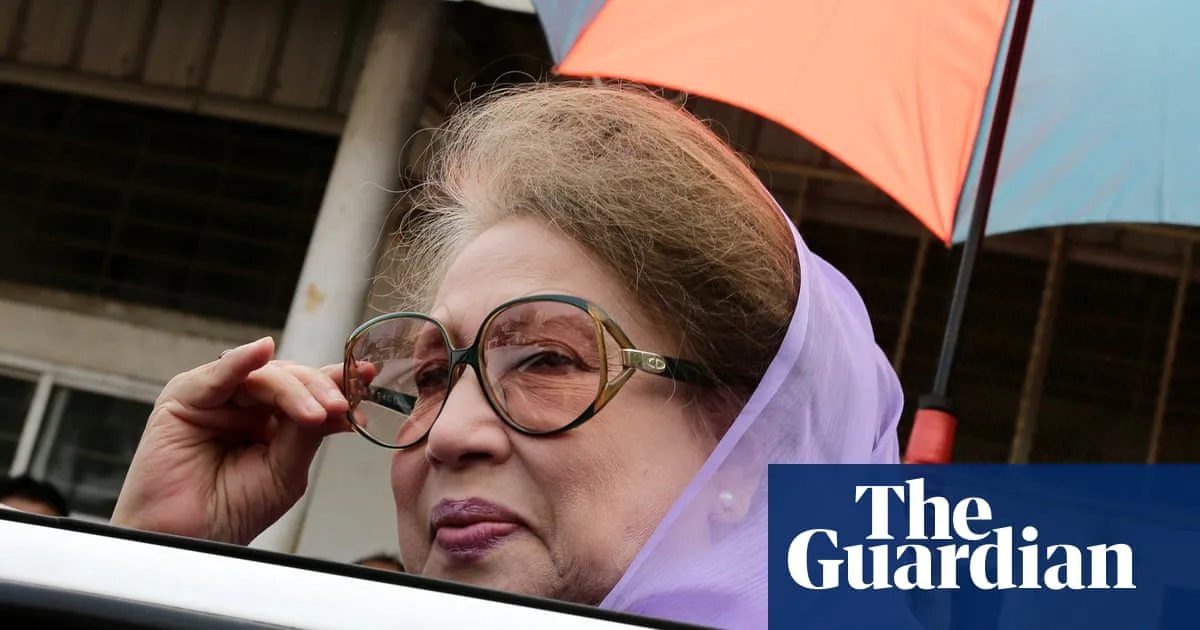
Khaleda Zia, the first female prime minister of Bangladesh, has died aged 80. Her death was announced on Tuesday morning by the Bangladesh Nationalist Party (BNP). Zia was one of the most significant and divisive political figures in the country since independence 50 years ago.
Zia was the widow of former president Ziaur Rahman, who was killed in a military coup in 1981. She took up his political mantle and first came to power in 1991, serving until 1996 and then a brief second stint. Her arch-rivalry with Sheikh Hasina defined Bangladesh's politics for a generation, with the two alternating as prime minister over the past three decades.
In 2018, Zia was convicted and jailed for 10 years on corruption charges, which her party said were politically motivated. Under Hasina, the BNP faced harassment and oppression, with many leaders jailed or exiled. Zia remained under house arrest for years as her health declined, but was freed after Hasina's fall in a mass uprising in 2024. In January, she was allowed to travel abroad for medical treatment after at least 18 earlier requests were rejected.
Despite ill health, Zia vowed in November to campaign in elections set for February 2026, the first vote since Hasina's fall. However, she was taken to hospital late in November, where her condition continued to decline.
Interim prime minister Muhammad Yunus called Zia a "symbol of the democratic movement". Her son Tarique Rahman, who lived in exile in the UK for 18 years, returned to Bangladesh this month to contest the elections. Zia is expected to be buried on Wednesday in Dhaka, alongside her husband.




