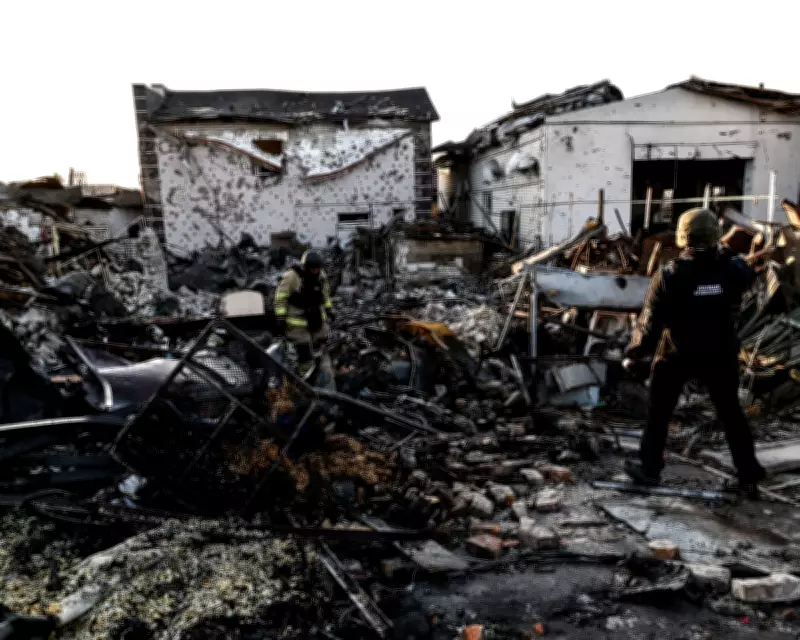
Rescue operations are underway at the location of a Russian aerial assault in Zaporizhzhia, Ukraine, highlighting the ongoing conflict's devastating impact on civilian areas. This incident underscores the urgent need for enhanced defensive measures as the war continues into its 1,482nd day.
Zelenskyy's Call for Drone Sales Regulation
In remarks released on Sunday, President Volodymyr Zelenskyy emphasized that foreign countries and companies seeking to purchase Ukrainian drones must not circumvent the Ukrainian government by engaging directly with manufacturers. Zelenskyy asserted that a new regulatory system is essential to prevent such bypassing, noting that his administration has already issued a reprimand to one manufacturer for selling interceptors without adequately considering the implications for Ukraine's national defence capabilities.
Global Interest in Ukrainian Drone Technology
The conflict between the United States, Israel, and Iran has sparked renewed international interest in Ukrainian drone interceptors. Specifically, the United States and its Middle Eastern allies are actively exploring methods to counter Iranian drone attacks, viewing Ukrainian technology as a potential asset in their strategic defences.
Diplomatic Developments and Peace Talks
Zelenskyy revealed that Ukraine is awaiting responses from Washington and Moscow regarding the next round of trilateral peace negotiations. He informed reporters that the United States had proposed hosting a meeting, but Russia declined to send a delegation. "We are waiting for a response from the Americans," Zelenskyy stated, highlighting the stalled diplomatic efforts.
Pushback Against Trump's Claims
The Ukrainian president appeared to challenge former U.S. President Donald Trump's assertion that the United States does not require Ukraine's assistance in drone defence. Zelenskyy clarified that the U.S. has contacted Ukraine "several times" to request support for specific countries or American interests. "All our institutions received these requests, and we responded to them," he said during a briefing, though he did not provide detailed specifics.
In a separate interview with the Financial Times, Trump warned that NATO faces a "very bad" future if allies fail to assist in reopening the Strait of Hormuz, a critical oil transport route effectively closed by Iran in the Middle East conflict. Trump argued that as the U.S. has supported Ukraine against Russia, he expects European nations to contribute to efforts in the Strait of Hormuz, whose closure has driven global energy prices upward. "If there's no response or if it's a negative response, I think it will be very bad for the future of NATO," Trump remarked, reiterating his longstanding criticism of the alliance for relying excessively on American resources.
Cultural and Environmental Impacts
In cultural news, the documentary Mr Nobody Against Putin, which chronicles a young Russian schoolteacher's quiet resistance against Russia's war on Ukraine, secured the Oscar for Best Documentary Feature on Sunday. Directed by David Borenstein and Pavel Talankin, the film utilizes two years of footage to expose how the Russian state indoctrinates students with pro-war propaganda, while also documenting Talankin's personal persecution and eventual exile. The Hollywood Reporter praised it as a "touching, intimate chronicle."
Environmental Crisis in Moldova
Moldova has declared a state of environmental alert in the Dniester River basin for 15 days, effective from March 16, 2026, following a fuel spill triggered by a Russian military strike in Ukraine. The CNMC government crisis management centre announced that the spill is believed to have originated from a Russian attack on the Dniester Hydroelectric Power Plant in Ukraine on March 7, posing significant ecological risks to the region.
Sanctions and Oil Transit Controversy
After the United States waived sanctions on Russian oil, Zelenskyy expressed opposition to allowing Russian oil to transit through Ukraine via the Druzhba pipeline, which previously transported oil to Hungary and Slovakia until late January. He questioned the inconsistency in policy, asking, "Why can we, in one case, tell the United States that we oppose lifting sanctions, while on the other hand forcing Ukraine to resume oil transit through Druzhba – and at a political price that effectively pays for anti-European policies?"
Human Interest Story
In a poignant human interest angle, the story of Nazar Daletskyi, a soldier initially thought to have been killed and buried in 2023, has emerged. His mother, Nataliia, visited his grave weekly until three years later when he unexpectedly contacted her by phone. This extraordinary account, detailed by Shaun Walker, explores the emotional turmoil and resilience of families affected by the war, offering a glimpse into the personal toll of the conflict.